|
** [Click on image to enlarge.] |
ARCTIC PERILS.
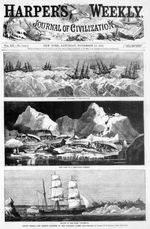
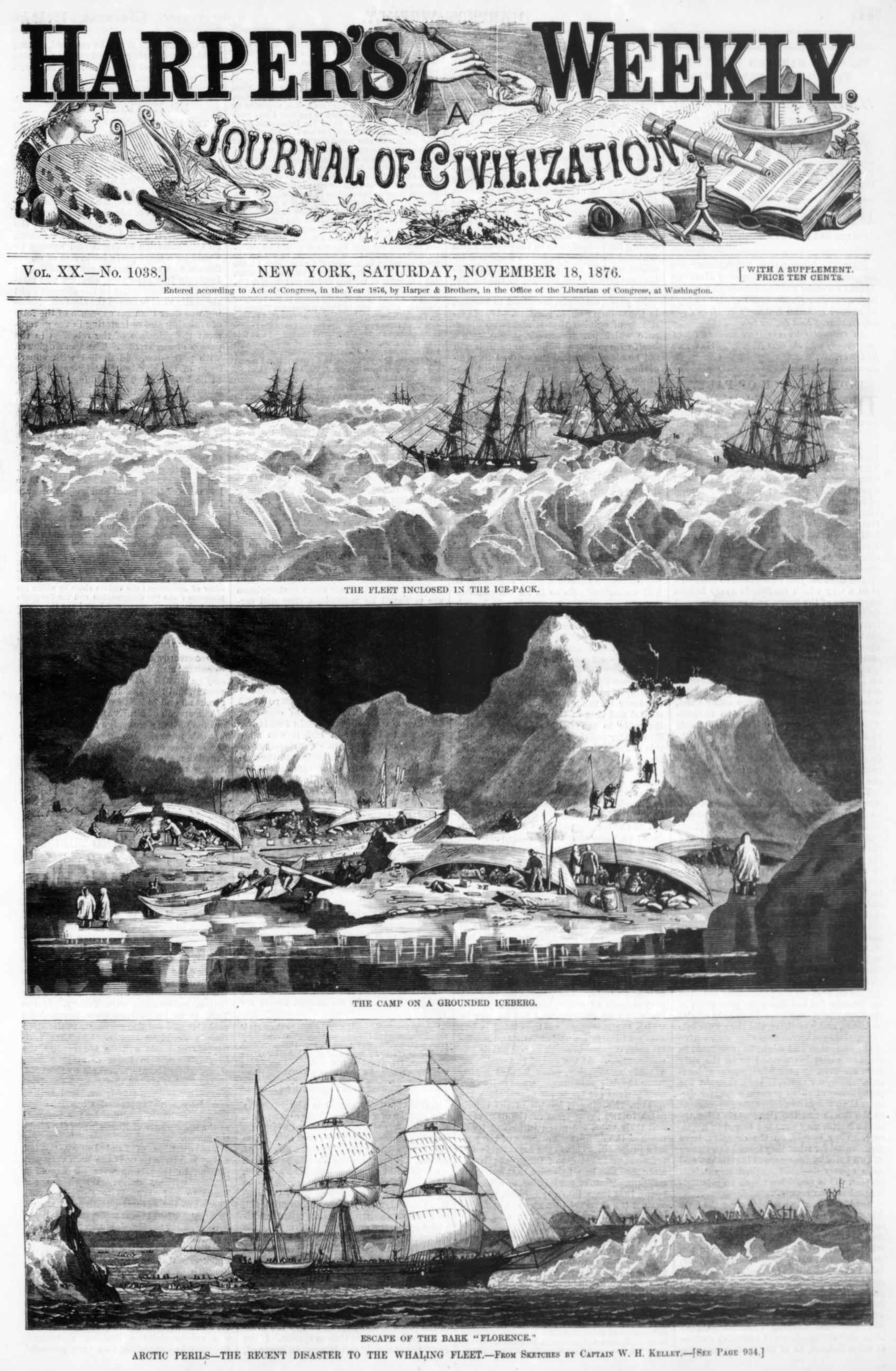
From Captain W. H. Kelley, master of the whaling ship Marengo, we have received the series of sketches printed on our first page, representing successive scenes of the recent disaster to the arctic whaling fleet. The first sketch shows eleven of the fleet of twelve ships inclosed in the ice-pack and abandoned by their crews. The twelfth, the bark Florence, was so fortunate as to get inshore, under the lee of a grounded iceberg, and thus escaped the pack. The second sketch shows the crews encamped on the southeast side of a grounded iceberg, where they found shelter from the bitter wind. Many of the men were utterly worn out with the severe labor of hauling the boats and carrying packs over the broken ice, and lay down under the boats to get such rest as they could on the bare ice. On the following day they made their way to land, at times dragging the boats over the ice, and at times finding strips of water. On reaching Point Barrow, where there is a native village, the shipwrecked men set about building two houses for winter-quarters. In this labor they were assisted by the natives, who lent them their dog teams to draw drift lumber to the site of the houses, and otherwise treated them with great kindness. Fortunately a northeast gale at length moved the pack ice, and the crew of the Florence, which had remained snugly anchored under the protecting lee of the grounded iceberg, had nothing between them and the open sea but a strip of ground ice. With great labor a channel was cut through this strip and the bark was liberated. As soon as she was out in open water the crews on shore were signaled to come on board. House-building was at once abandoned, a rush made for the boats, and after a pull of about ten miles, the men who had expected to pass the winter on Point Barrow found themselves once more afloat and homeward bound. But for the providential escape of the Florence, we might have had a worse disaster to record than the loss of the ships. |
|
Source.
Wilkes, Charles.
This transcription used the images at the
Internet Archive.
Last updated by Tom Tyler, Denver, CO, USA, May 21, 2025
|
|

| ||||||