|
|
|
Captain William Driver
and the Pitcairners 1831 |
. . . .
Capt. Driver the next morning went to the missionary station, called Thepan, on the other side of the bay, a distance of sixteen miles, to get water. He told the missionaries his encounter and its result, which greatly surprised them, for they said that only a year before, in the very same place, an English ship had been boarded by this same war party, and all on board killed and eaten by them, in memory of which the place was called "Guo Rodica," or town of Hell. Here he obtained water and proceeded to Tahiti, where he found sixty-five persons, descendants of the mutineers of the English ship "Bounty," with their self-created teacher, George H. Nobbs, an Irishman, who once was a lieutenant of a Chilian man of War. These people at their own request had been taken from Pitcairn, an island in the southeast corner of the Polynesian Archipelago, a mile and a half square, and landed at Tahiti, where they all lived together as though one family in an old thatched shed which formerly had been used by the natives for their dances. Here twelve had just died of ship-fever, and others convalescent were still weak and ill. Twelve had left in a French pearl-fisher, hoping to reach Pitcairn, their home, as they termed it. The Queen of Tahiti, Pomare, came on board the "Charles Doggett," and entreated Capt. Driver to take the crying children home, as she termed them, as they all wanted to return to Pitcairn. Her appeal, together with the tears and lamentations of the people, so moved the tender heart of the captain that he consented to carry the sixty-five survivors back to Pitcairn, fourteen hundred miles out of his course, at the risk of losing the insurance on his vessel. They did not reach Pitcairn till the end of the eighteenth day, where, on account of the surf and coral reefs, they could only be landed in small boats, |
which with difficulty he did in safety, together with twelve boat-loads of baggage and their goods: for which humanity Capt. Driver received some old copper from the ship "Bounty," twelve blankets, one hundred and thirty-nine missionary drafts, and the following letter, the original of which was given the Compiler by Capt. Driver, after whose death she presented it to the Essex Institute of Salem, Mass., framed, where it can be seen at any time. This letter was written by George H. Nobbs, their teacher, as he termed himself, but he was actually their Governor. "Pitcairn Island, Sept. 3d 1831. This is to certify that Capt. Driver of the brig Chars. Doggett of Salem, carried sixty five of the inhabitants of Pitcairn Island from Tahiti back to their native land during which voyage Capt. Driver behaved with the greatest kindness and magnanimity becoming a man and a Christian: and we can never remunerate him for the kindness we have received, we sincerly hope that (through the blessing of the Almighty) he will reap that reward which infallibly attend the Christian
Capt. Driver's "kindness and humanity" were soon forgotten, as his name never appeared on their records, nor was it ever mentioned by any author in any work on the island. Capt. Driver always said "that it was recorded above, as every ship at that time in the Western Pacific ground, where his business called him, was lost in a terrible tornado, save his ship and crew, who rode out of it in safety." In a book called "Sketch of Salem," published at Salem, a short account of this Tahiti adventure is to be found, on page 72[sic]. To go to Pitcairn, part of the crew and some goods had to be left at Tahiti to accommodate the passengers to be removed, for which Capt. Driver had to return. He then set sail for the Feejee Islands, where he was as warmly received as before. . . . .
|
|
. . . .
|
. . . .
Note to Pages 179, 180.
The "Bounty" sailed from England, Oct. 9, 1787, for Tahiti, also known as Otaheite a misconception of "O'Tahiti," i.e., "Of Tahiti," – the O in the native dialect being equivalent to the English "Of" – for the purpose of procuring bread fruit trees for some West Indian merchants who desired to introduce them into the West Indies that they might prove a valuable addition to the food of the negroes of their plantations, on account of their bearing eight months in the year, according to the report of Capt. Cook who visited Otaheite during his three voyages of discovery. The "Bounty" was commanded by Lieut. Bligh, R. N., and officers; Fletcher Christian, mate; Edward Young, Geo. Stewart, Peter Heywood, John Hallett, and Thomas Heyward, midshipmen; and men, in all forty-five persons. According to Lady Belcher in her "Mutineers of the Bounty," from which this account has been taken: "Lieut. Bligh was of an irritable and passionate disposition and of a most suspicious turn of mind. The language indulged in, both to officers and men, was so harsh and offensive as to be exceptional even at a period when it was deemed that discipline could not be obtained without the use of profane epithets. For many months his indignities had been borne with patience and forbearance, until at last it seemed as if endurance had passed its utmost limits. This tyranny to Christian appeared more insupportable on considering how almost impossible it would be for him, as a junior officer, to bring his oppressor to a court-martial with any hope of success. There was but one mode of escape from his tyranny, and that was to take the vessel and carry Lieut. Bligh as a prisoner to England." This seemed the sentiment of many if not all of the men, for in a moment on the morning of April 28, 1789, Lieut. Bligh was seized, bound, and Christian, with an unsheathed bayonet in one hand and a pistol in the other, took charge of the ship, ordered the boatswain and carpenter to hoist out the cutter, and Hayward, Hallett, Mr. Fryer, the clerk, Morrison, and other persons, in all eighteen, to get into her, then he ordered Lieut. Bligh to do the same, and handing him a book of nautical tables and a sextant the launch was veered astern and cast adrift, and her crew took to their oars. The mutineers thirty-nine days after arrived in the "Bounty" at Tahiti, where all decided to settle except Christian and eight others, accordingly, June 16th, they put to sea and twelve Tahitian women, nine men, and eight boys secreted themselves aboard, and were not discovered until far from land. Christian and his companions desired remoteness from all Englishmen and learning of the loneliness of the Island of Pitcairn from a copy of Captain Carteret's Voyages to the South Seas, which was among the books left on board the "Bounty," they determined to search for it as a safe retreat for themselves. Jan. 23, 1790, a mere rock hove in sight which on nearer approach proved to be Pitcairn Island. Christian surveyed the island and found it four and one half miles in circumference, all rock on its edge, but beautiful valleys, trees, and foliage in tne interior and without inhabitants, although distinctive marks showed former occupancy, perhaps by those vanquished in war sent adrift on a raft to whatever place they could reach, the then custom of the Gambier Island, 300 miles distant from Pitcairn, but unable to remain on account of the scarcity of food and water, hence drifted off as they came. Christian divided the island into nine shares, which he gave to himself and his eight compan- |
ions, who were: John Mills, Isaac Martin, Wm. Brown, Edward Young, Wm. M'Kay, John Williams, Matthew Quintal, and Alexander Smith, alias John Adams, for after learning of the arrival of Lieut. Bligh in England and of a ship sent to Tahiti to take to England as prisoners those of the mutineers left there, he changed his name to John Adams. Christian had the planks, copper, nails, bolts, masts, sails, everything that might lead to the discovery of the "Bounty," removed on shore, then set fire to her hull, and sunk her remains in twenty-five fathoms of water. Houses were then built with everything available, and guarded with a palisade to prevent depredations of poultry, hogs, and goats, which were allowed to roam at large. The mutineers were married by Christian to the Tahitian women who had secreted themselves on board the "Bounty," according to the service as found in the English Prayer Book, a copy of which Christian constantly had about him, and constantly studied. Respect for him was predominant among them, which never lessened, partly from his superior intellect, and partly habitual deference to a superior officer. Three years they lived peacefully, then the wife of Williams fell from a high cliff, and was killed, and Williams not considering the black men (Tahitians) human beings demanded the wife of one of them to replace his loss; this instantly occasioned a riot and the Tahitians determined to massacre all the white men, and did, killing all but Smith, Young, Quintal, and M'Coy: then the widows decided to kill all the black men, which they did. Soon after two of the remaining Englishmen died a violent death, and Young died of an asthmatic trouble, leaving Alexander Smith, in 1800, sole surviving man on the island, the only guardian and teacher of a community of helpless women and young children. He took Christian's Bible and Prayer Book, and according to the Jewish law as found in the Old Testament, governed the island, teaching all to observe the Jewish fasts and feasts, and would not discontinue them until long persuasion convinced him that under the Christian dispensation they were unnecessary. Sept. 1808, the first vessel since their settlement visited Pitcairn: an American brig called the "Topaze," Capt. Mayhew Folger, master, being short of water, put in at Pitcairn, attracted to it by seeing smoke rising from it. About 1822, a whaler stopped, and one of her crew, John Buffett, requested permission to remain and assist Adams in teaching, which his captain granted. In 1831 he was one of the number removed by Capt. Wm. Driver from Tahiti to Pitcairn, for his name is of the number signed to the letter of thanks received by Capt. William Driver, as found on page 180 of this book. Some years after another vessel stopped at the island, and a sailor, John Evans, son of a coachmaker of Long Acre, requested permission to become an inhabitant: he married a Pitcairn woman, and became a useful citizen of the community. His name is also signed to the letter of Capt Driver. In 1828 a third seafaring man, George Hunn Nobbs, arrived at Pitcairn with an invalid, Mr. Bunker, who soon after died on the island. They came in a private vessel from Callao, which Nobbs took and made for himself a house out of her timbers and wood work. He had a fair knowledge of medicine and surgery, which be exercised for the benefit of the settlement, also a vocation for the ministry, – subsequently he was ordained in Fulham Church, by the Bishop of London, as "Chaplain of Pitcairn Island." John Adams died March 29, 1829, and Nobbs succeeded him in the government and care of the island by Adams' request. Nobbs married Sarah Christian, granddaughter of Fletcher Christian, the mutineer, and a daughter of Charles Christian and a Tahitian woman, who was an infant in arms when her mother left Tahiti with the mutineers as a stowaway. Nobbs, according to his own testimony, assumed his name as a matter of convenience when he first went to sea, with his mother's consent, taken from a couple with whom he dwelt for some time previous, and who had no child of their own. He lived to be past seventy years of age: he had ten living children, eight of whom in 1809[sic] were married. Nobbs' name is also signed to Capt. Driver's letter, where he styles himself teacher. In 1830 the colony consisting of 87 persons were fearful of a famine occasioned by a long drought: consequently a proposal was made by the English Government to the Islanders to remove them to Tahiti, on account of its being the native place of some of the women: concerning this there was a great difference of opinion, their attachment to the island and themselves was very strong, only eight surnames were among them, five of "Bounty" stock, and three new comers, hence from the numerous inter-marriages they were all related over and over again, but rather than be separated they at last all decided to keep together and go, accordingly, March, 1831, they embarked in the Government vessel, "Sarah Ann,"[sic] and anived at Tahiti on the 21st of the same month. The climate was unfavorable and soon sickness appeared among them in the form of typhus fever, ten died, and others were weak and ill, thus Capt Wm. Driver found them when he arrived at Tahiti, July, 1831, as stated on page 179 of this book, whose tears, entreaties and prayers made to him in his own language caused him to remove to Pitcairn, Sept. 2, 1831, but of whom Lady Belcher, on page 191 of her book, only records that, "an American brig, Sept. 1831, brought away all the remaining families from Tahiti." Arthur Quintal who made only his mark on the letter of Capt. Driver, was the son of Matthew Quintal, the mutineer, and Isabella, a Tahitian woman, who died Aug. 1841. At the time of the removal Arthur was about thirty-two years of age, Capt. Driver stated the then oldest person of the survivors. Lady Belcher says he was a fine strong-made man, with an honest open countenance. Chief Magistrate of the Pitcairners in 1850, living in 1868, aged 78 years. John Buffett was chief magistrate in 1865, which office was held in turn by each of the Englishmen according to the law made by themselves. Pitcairn was named, according to Capt. Carteret who discovered it in 1767, after the young midshipman who descried it in that year, from the mast-head of his ship at a distance of 15 miles. This youth a son of Major Pitcairn of the marines who was killed at the battle of Bunker's Hill was himself lost in the frigate "Aurora." The land originally divided by the mutineers into nine parts was again subdivided among their children, and again the children of the third generation had a portion of their subdivision. Families say of eleven children of course would have but the eleventh of the eleventh portion, in this way the land was reduced to a mere pinch, and therefore, for |
want of sufficient ground they saw the necessity for emigration. Norfolk Island which had been a penal station was offered them by the British Government to which eventually they all removed; here they were far from well, happy or contented, their land grants were misunderstood by them at Norfolk, and consequently some of them returned a second time to Pitcairn, others, among them Nobbs remained at Norfolk, here we will leave them. Otaheite, now generally called Tahiti, was accidentally discovered by Capt. Wallis during a voyage to the South Seas for the purpose of observing the transit of Venus the later part of the last century, the descriptions brought back by him, and afterwards by Capt. Cook created great interest in England. . . . .
|
|
Source.
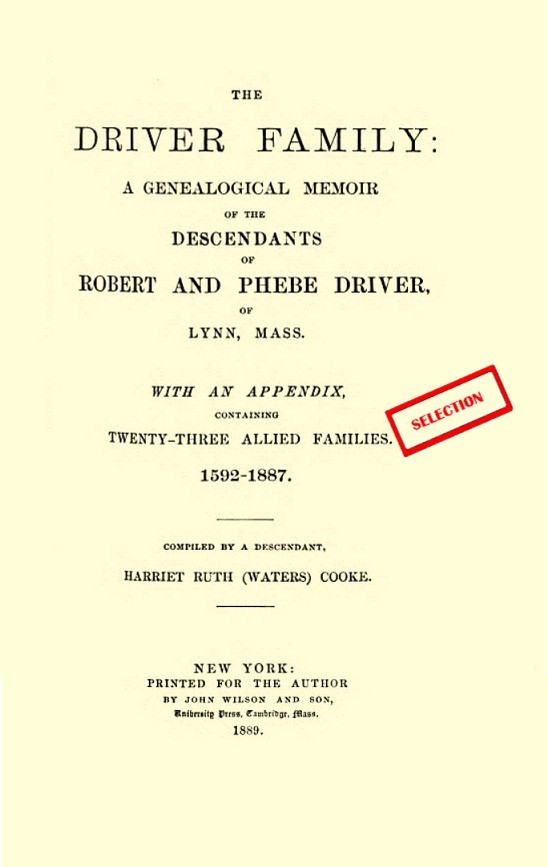
Harriet Ruth Cooke.
This transcription used images from the
Internet Archive.
Last updated by Tom Tyler, Denver, CO, USA, Oct 25, 2025
|
|

