|
|
|
GEORGE BENNETT
meets JANE QUINTAL. (Rurutu, September 1829) |
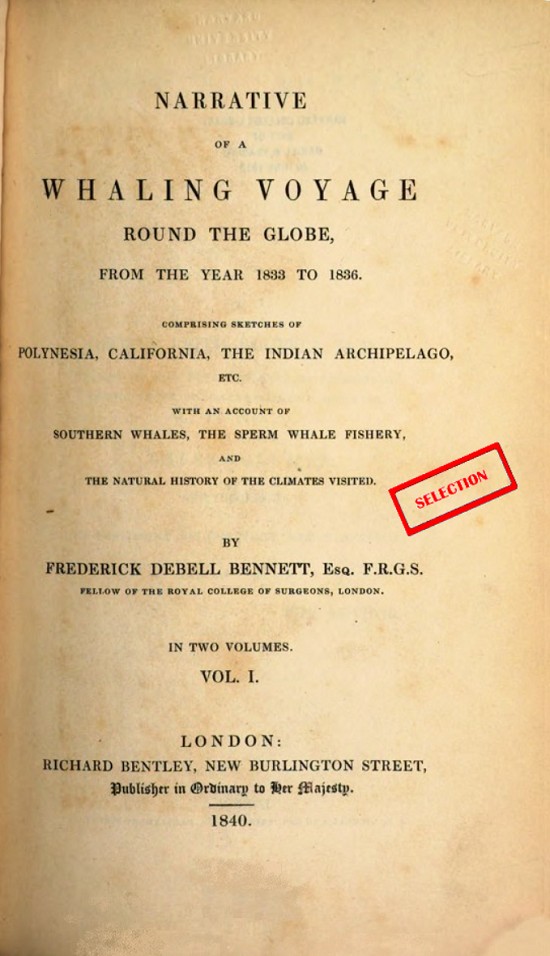
[GEORGE BENNETT* MEETS JANE QUINTAL.](from a footnote in F. D. Bennett's Narrative, Volume 1, pp. 30-31)
———
One of the females, Jane Quintal, had left the island, in company with an English sailor, some years previous to our visit. Her paramour left her at the island of Rurutu, or Oetiroa, where she married a native, and continued to reside. My brother, Mr. G. Bennett, thus describes an interview he had with this female during his stay at Rurutu, in September, 1829: "On the beach I was accosted by a tall, fine, half-caste woman, dressed in neat European clothing. Her manner was artless, and she spoke the English language with correctness. She informed me that her name was Jane Quintal, of Pitcairn's Island. 'You have heard of Matthew Quintal?' she said: 'I am his daughter.' "The following conversation then took place between us: — How long is it since you left Pitcairn's Island?' — 'A few years ago, in a whale-ship.' — 'Why did you leave?' — 'There are no husbands there; and besides,' she continued, 'the island is too small for us. It is, sir, but a very small island; quite a rock.' — 'You are married now, I suppose?' seeing a little chubby dark urchin in her arms. — 'Yes,' she replied; 'I married a native of this island (Rurutu). I was obliged soon to get married, they are so very particular; all missionaries. I could not talk to any male creature when single, so I got married.' — 'Do you wish to return to Pitcairn's Island?' — 'No, I am very comfortable here." Having ascertained that I was in the medical profession, she made me promise to send her "stuff to raise a blister,' sticking-plaster, &c. as she intended to practise the profession herself on the island." * George Bennett, like his younger brother Frederick Debell Bennett, sailed in the South Sea on a whale ship as a surgeon and naturalist. The younger Bennett's Narrative of a whaling voyage round the globe, from the year 1833 to 1836, is a classic of the whaling and Pacific exploration literature. |
|
Note
Jane Quintal1
b. 1795. Jane Quintal was born in 1795 at Pitcairn Island. She was the daughter of Matthew Quintal and Tevarua. Jane, having 'strayed from the path of virtue', was so harshly treated by her brother, Arthur, that when she had the opportunity to do so, she left the island. The Captain of a passing vessel, being informed of the matter, and learning of Jane's wish, kindly allowed her passage on his ship. She was taken to the island of Rurutu, where she was most kindly received. One of the chiefs of the island made her his wife, and she eventually became the mother of a numerous family. (Rosalind Young: Mutiny of the Bounty and Story of Pitcairn Island) An alternate version has Jane leaving Pitcairn in 1826 with a Naval Captain by whom she was pregnant. Not wanting her, he abandoned her at Rurutu. Alone and pregnant, 'I could not talk to any male creature while single, so I got married!', she recounted. (Silverman: Pitcairn Island.) From: The Peerage website.
George Bennett (1804–1893)
by A. H. Chisholm George Bennett (1804-1893), medical practitioner and naturalist, was born on 31 January 1804 at Plymouth, England. He was strongly attracted by the sea, and at 15 undertook the first of his many voyages. Returning to England in 1821, he studied first at Plymouth and then at the Middlesex Hospital and the Hunterian School of Medicine, where he came under the influence of such notable men as Charles Bell, Herbert Mayo and Caesar Hawkins. On 7 March 1828 he obtained his diploma of membership of the Royal College of Surgeons, and meanwhile had made the acquaintance of Richard Owen, then a lecturer in comparative anatomy in the medical school attached to St Bartholomew's Hospital. Owen was the chief British comparative anatomist of his period, and his influence, particularly in respect of palaeontology, was felt by Bennett during the whole of his career in Australia. Wanderings by Bennett from 1828 to 1835 embraced a wide area of the Pacific, and when he returned to England from one voyage in 1831, he brought with him a large collection of plants, as well as a live Ungka ape from Singapore and a young native girl named Elau from the New Hebrides; the girl, who had been rescued when about to be sacrificed by a hostile tribe, died at Plymouth in 1834. Numerous papers on natural history were written by Bennett as a result of his journeys; they included, in particular, discussions of plants, a description of the living animal of the pearly nautilus, and remarks on certain elements in the fauna of Australia, and these writings were responsible for his election as a fellow of the Linnean Society of London and a corresponding member of the Zoological Society. Bennett had first visited Australia in 1829. He did so again in 1832, arriving in spring and becoming immediately impressed by 'the beauties of the Kingdom of Flora which are lavished so profusely in this colony'. Travels inland followed, and so keen was his work, notably on the platypus, then not definitely proved to be oviparous, that he was able to send Owen many specimens of extant fauna and a considerable number of fossils. He then published Wanderings in New South Wales … Being the Journal of a Naturalist, vols 1-2 (London, 1834), a work of merit for its good writing and generally sound observation; his only serious slip was in regard to the nesting habits of the lyrebird, upon which he was apparently misled by Aboriginals. Back in England, Bennett received a signal honour by being awarded the honorary gold medal of the Royal College of Surgeons in recognition of his contributions to zoological science. He returned again to Australia in 1836, and this time he remained, developing a successful medical practice in Sydney and becoming a leading figure in the newly established Australian Museum, the Acclimatization Society and the Zoological Society; his association with the museum, of which he was the first secretary, extended over many years, and in old documents of the institution he is referred to, variously, as 'Director', 'Superintendent' and 'Zoologist'. Meanwhile he assisted visiting zoologists, acted as agent for the birdman, John Gould, maintained a steady correspondence with Owen and others, and assembled material for a second book; this work, broad in scope and informative, was published in 1860 under the title Gatherings of a Naturalist in Australasia. In 1890, at the age of 86, he was awarded the Clarke memorial medal by the Royal Society of New South Wales. Bennett died in Sydney on 29 September 1893, leaving an impressive record, emphasized by the numbers of plants and animals that bear his name, as 'the greatest of the physician-naturalists of Australia'. He had married three times. By the first marriage there were two sons and three daughters, by the second a son, and by the third, to Sarah Adcock, two children who died in infancy. A large library which he left was unfortunately rejected by the University of Sydney when offered for £2000, and was sold by public auction. This article was published: in the Australian Dictionary of Biography, Volume 1, 1966 - online in 2006. From: A. H. Chisholm, 'Bennett, George (1804–1893)', Australian Dictionary of Biography, National Centre of Biography, Australian National University, published first in hardcopy 1966, accessed online 8 August 2025. See also: Wikiipedia article. |
|
Source.
Bennett, Frederick Debell.
This transcription used the images at the
HathiTrust.
Last updated by Tom Tyler, Denver, CO, USA, Oct 23, 2025
|
|

