|
|
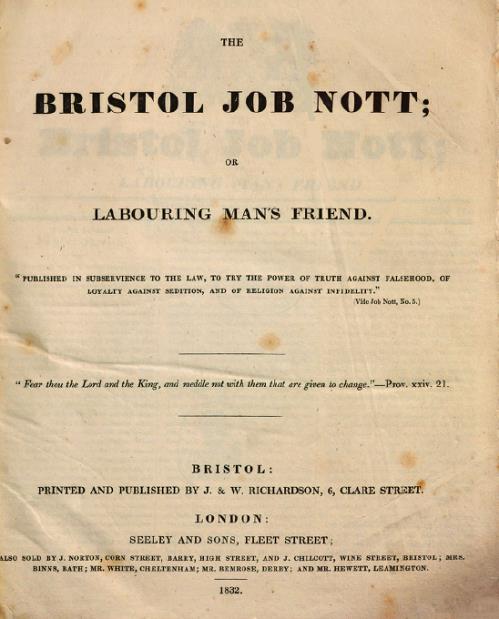
THEBristol Job Nott;OR,LABOURING MAN'S FRIEND.
|
. . . .
THE MUTINEERS;
Most people have heard some mention of this interesting story, it is one from which many excellent lessons may be learned; and the readers, of Job Nott will, perhaps, be pleased to have a short history of the whole affair. The account from which mine is taken, was published two years ago in Captain Beachey's Narrative of a Voyage to the Pacific. He visited Pitcairn's islands, where part of the mutineers took refuge, and received his information from John Adams, the only man then living of those who settled there after the mutiny. John Adams wrote down an account himself, and signed it with his name. His Majesty's ship Bounty, sailed from England under the command of Lieut. Bligh, in Dec. 1787; she was ordered to go to Otaheite; to get plants of a very useful tree, called the bread-fruit tree; and then to take them to our colonies in the West Indies. Her crew consisted of 44 persons; one of whom was a gardener. They had a very stormy passage, and did not reach Otaheite till Oct. 1788; six mouths were spent in collecting and stowing away the bread-fruit trees; and during this time the crew were allowed to go on shore as much as they pleased: they made many friends among the islanders, and one sailer became much attached to an Otaheitian woman. In April, 1789, they left Otaheite, and proceeded.to another island where they took in fresh stores. During the voyage, Lieut. Bligh had given some causes for discontent to both officers and men, particularly to one officer of the name of Christian; this young man had come out under the care of Bligh, and owed him some money. Whenever any difference arose, his commander used to remind him of his debt, and this provoked Christian to such a degree, that on one occasion he replied that a day of reckoning would arrive. The day before the mutiny, there was a serious quarrel about some cocoa-nuts which were missing from Bligh's stores; and Christian, as usual, fell under his commander's displeasure. Just at this, time the ship was passing within sight of the Friendly Islands; and on a beautiful still night Christian stood on the deck thinking over his grievances, which at last appeared so intolerable to him, that he resolved to bear any thing rather than continue subject to them. He had been long absent from England, and began to forget his love for his native country; so he resolved to give up all his friends and all his prospects in life, and to set himself adrift on a raft and endeavour to reach one of the Islands in sight. He soon made his raft, got together some necessaries, and was on the point of launching it, when a young officer to whom he told his plan, advised him instead of hazarding his life in this way; to try to take possession of the ship, in which they could all return to Otaheite, and live with their friends there, Christian resolved to make this desperate attempt, and in case he failed, to throw himself into the sea. He happened to have the morning watch, and as soon as he came on deck be entered into conversation with Quintal, the man who was attached to the Otaheite woman, and after reminding him of the happy days they had spent there, tried to persuade him to come into his scheme. Quintal at first refused, saying, it was too dangerous; but Christian, knowing that he had gone too far to draw back, used all sorts of arguments; called Quintal a coward, and told him what he meant to do in case he was not successful. At last this man consented, provided his comrades were gained; and before day light the greatest part el the ship's company were brought over. Adams himself was asleep in his hammock, when one of the seamen whispered to him that Christian was going to take the ship from her commander, put him and the master on shore, and return to Otaheite. He did not at first take any part in the matter, but finding at length that the mutineers were the strongest party, he went to the arm chest, where Chastise was giving out arms, and got a cutlass. The whole party being armed, they first secured the officers; and then went to Lieut. Bligh's cabin, seized him, bound his hands behind him, and brought him on deck. When there, he tried various arguments to bring his men back to their duty, but was answered only with abuse; and one man struck him a blow. The only opposition they met with was from the master, who made an attempt to form a party to retake the ship; he was soon overpowered and sent below. The master had more cause for discontent than any other men in the ship; he had been more severely used than any one else; and yet he did his duty thus zealously, when others were rebelling. After a short time Lieut. Bligh, and those who continued faithful to him, were ordered into one of the ship's boats; where they had put some stores, water; a compass, and some cutlasses; and when they were about ten leagues from land, she was cast off to seek her way through the wide waters; 19 persons went in her, 25 remained in the ship. Huzzas for Otaheite was the cry on board the Bounty, as soon as the boat was out of hearing. But their course to Otaheite, was unblessed by Him who guideth the vessel through her perilous voyage, to the haven where she would be. The wind was contrary, and they were obliged to land ea an island named Tobouai, the inhabitants of which were unfriendly to them; they forced a landing, but as the natives fled to the woods, they found it of no use to remain there. — Eight days after they left this place they reached Otaheite, where they were received very kindly by their old friends, who immediately enquired for the rest of the crew. Some story was told about Lieut. Bligh's having settled on an uninhabited island, and sent the ship back to get stores for the colony, and also to invite some of the natives to accompany them to the new settlement. This story succeeded very well; the chiefs supplied them with stores, and gave up to them a cow and bull which were left in their care. A good many of the natives, both male and female joined them, and they set sail again for Tobouai; there they were better received than before, because the Otaheitians were able to converse with the inhabitants, Soon after their landing, the sailors set about building a fort to protect their property; but the natives feared this was intended to oppose them, and therefore they laid a plan to surprise the fort and kill all the strangers. One of the Otaheitians overheard the natives talking of this scheme, and put the party on their guard; so that when they were attacked; they beat off their enemies and killed many of them. After this event the Englishmen were continually in fear of the savages, and at last they resolved to return to Otaheite, though much against the advice of Christian, who said if they did so their crime would certainly be discovered. During the voyage he made up his mind to go to some uninhabited island and there settle; very few of his shipmates liked this plan; but they agreed to let him have the ship when they got to Otaheite, and to divide the stores and provisions with him, and those who chose to go with him. Young, Brown, Mills, Williams, Mac-Coy, Martin, Quintal, Adams and six of the natives resolved to follow the fate of Christian; they, therefore; only staid twenty-four hours at Otaheite, and then sailed away, carrying with them several women, whom |
they had enticed on board, under pretence of taking leave of them. Thus this little party bade farewell to all the rest of the world, and steered their course for Pitcairn's Island, which they thought would suit them for their future home. They soon reached this island, and were very well satisfied with their choice; it had wood, water, a good soil, and some fruit. Ships could not very easily touch at it, which was a satisfaction to those whose crime had made their countrymen their enemies; and in case any vessel did come into their harbour, there were some caves to which they could retreat. So they burnt their vessel and landed the 25th of January, 1790. On shore they saw some ruined huts; but the inhabitants had long left them, and they did not find one human being on the island. The first thing they did was to choose a spot of ground for their village; and then they divided the rest of the island amongst them, giving no share however to the poor blacks, who, as they had no other means of living, were obliged to work for the white men, with whom they had come as friends. This was a great hardship, and those who had suffered from an oppressor themselves, should not have been the men to exercise tyranny on their fellow creatures. They submitted, however, very patiently to their lot, and helped to cultivate the land their masters had taken possession of. At first the whole colony lived in tents, which were made with the sails of the Bounty, and when their houses were built the canvass served them for clothes. For two years they lived very happily and contentedly together, but at the end of that time Williams lost his wife, who was killed by falling from a cliff, which she had climbed in search of bird's eggs. He was a blacksmith, and as be knew the colony could not do without him, he threatened to take one of the boats and leave them, if they did not find him another wife, a very unreasonable demand; for there were only as many women as men on the island, and be could not have another wife without taking her from one of his companions. At last one of the poor blacks was forced to give up his wife to Williams, and this injustice so provoked his countrymen, that, they all joined in a plot to murder the Englishmen. There is little doubt that they would have succeeded in this bloody purpose, if the woman to whom they told the secret had not warned the white men, by singing a song to them, the words of which were, "Why does black man sharpen axe? To kill white man." When they found they were discovered, some of them fled to the woods; and the others on consideration of pardon, promised to murder the runaways. They did so, and from this time every thing went on quietly for about two years more; At the end of that time the blacks again rose on their masters, because they were ill used by them, particularly by Quintal and Mac-Coy. One of them borrowed a gun from his master, under pretence of shooting wild hogs, and joining his countrymen he fell upon Williams and shot him dead. Martin heard the report of the gun, but only said, "We shall have a glorious feast to day," thinking a hog had been shot. They next went to Christian's plantation, where they found him at work in his garden alone — they fired at him, but did not kill,him instantly, for his groans were heard by Mac-Coy, who said, "there is some person dying.", Mills answered, "it is only Mainman[sic] (Christian's wife) calling her children to dinner." Mills, Brown, and Martin were also killed, and Adams was wounded, but was able to escape to the woods; he afterwards gave himself up to the blacks, as did Young also, and they were kindly treated. Here the bloodshed ended for the present, leaving only four white men alive out of the nine. Quintal and Mac-Coy, who had used the blacks the worst, fled to the mountains; Adams and Young remained at the village, where the blacks were now masters. Scarce a week had passed before they began to quarrel among themselves, and one of them killing a companion, fled to the mountains, joined the two whites there, and fell by their hands. The two remaining blacks were now easily overcome; one was killed by a woman, and Young shot the other. Thus died the last of the black men; and here I cannot forbear pausing to remark, hew much of man's misery in this world is the fault of his own guilty conduct: ail those, whose sufferings have been the subject of this sad history, brought their sorrows on their own heads, by disobeying the commands of Him who hath said, "do unto others at ye would they should do unto you." Had Lieutenant Bligh treated his men with kindness, they would not have been tempted to expose him to the mercy of the wide waves; while they banished themselves for ever from their home and their friends. Their great crime, in casting off their obedience to their King and country, in whose name Bligh was set over them, made them wanderers on the face of the earth, and forced them to take refuge in the desert island. Their injustice to their poor black friends, turned these humble and patient creatures into fierce and deadly enemies; the blacks themselves perished by the evil which hunts the violent man, and which is the fulfillment of the ancient sentence pronounced by God himself, "Who so sheddeth man's blood, by man shall his blood be shed." There now remained on the Island, only four white men, ten women, and some children; and these all joined and lived peaceably together in the old settlement, employing themselves in gardening, fishing, catching birds, and entrapping the wild hogs, which had become very numerous, and very hurtful to the plantations. About this time, Young, who had been a midshipman, and had a good education, began to write a journal — the first thing he notices is the discontent of the women. They were grieved at the loss of their husbands, and some of them wished much to leave the Island. The men tried to build them a boat, and for want of planks: and nails, Jenny (one of those who wished to go) tore up the boards of her house — she could not prevail on her companions to do the same — so the boat when it was built, was so bad as to upset. The women were much grieved at this accident; they were too ignorant and foolish to consider the dangers they would meet with, if they set to sea in an open boat alone. They only thought that in this way, they should get out of the way of the men; who did not treat them kindly. Mac-Coy and Quintal were quarrelsome and bad tempered, and would not give them any thing. Unkindness at length made the women, so desperate, that they made several attempts to murder the men, and got into the habit of running away to the woods whenever they were affronted. After a time things mended; the men got kinder to them and to each other. Whoever had too much of any article spared it to his neighbours, and was repaid when their crops were plentiful, or their hunting and fishing successful. Unfortunately, however, this better state of things was disturbed by Mac,Coy's finding out he could make spirits of the roots of a plant which grew on the Island. His companion, Quintal, altered, his kettle into a still, and with this they found they. could distil plenty of intoxicating liquor; so they took to use it freely. Mac-Coy was particularly. given to drinking; and one day, in a dreadful fit of intoxication, he fell over the cliff and was killed on the spot. The melancholy fate of the comrade so shocked the few remaining behind,that they resolved never to touch spirits again. Adams, though he lived so many years afterwards, is said never to have broken his vow. One other horrid event remains to be told, and then we shall be able to turn to a pleasanter picture. Quintal's wife was killed by a fall from the cliff; and, though there were now plenty of women for him to choose another from, and though he had seen the dreadful consequences of such selfishness before, yet he resolved to take the wife of one of his companions to supply her place. When he was refused, he made an attempt to murder them, and though this failed, be swore he would try again. They believed his threats, and thought themselves justified in putting him to death — he was therefore killed with an axe. And now Adams and Young were all that remained of the fifteen men who landed on the Island — they were both men of a serious turn of mind, and after all the dreadful scenes they had witnessed, it would have been wonderful if their present lonely condition had not disposed them to repentance. Since Christian's death, they had been in the habit of reading the Church service on the Sabbath day; they now resolved to have family prayers morning and evening, and to add the afternoon service on Sundays. They resolved also to train up their children, and those of their late companions in piety and virtue. R.
(To be continued.)
|
THEBristol Job Nott;OR,LABOURING MAN'S FRIEND.
|
. . . .
THE HAPPY ISLANDERS;
The sketch given in the preceding number of the history of the Settlers on Pitcairn's island, and of their unhappy broils and massacres, concluded with the wise resolution adopted by Adams and Young, the only two surviving men, to establish Christian ordinances, and to train up their children and those of their late companions in piety and virtue. "In this undertaking Young's education enabled him to be of great service, but he was not long permitted to continue his exertions; he died of the asthma about a twelve month after the death of Quintal. Poor Adams was now left alone, and for some time grieved sorely for the loss of his companion; however he made a good use of his affliction, for he became even more attentive to his religious duties, and more anxious to perform his pious resolution with regard to the poor children. There were now nineteen of them on the island, the eldest between eight and nine years old; had they been left much longer without instruction, their bad habits would have become fixed, and most likely they would have grown up to follow the dreadful example their unhappy parents had set them. The task was a very laborious one, for the women were first to be taught lest their want of knowledge and their foolish notions should stand in the way of the children's improvement. His labour was soon rewarded, for the Otaheitians are of a mild and tractable disposition; both the women and children in a short time showed such a thirst for Scriptural knowledge, that Adams' whole time was taken up in answering their inquiries; and when they grew up, they became as remarkable for piety and virtue, as their parents had been for their vicious and irreligious conduct. Capt Beechey landed at Pitcairn's island, about twenty-five years after this happy change took place in the inhabitants, and those who observe the effects of religion on this little society will, I am sure say with king Solomon, 'her ways are ways of pleasantness and all her paths are peace.' Where before there had been 'confusion and every evil work,' he brought the practice of all that is just, and pure, and lovely, and of good report. "I will endeavour to pick out all the most interesting part of Capt. Beechey's account of his visit with these amiable people; and though, for the sake of making it shorter, I must put it in rather different words, I shall give it as if he was telling his own story, which in the meaning, if not in the exceptions, he really is. "Some time before the Blossom came close to the island she was met by a boat, so handsome and well rigged, that we all supposed her to belong to a |
ship that might be lying in the island; when she came nearer, however, we found she was manned by old Adams and all the young men of the island. Adams was then sixty-four years old, and very strong and active of his age, though rather fat; he was dressed in a sailor's shirt and trowsers, and a low crowned hat; he had not forgotten his sailor habits, for he doffed his hat and smoothed down his bald forehead every time he was spoken to by an officer: he had never been on board a man of war since the mutiny, and the things around him seemed to remind him painfully of all that had passed during those many long years. His companions, ten in number, were tall fine young men, and so simple and fearful of doing wrong, that it was impossible to take offence at any thing they said or did. Their dress was chiefly made up of presents they had received from merchant men, which had touched at the island, and it was rather a funny rig; some had long black coats, and no other garment but their trowsers; some had shirts, but no coats; and some had waistcoats, without either shirts or coats. They were very much amused with looking about the ship, which they said was so rich compared with those they had been used to see, that they were afraid of doing mischief if they moved or touched any thing without leave. They had no latches to their own doors, and did not know how to open them; so the officers had enough to do to answer their petitions, 'Please may I go out of the cabin?' 'Please to open the door!' They always used the Christian name in speaking to any body, and those who were fortunate enough to find a namesake among the officers, were mightily pleased with the circumstance. The ship could not come to anchor for a good many hours after they came on board, and by that time they had quite won our hearts by their amiable and gentle manners. We longed to visit their houses, and rather than pass another night on board, we put off in our boats and accompanied them ashore; the surf was so high that we trusted ourselves to the natives, who landed us two by two in their whale boat. The first person we met on shore was Hannah Young, a very interesting young woman, the daughter of Adams; she said the rest of the party were gone over the hill to look at the ship: it seems they had all been much frightened when they found the vessel was a man of war — they feared some harm might happen to their dear old friend Adams, and when Hannah received her father safe on shore again, she kissed his cheek with great affection. Presently her companions joined her, and they all welcomed us to the island with much kindness; they almost all wore the cloth of the island made into petticoats and mantles, which fell down to their ancles; they were tall and large limbed, but very pleasing in countenance and gentle in manner; their skins were fairer than those of the men, but still of a dark gipsey hue, and their black glossy hair hung down on their shoulders, being turned from their foreheads and temples, and kept in its place by pretty wreathes of fresh sweet-scented flowers. They said they hoped we were come to spend several days with them, and when we set out for their village, each took up some part of the things we brought on shore to carry for us. Our walk was very fatiguing, for the path was so steep that we were glad to lay hold of the bushes and grass to help us up the hill; but the natives, even the women, carried their burdens over the most difficult parts without the least inconvenience, though it was a very hot evening. The village consisted of five houses built on a piece of cleared ground that sloped towards the sea, and had a pretty view over some cocoa nut groves. As soon as we arrived, the women began cooking our supper, and as this was done in the Otaheite way, which is rather different to our English fashions, I shall describe the preparations, for the entertainment of the reader. An oven is made in the ground large enough to bold a good sized pig, and this is lined with stones made as hot as possible; the stones are then covered with a layer of broad leaves, and then the meat is put in. If it happens to be a pig, hot stones are also put in its inside; and around the meat are placed the vegetables that are to be eaten with it, the whole is then covered over with leaves, and buried under a heap of earth, straw, and ashes; in an hour and a quarter the feast is ready, and is better cooked than if it had been roasted at a fire. When we were called to supper, we were surprised to find a table laid with plates, knives and forks; to be sure they were not all of one set, but all found something to put their portion upon; and only a few of the natives were obliged to use their fingers, instead of the articles we Englishmen are accustomed to eat our meat with. Nobody ventured to touch a bit of the smoaking pig until grace had been said, and then at the word 'turn to,' the whole party made the most of their time in order that they might all be ready for the grace after meat. In Pitcairn's island it is not thought proper to touch so much as a bit of bread without saying grace before and after it. On one occasion Adams was talking very earnestly, and put a piece into his month before he had said his grace, but recollecting himself before he had swallowed it, he put aside what he had taken, said his grace, and began again. We brought some wine with us, but besides this there was only water at the table; it was in a pitcher at the top of the table, and as the natives are rather fond of using their fingers for forks, and did not take much care whether they held the jug by the spout or the handle, it had not gone far round the circle before it was pretty well mixed with the gravy of the dish. The cottage was lighted with torches, made of an oily berry called the dodoc, strung on the fibres of the palm leaf. We made a hearty meal with our kind hosts, and the only thing we regretted was, that the women were not allowed to sit at the table with us. We tried many times to reason them out of this custom, but their answer was, man was made first and ought to be served first,' and we were never able to convince them they were wrong in this particular. The women thought it was all very right, for it was an old custom of the country; so they stood very good humouredly behind our chairs, laughing and chatting with us, and flapping the flies, which are very troublesome in that hot climate. When the women and children had done their suppers, we were shown to our beds — the mattrasses were made of palm leaves, and the sheets of native cloth; this cloth is used in all the South Sea islands, and is made by beating the bark of a tree called the cloth tree, with a sort of mallet — it is a laborious manufacture, but when it is stained and made into dresses, looks very pretty and more like woven calico than any body would expect. We had not been long in bed before we were roused by the singing of the evening hymn, which always makes a part of their family devotions; and the sound of the morning hymn, awoke us again before sun rise the next morning. As soon as we rose, the young women came to see how we passed the night, and to bring us little presents of fruit and flowers. We came together to breakfast about noon, which is their usual time of eating, and after that they showed us their village and the grounds around it; in one of the houses we found two girls at beating cloth, which was meant as a present for us when we went away. The village is encompassed by beautiful palm trees, which kept nodding in the pleasant breeze like plumes of ostrich feathers; a lofty mountain rises to the west, one side of which descends in dreadful precipices to the sea; and there the sea fowl build their nests and rear their young, undisturbed by man, whose foot can find no resting place on its steep surface. Round the houses were built enclosures for fattening pigs, goats, and poultry; and beyond them is the cultivated ground in which are raised all sorts of plants — not those we grow in England, but others which the goodness of God has fitted for warmer climates. Within the enclosure is the burial-ground, where the bodies of all those who have died on the island are laid. Adams does not live in the village, but in a solitary cottage on the side of the hill, where he enjoys quietness and a cool refreshing breeze; there are also four other cottages to the east, which belong to the Youngs and the Quintals. All the houses are strongly built of wood, and thatched with palm leaves; most of them have an upper room which is used for sleeping in, and which has beds built into each corner large enough for three or four persons; the lower room is the eating room, and has a broad table and stools for the furniture; the floor and sides of the houses are of stout plank — the floor is fixed, but the boards at the sides slide in grooves in the uprights, and can be removed so as to throw any part open — a very nice contrivance, and very agreeable in that warm climate. The way into the bed room is up a strong ladder, and through a trap door in the middle of the ceiling. "When we had finished examining all these things we took a walk along one of the rough paths (for there are no roads) which led us in a sloping direction to the top of the mountain; the natives, who are accustomed to exercise, skip about the crags like goats; but we, who are unpractised in such feats, were forced to borrow help from them and from the tufts of grass to enable us to get home again. While we were there struggling on, a group of little children passed us carrying water on their heads, and very composedly munching a water melon; they smiled at our awkwardness, but they had been trained to the habit, and that alone can give firmness to the foot on such paths. Just as we got home we heard a loud whoop, and this shewed that though it was now dark, we were not the last from home; it was a signal, and the inhabitants are so perfect in this way of communicating with each other, that they can tell at a very great distance, not only who the person is, but what he wants. Here is not much variety in this retreat, and the description of one day would serve very well to give an idea bow all their time passes. "Some books of travels which have been left on the island, and the accounts they have heard from their visitors, have made some of them very anxious to see the world, and to be more useful than they think they can be on their narrow island; and Geo. Adams in particular would have sailed with us, had not his mother strongly opposed it. Poor George had no wife to keep him at home, and his case is one example how strictly these people keep their word. In his early days he fell in love with Polly Young, but that young lady probably liking some one else said rather hastily, she never would have him. George hoped time would alter her resolution, and therefore continued to take great pains to please her; his attentions and his handsome figure soon softened Polly's heart, and she would gladly have given him her hand; but the vow of her youth was not to be broken, and when we landed they were both grieving over her rash resolution. Our opinion was asked on the case, and we pronounced that it was better they should marry than both continue unhappy, by keeping a rash vow made when Polly was too young to know her own mind; they were pleased with this judgment, but could not be prevailed upon to act upon it, and they were unmarried when we left the island. During our visit we were entertained first by one person and then by another, and our food consisted of roast pig and vegetables; when they are alone they seldom kill a pig, and as they are not fond either of milk or flesh of their goats, they live mostly on vegetables. The morning is employed in cultivating their ground, and in the afternoon, if they have time, they go to sea and fish for a few hours; it is not often they are at leisure for this sport, as working in their gardens, and doing little repairs to their houses, and their boats, generally employ them the whole day. At sunset they go to prayers, and after this follows the supper, and then they say prayers again, chaunt the evening hymn, and go to bed. The children go to school at regular hours, and are taught reading, writing, and arithmetic; they have a very able and willing master |
in John Buffet, a sailor, who belonged to a ship that visited that island, and who was so pleased with their behaviour, that being himself of a serious and devout turn of mind, he resolved to remain and pass the rest of his days with them. John Buffet has taken on himself the offices of schoolmaster and clergyman to this community, and is much beloved and respected by his flock. The Sabbath day is given wholly to prayer, reading, and meditation; no boat is allowed to leave the shore, and no work of an kind to be done except cooking, and every thing is got ready for that on the Saturday. "We passed one Sunday on shore, and went to their church; service was very well performed, Adams reading the prayers and Buffet the lesson, and hymns were sung by the congregation. Every individual shewed great devotion, and even in the little children there was a seriousness and attention, that would put to shame some of our congregations at home. In the litany, they prayed for the king and royal family, with great appearance of loyalty and affection. A sermon followed, which was very well delivered by John Buffet; and lest, any part of it should be forgotten, he read it three times over. The service was very long, but no one appeared weary of is, not even the little children. In about half an hour after it was over, we went to prayers again, and at sunset there was another service; so that, reckoning the morning and evening prayers, they may be said to have church five times on Sunday. Marriages and christenings are performed by Adams; and one ring has served for all the weddings on the island by turns. Adams was much pleased at the arrival of a man of war, as that enabled him to have the marriage service performed between himself and his wife; she was then an old bedridden woman, but he said it would be a greet satisfaction to his mind, and it was all done in proper form. "All which remains to be said about these excellent people is, that they live together in perfect harmony and contentment; that they are pious, and virtuous, and cheerful, though grave; and that they are hospitable, even beyond the limits of prudence. They seem to have very few failings, and they are so open and sincere, that we are sure they did not conceal any from us. When we were about to leave the island, our friends assembled to bid us farewell, and say how sorry they were to part with us: each one brought some little present which we were desired to keep as remembrances of our kind friends; we gave them also some useful articles, and they all accompanied as to the beach where we took leave of the female part of the inhabitants. Adams and the young men came off in their boat, being determined to go with us to sea, as far as they could with safety; they continued with us till we were a great distance from the land, and then shaking each of us kindly by the hand, and expressing great sorrow for our departure, they wished us a happy voyage, and said they hoped we should one day meet again. As soon as they were clear of the ship, they stood up in their boat and gave us three hearty cheers, which we returned as heartily; and thus we took s final leave of these amiable and excellent people, whose good conduct and strange situation had so deeply interested us. "Thus finishes Capt. Beeehey's account, which appears to me to put the good effects of religion, virtue, and good order, in so strong a light, that there can be no person who will not acknowledge how much they tend to the happiness of mankind. The gifts of God were bestowed as liberally on the first miserable settlers, as their happy and peaceful descendants; in their habits and tempers alone lay the difference. And thus it will be in every land; misery is every where the fruit of irreligion, because religion only can make man fulfil his duties to his fellow man. The laws of the country, in which he lives, may restrain him from committing the dreadful crimes these mutineers were guilty of; but the laws alone will not make him live with his fellows, in a family of love, like the present inhabitants of Pitcairn's Island.". R.
[This narrative supplies an excellent illustration of the principles adduced in the last Number respecting natural rights. The settlers set out by overthrowing the legitimate government, and they were punished by being made to experience the miseries of a want of all government. These settlers had, according to the theory of natural right, all of them, an equal claim to personal security; but there was no higher power to maintain and upheld them in this right, and therefore they fell butchering one another, till only two men, and a few women and children were left alive. They had all an equal right to personal liberty — but the first thing the Europeans do, is to take advantage of their superior strength, understanding, and skill, to reduce their Otaheitian companions into a state of servitude and dependence. They had all an equal right to private property, and yet might so completely prevails over right, that not only no share in the lands is given to the weaker party, but one of the poor Otaheitians is forcibly deprived of his wife, and another threatened with the like violence, which was only prevented by the infliction of death upon the aggressor. Here then we have a striking example of how little value are abstract rights without the protection of the laws enforced by a higher authority, and above all, sanctioned by religion. On the other hand, we have in the sequel of the history of these settlers, a striking example of the benefits of subordination founded on religion. Prom the time that Adams and Young began to inculcate the principles Christianity, and to train up their families in habits of attendance upon its ordinances — the whole face of the little community is changed; subordination, with all its attendant blessings, succeed in place of violence and wrong; life, liberty, and property, are secured; all the social virtues are cultivated; peace and harmony are maintained — useful arts are practised, as far as means and circumstances allow, and even hospitality and native politeness add a grace to their rustic habits. Above all, a spirit of piety pervades the community, and affords the surest pledge of a continuance of these blessings. Let the vaunting pretenders to a miscalled freedom come hither and see how superior that practical liberty which results from religion and social order, is to their visionary principles of abstract right. — J. N.]. |
|
Source.
"The Mutineers" & "The Happy Islanders". The two parts of this article are available in PDF format courtesy of HathiTrust: Part 1 & Part 2
Last updated by Tom Tyler, Denver, CO, USA, Oct 24, 2025
|
|

