|
|
Journal from the voyage of the HMS Comet from Sydney to Pitcairn Island, captained by Alexander Sandilands,
Royal Navy, 1830-1831. [Page 1] Having been pursuaded by some ladies at Sidney to keep a journal during a voyage to visit several of the islands in the South Sea, (the purpose of which visit was, chiefly to remove part of the Inhabitants of Pitcairns Islands to Otaheite, the former island not been sufficiently productive to to sustain them) I commenced upon our first leaving Sidney, but, knowing that of itself, it would not be at all amusing, I have endeavoured to rectify that defect, by adding a few sketches of the places alluded to. 
[Charcoal drawing of Sydney Heads] [Click on image to enlarge.] We sailed from Port Jackson on December 27th 1830, in Company with the Lucy Ann a Government Vessel, having on board three Passingers, Captain and Mr Macleay, son of the Colonial Secretary at Sidney. Passing through the heads, I had the opportunity of taking the above sketch of the North and South Heads. There is a revolving light house situated on [Page 2] the highest part ofthe South head, and stands seven hundred and forty feet from the Sea. Nothing particular happened during the earlier part of our voyage except that the wind was mostly unfavourable, but I can not forbear to remark that we commenced the New Year in not a very promissing manner, the wind being as direct in our teeth as it could possibly be. On the 19th of January about 6 in the afternoon we observed the land to leeward, which we discovered to be the Cavallos, a group of Islands about thirty miles from the Bay of Islands. On the twentieth at daylight we observed Cape Brem, a drawing of which I took whilst in a [indecipherable], which last the greater part of the day. 
[Cape - the Eastern side of the entrance to the Bay of Islands] [Click on image to enlarge.] This Cape forms the Eastern side of the entrance to the Bay of Islands, about seven o-clock in the evening it came on to blow a strong Gale which obliged us to stand off shore, till daylight on the Twenty First, when, with a moderate breeze we sailed into the Bay of Islands, and anchored about a mile off a small village inhabited solely by the natives, except one man who was remarkably useful to us, especialy as an interpreter. We had not [Page 3] been long anchored before we were surrounded by the natives, in their canoes, who amused us very much with their dancing, and hideous yells; having a great deal of work to do, we did not alow any of them to come on board till four o-clock, and the work was done, when our deck was very shortly covered with them, they were very curious in examining the great Guns, our first lieutenant ordered a Gun to be loaded with the intention of letting one of them fire it, but there was not one would venture, but ran to a very respectful distance when they saw the Gunner prepairing to do it for them, and laughed very hartily after it was fired. They were in general very fine men, the chiefs had their faces tattoed all over, the rest had either none at all or mearly a little on the lips; some of the women were tolerably pretty, and most of them had very fine eyes, their dress is both simple and pretty, being composed of a [indecipherable] or rug, very curiously made, of flax, sometimes white, but more commonly of a dark Brown, the Chifs wear a covering of the same shape, but made of different coloured Dog’s skins cut in stripes, and sowen together, they also wear a sharks tooth beautifully polished hung to each ear. Both the men and the women are very indolent in regard to their person, seldom taking the trouble to wash themselves or their clothes; The men mostly employ themselves in fishing or carrving spears, and Boxes, which they do astonishingly well, the chief employment for the women is making the [indecipherable] which they wear, some of which are very cleverly done, and show a great deal of taste. In the interior of the country the wars [Page 4] are very frequent, but in the more civilied parts they but seldom occur, but when they do, they stilll retain that most horrible custom of devouring their unfortunate captives. Blankets, Tobacco, and all kinds of arms, are the things they desire most, and will give any thing they possess for theirs on exchange, which was made on board, I think worth mentioning, of an old sword scarcely worth five shillings, for three fine Pigs, a great many other bargains equally good were made every day. There are four Missionaries endeavouring, with very little success to convert these almost savages; two of them are settled about fifteen miles in the country, the other two are in a small village on the eastern side of the Bay, of which the following is a drawing. 
[Bay of Islands.] [Click on image to enlarge.] The inhabitants of this village do not exceed one hundred in number, but these few are regular attendants at the school and Church . They do not hold any communication with the other natives. This Island [Page 5] produces flax of a very good quality, Tobacco has been known to grow, but it does not flourish, Their potatoes are far superior to the generality of potatoes at Sidney. On the 24th of January we left this island having replenished our stock of Water, but considering the long passage we were likely to make we were put on an allowance of five pints of water a day. Two days after our departure from New Zealand it came on to blow a Gale of Wind, which was at first foul, but gradually shifted round till it became fair, moderating at the same time. On the 27th of February at day light we observed Pitcairns Island a head distance about 5 and thirty miles, the wind being foul we did not reach it till 7 O-clock the next evening; when we observed the natives displaying an English Ensign: shortly after we were boarded by two of them in a small canoe, several of them paid us a visit during the day and dined with us. In the afternoon the captain went on shore to communicate to them his mission , he wished them to hold a meeting that night, to deside, who were to leave the Island, and who not but they declined meeting untill the next day, it being their Sunday, though our Monday, they were several days before they [Page 6] desided, first they agreed that half should leave, but latterly they all agreed to leave the island. They had not had any rain for fifteen months, and the water they had was gradually decreasing, it was very remarkable that the day before they left the island they had an exceeding hard shower of rain. 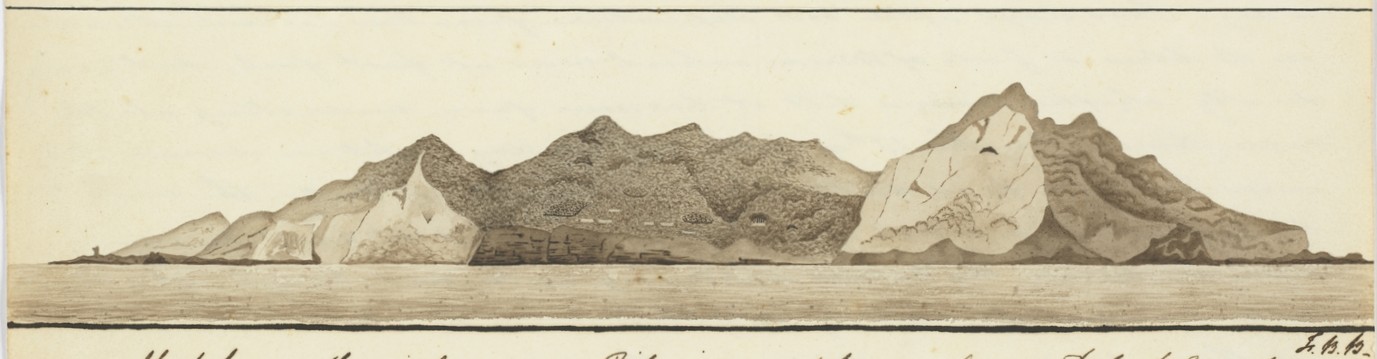
Sketch of the island of Pitcairn taken on board H.M.S. Comet on the 28th February 1831 [Click on image to enlarge.] [Page 7] 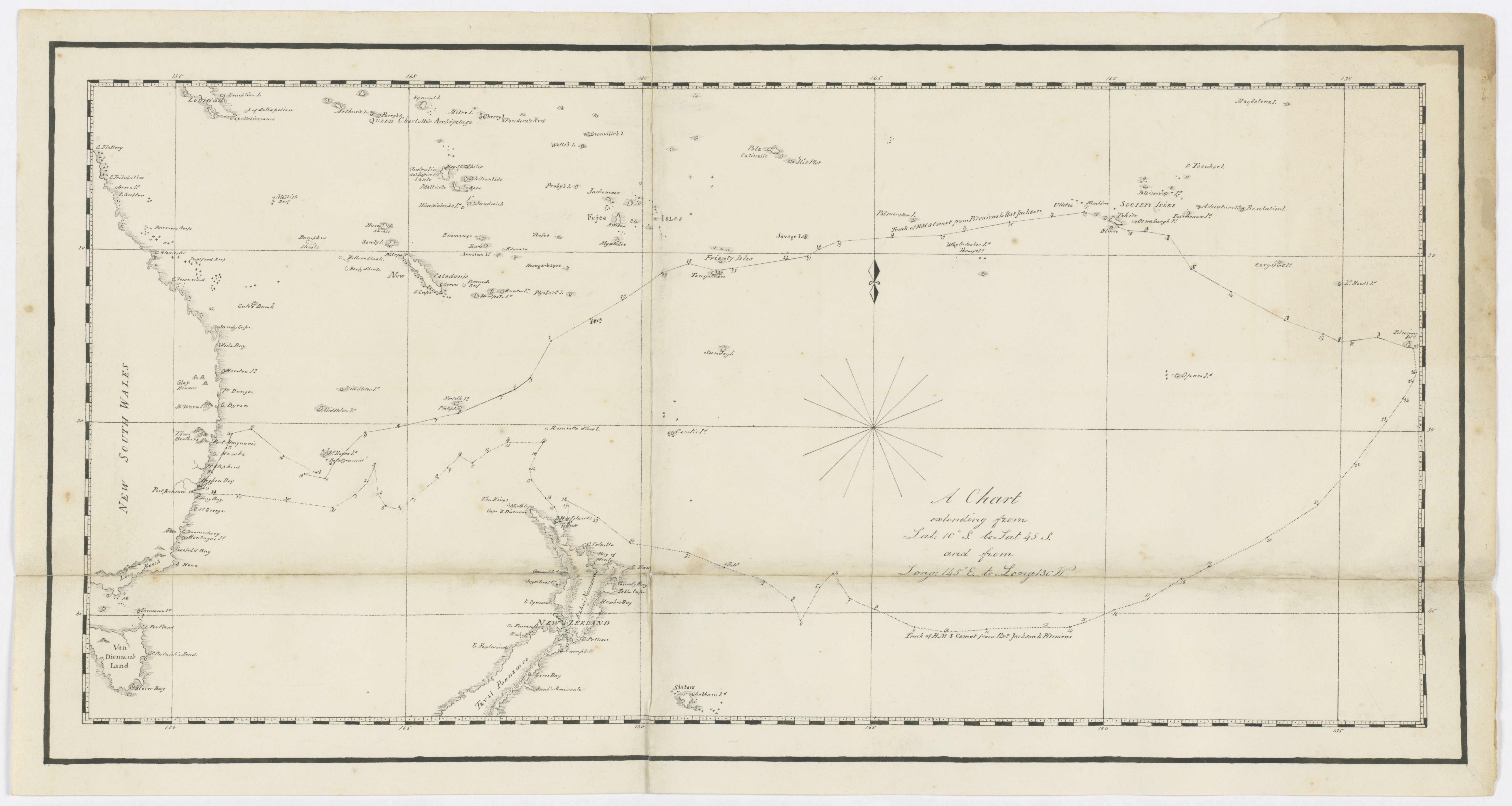
A Chart extending from Lat: 10° S. to Lat 45 S. and from Long: 145° E. to Long: 130 W. [Track of H.M.S. Comet from Port Jackson to Pitcairns.] [Click on image to enlarge.] [Transcribed by Robin Mathews for the State Library of New South Wales]
|
|
Source.
Keeper unknown - held by the State Library of New South Wales.
This transcription used images from the
Mitchell Library, State Library of New South Wales.
Last updated by Tom Tyler, Denver, CO, USA, Oct 23, 2025
|
|

