|
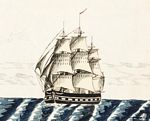
1852 – The Ship George Howland is Seized by Convicts at Charles Island in the Galapagos Islands
|
|
|
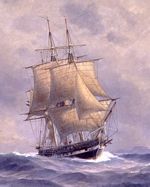
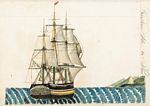
1851 – Swedish Frigate HSwMS Eugenie
Historical information about the Swedish frigate Eugenie, which circumnavigated the world in the years 1851-1853. The Eugenie was a key player in the drama of the George Howland's seizure and subsequent events in the Bay of Guayaquil in March 1852.
|
|
|
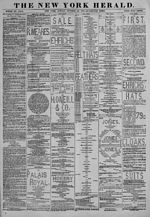
1852 – The Seizure of the George Howland in Newspapers
A collection of contemporary newspaper articles that featured or mentioned the seizure of the whale ship George Howland in the Galapagos Islands and the events which followed in the Bay of Guayaquil in 1852. The duplication of content from one newspaper to another is illustrative of the nature of the way in which publishers obtained their news and reissued it.
|

|
|
1852 - The Ecuador Chapter of Skogman's 'The voyage of the frigate Eugenie around the world 1851-1853, under the command of C.A. Virgin'
Carl Skogman.
Fregatten Eugenies resa omkring jorden åren 1851-1853, under befäl af C.A. Virgin.
A. Bonnier, Stockholm, [1855].
pp. 140-164.
Selection.
|
|
Carl Johan Alfred Skogman (1820-1907), a Swedish baron, surveyor, captain in the navy, member of parliament and draftsman was an officer on the frigate Eugenie on its voyage around the world in 1851-1853. This chapter is an account of the visit to Guayaquil, Ecuador, where the frigate encountered the American whale ship George Howland which had been recently deserted by the pirates who had taken the vessel at Charles Island (Floreana or Santa Maria Island) in the Galapagos Islands. Skogman's account of the pirate's depradations is one of the best first-hand accounts of this matter.
|
|
|
|
1852 - The Galapagos Chapter of Skogman's 'The voyage of the frigate Eugenie around the world 1851-1853, under the command of C.A. Virgin'
Carl Skogman.
Fregatten Eugenies resa omkring jorden åren 1851-1853, under befäl af C.A. Virgin.
A. Bonnier, Stockholm, [1855].
pp. 165-183.
Selection.
|
|
Carl Johan Alfred Skogman (1820-1907), a Swedish baron, surveyor, captain in the navy, member of parliament and draftsman was an officer on the frigate Eugenie on its voyage around the world in 1851-1853. This chapter is an account of the visit to the Galapgos Islands, where the frigate encountered the Ecuadoran victims of rape and murder committed by the pirates at Chatham Island en route to the South American coast.
|
|
|
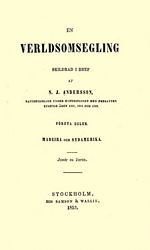
1852 – Ecuador chapter from Andersson's The Swedish frigate Eugenie's voyage around the world
Nils Johan Andersson.
En Verldsomsegling: skildrad i bref af N. J. Andersson, naturforskare under expeditionen med fregatten eugenie åren 1851, 1852 och 1853 - Första Delen - Madeira och Sydamerika.
Stockholm: Samson & Walling, 1853.
Vol. 1.
pp. 200-219.
Selection.
|
|
Nils Johan Andersson (1821–1880), was a Swedish botanist who accompanied the Swedish Naval frigate HSwMS Eugenie, Captain Christian Adolf Virgin, on its circumnavigation in 1852-1853. This chapter is an account of the visit to Guayaquil, Ecuador, where the frigate encountered the American whale ship George Howland which had been recently deserted by the pirates who had taken the vessel at Charles Island (Floreana or Santa Maria Island) in the Galapagos Islands. Andersson also witnessed the public execution of the captured pirates in the city.
|
|
|
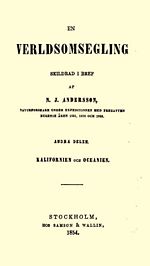
1852 – Galapagos chapter from Andersson's The Swedish frigate Eugenie's voyage around the world
Nils Johan Andersson.
En Verldsomsegling: skildrad i bref af N. J. Andersson, naturforskare under expeditionen med fregatten eugenie åren 1851, 1852 och 1853 - Andra Delen - Kalifornien och Oceanien.
Stockholm: Samson & Walling, 1854.
pp. 1-32.
Selection.
|
|
Nils Johan Andersson (1821–1880), was a Swedish botanist who accompanied the Swedish Naval frigate HSwMS Eugenie, Captain Christian Adolf Virgin, on its circumnavigation in 1852-1853. This chapter is an account of the visit to the Galapagos Islands, where the frigate met Ecuadoran survivors of the rape and murder on Chatham Island by the pirates when they stopped with the American whale ship George Howland on their way to the South American coast. Andersson did some scientific collecting on several of islands the frigate visited.
|
|
|
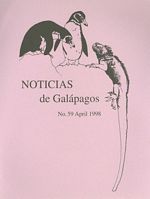
1998 - Lundh - Voyage of the Frigate Eugenie
J. P. Lundh.
"Voyage of the Frigate Eugenie,"
Noticias De Galápgos
No. 59 (April 1998).
pp.7-8.
Full text.
|
|
Long-time Galapagos and Ecuador resident J.P. Lundh's brief history of the circumnavigation by the royal Swedish frigate, Eugenie in the 1850's. In this work of Lundh's just a short note on the George Howland affair in 1852 in which the Eugenie played a significant role.
|
|
|
2001 – Lundh Ch. 9: Briones the Pirate
Jacob P. Lundh.
The Galapagos: A Brief History.
web: https://www.lundh.no/jacob/galapagos/pg05.htm Retrieved January 8, 2026.
© Jacob P. Lundh, 1999, 2001.
pp. 53-58.
Selection.
|
|
Lundh gives a short history of the Ecuadorian bandit Manuel Briones who was the ring-leader of the seizure of the American whaleship George Howland at Charles Island, Galapagos, in March 1852. The two Swedish accounts of the circumnavigation of the Swedish frigate Eugenie (Andersson and Skogman) were Lundh's sources.
|
|
 Whalesite
Contents
Whalesite
Contents

.jpg)