Previous George Howland  Contents  Whalesite Next

zzzz
with thanks to PBA Galleries, Berkeley, CA     
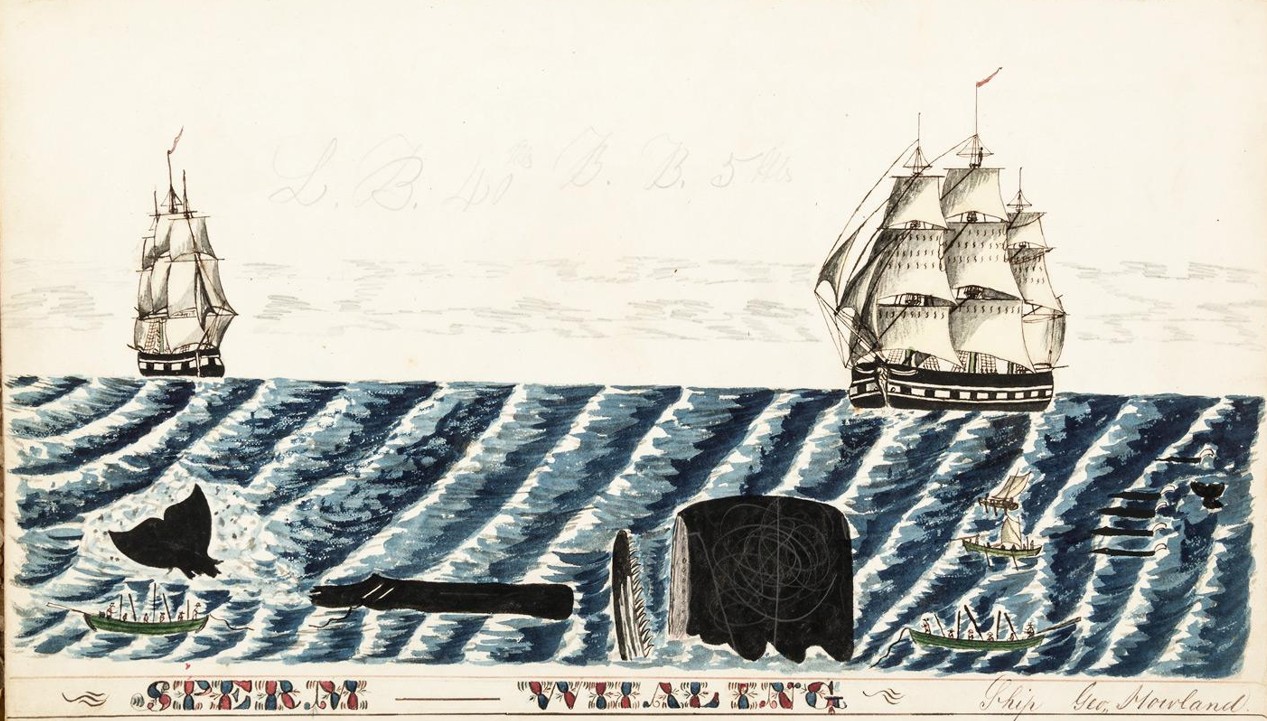
Logbook Illustration of the Ship George Howland
by Captain Aaron C. Cushman, Voyage of 1842-1845

[Click on image to enlarge.]

The Seizure of the George Howland
in Newspapers.

Contents
Introduction.
Part 1. First notices of seizure and convicts depredations.
Part 2. American Consul's communications to the United States.
Part 3. William B. Peacock's letter to New Bedford.
Part 4. Notices in Honolulu and San Francisco
Part 5. Captain Cromwell's letter to Mathew Howland
Part 6. Rescue of part of crew from Albemarle Island, Galapagos
Part 7. Return of the George Howland to New Bedford.

Introduction.

Part 1.
Notice of the George Howland's Seizure at Charles Island, Galapagos Islands & the Convicts Later Depredations.

Daily Picayune

(New Orleans, Louisiana)
April 16, 1852


From South America.

      Movements Of Flores – The Panama papers learn by the British steamer Louisa, that Flores, was in status quo at Lobos Afuera, an island some forty miles front Lambayeque, with his steamer Chili, and three sail vessels; that the citizens of Lima generally considered his prospects of success very fair; that, contrary to orders, the Lima undertook to go into Guayaquil on the 27th ult., where Flores was expected, after sunset, and was fired upon five times, and that great preparations had been made for the reception of Flores, and a large number of soldiers were paraded fully armed and equipped when the necessary landings were made from the Lima. None, excepting those who were to remain and those who went ashore for exchange of the mails, were permitted to land. The cause of the rash experiment of running into Guayaquil at night, was the request of the Ecuadorian Ambassador, who had left Lima, and was returning to his Government, and who declared that he would himself take the responsibility of the disobedience of orders.

      The ship Lyons cleared from Valparaiso some days before the Lima, ostensibly for California, and proceeded to Callao with 450 Chilians and cannons, &.c., for Gen. Flores. Those in charge of her expected to receive order from Flores at Callao Before, however, the Lima reached Guayaquil, the Lyons was discovered near by, running into Lobos Afuera. Thus is the delay of Flores at this island explained. The Lyons left Valparaiso under the American flag, without paying a single bill there, and the Government sent a steamer after her, which returned in two days, not having overhauled her.

      Business was improving at Valparaiso. A few days before the steamer sailed, a vessel from Baltimore arrived with 1,000 barrels of flour, which she landed at $8 per barrel, without paying duty. This was in accordance with a regulation of the customs, that when flour is at $8 per barrel or upwards, foreign flour shall be admitted free of duty. This article has been as high as $9, but this cargo, and the arrival of large quantities from the interior, reduced it to $6, with a downward tendency. Crops were all good.

      Some Ecuadorian convicts at the Galapago Islands, having murdered the captain and crew of an American whale ship cruising near there, took possession thereof, and started for Guayaquil, hoping to conciliate the Government by opposing Flores. They took two schooners in his interest, and murdered all on board, some fifty men. They were taken by a Swedish frigate, which had been stationed to prevent the entry of the harbor by vessels unauthorized.


New Orleans Daily Crescent

(New Orleans, Louisiana)
April 16, 1852


Arrival of the United States.
EIGHTEEN DAYS LATER FROM CALIFORNIA.


The steamer United States. Charles C. Berry, Commander, arrived here yesterday morning from Aspinwall, Navy Bay, on the 7th, and three days and sixteen hours from Kingston, Jamaica. We have been furnished with the following memoranda:

.  .  .  . 

      By a regulation of the Post-office Department, the mails can only be forwarded by way of Havana, and as the El Dorado was bound for New York direct the mails were detained for the next steamer. The U. S. Mail steamer Cherokee arrived at Aspinwall on the 6th inst., and left with the mails on the 7th inst., at 6 A. M., for New York and New Orleans via Havana. This arrangement. says the report of the U. S. Mail Agent, must cause much confusion and annoyance to the ccmmercial community, and especially to the consignees of the El Dorado, as they will not probably receive their letters until six days after the arrival of the treasure.

      In justice, however, to the U. S. Mail Agent, it is proper to remark. that had thle mails been forwarded by the El Dorado, and by accident delayed or lost, he would be liable to censure, whereas in this instance he has acted according to instructions; and it may justly be added that he is a gentleman well qualified for his station.

      To prevent a recurrence, it is necessary to allow the Mail Agent some discretionary power: and as there are frequently steamers for New York and New Orleans direct it would save much time to forward the mails by such conveyances.

.  .  .  . 


New York Herald

(New York N.Y.)
April 17, 1852


The News.

      By the arrival of the Sierra Nevada, one of the steamers of an independent line by the Panama route, we have three days' later intelligence from California. The mails, however, are still behind-hand, although two steaamers have arrived since they were brought to the Isthmus. it appears that the agent is under rigid instructions to put the United States mails in those steamers only which touch at Havana.

.  .  .  . 

      Additionally to the California news, by the Sierra Nevada, we have received very late advices from Jamaica, Galagapos Islands, Peru, Ecuador, and New Granada.

      The accounts from Galapagos Islands inform us of the seizure of the American whale ship George Howland, by the Ecuadorean convicts. After setting the officers and crew on shore, and murdering the Governor of the islands, the villains set sail for Tombez. On the way, they captured a small schooner, filled with men, who were going to join the Flores expedition. They cut the throats of twenty-three of these expeditionists, in hope of making atonement to the government for their former misdeeds. The murderers were eventually captured and carried to Guayaquil.

      According to the advices from Ecuador, the invading force under Flores had not landed, but was hovering around the coast. It was an extensive affair of the kind, and will probably succeed, unless the Swedish frigate, stationed at Guayaquil, aids the Ecuadorean government. The force at that point is too weak to cope with that of Flores; and judging from the unsuccessful effort to hit the English steamer Lima, he is safe from tbe cannon balls of the government forts. It is expected that if Flores fails, there will be a war between Peru aud Ecuador, in consequence of the assistance which the former afforded the invaders.


Evening Post

(New York, New York)
April 17, 1852


THREE DAYS LATER FROM CALIFORNIA.
Arrival of the Sierra Nevada.

      The steamship Sierra Nevada, Captain Wilson, arrived yesterday from Aspinwall, (Navy Bay,) and Kingston, Jamaica. She left the former at 8 P.M., on the 6th, and the latter on the morning of the 10th instant.

      She brings news from San Francisco to the 20th ult., which had arrived at Panama by the Tennessee.

      The mails by the Tennessee left Aspinwall on the 7th inst., in the steamer Cherokee, for New York.

.  .  .  . 

      Later from Valparaiso and Gallipagos Islands.

      We have received a month later news from the South Pacific, by the Sierra Nevada, arrived last night.

      It was taken to Panama by the English mail steamer Lima, which left Callao on the 25th ult.

.  .  .  . 

      Seizure of an American Ship. – Murder of Twenty Men. – It appears that the prisoners at the Gallipagos Islands, (which are the Ecuadorian penal settlement,) to the number of about forty-five, seized an American whale ship lying there, called the George Howland, Capt. Cromwell, of New Bedford, and after killing the Governor of the Island, and putting the captain and crew of the vessel on shore, sailed for Tumbez, which is on the line between Peru and Ecuador; but on the way the fell in with a small schooner, which had started from Payta, with a number of men to join Flores – this they took and deliberately cut the throats of twenty-three of them, expecting thereby to make their peace with the government. It so happened that the Swedish frigate was coming along and fell in with and captured them, and brought them into Guayaquil. The frigate claims a heavy salvage on the ship and schooner, as pirates, and they are there under the Swedish colors. The men were delivered up to government and are being tried. It is said the George Howland had considerable oil, and representations upon the subject have been sent home to the United States government.


Newark Daily Advertiser

(Newark, New Jersey)
April 17, 1852


BY TELEGRAPH THIS AFTERNOON.

.  .  .  . 

Four Days Later From California.
Arrival of the Sierra Nevada.

      By the arrival of the Steamer Sierra Nevada, at New York yesterday, from Navy Bay on the 6th via Jamaica, we have San Francisco dates to the 20th ult., and Panama to the 4th inst.

.  .  .  . 
Chili and Peru – Massacre at Sea.

      Valparaiso dates to the 20th ult. state that General Flores had been covertly and materially aided by the Peruvians and English in the movement against Ecuador.

.  .  .  . 

      The prisoners at the Gallapagos Islands, the penal settlement of Ecuador, seized an American whale ship lying there, the George Howland, of New Bedford, and after killing the Governor of the Island, and putting the captain and crew of the vessel on shore, sailed for Tombez. Subsequently, they fell in with a small schooner belonging to Flores' expedition, and having captured it, cut the throats of 23 of those on board, in hopes of thus making their peace with the Ecuadorian Government. They were subsequently captured by a Swedish brig, and taken into Guayaquil.


Boston_Herald

(Boston, Mass.)
April 17, 1852


THREE DAYS LATER
FROM CALIFORNIA
——
ARRIVAL OF THE
STEAMSHIP SIERRA NEVADA
AT NEW YORK.
——
NEARLY HALF A MILLION IN GOLD!!
——
IMPORTANT FROM CHILI.
——
DIABOLICAL BUTCHERY.

——
Crew of an American whaler Murdered.
——
New York, April 16.     

     The steamer Sierra Nevada, Capt, Wilson, from Aspinwall and Kingston, arrivod at six o'clock this evening, with 280 passengers, and $400,000 in gold dust. The Sierra Nevada left Kingston on the 18th.

.  .  .  . 
late and important from chili.

      The W. Scott brought advices from Valparasiso to the 20th Match. An American whaleship, name not stated, was seized by the convicts of the Gallipagos Islands, and the captain and crew murdered. The convicts then proceeded to Guayaquil, with the intention of opposing Gen. Flores. On their way they fell in with two schooners belonging to Flores, and having seized them, murdered all on board in the most brutal manner, including the nephew and son-in-law of General Flores, On one of these vessels they cut the throats of fifty-three men from ear to ear! The whaleship was afterwards taken possession of by a Swedish frigate, the convicts placed in irons, and the vessel anchored in the Guayaquil river.

      The sloop-of-war Portsmouth and the 50 gun ship St. Lawrence had arrived at Valparaiso from the States. The latter was to sail for Panama April 1st.

.  .  .  . 
isthmus news.

      The new railroad on the Isthmus is spoken of in very high terms.


The Crew of the Whale Ship George Howland Massacred.
New York, April 17.     

      The whale ship seized by the convicts at the Gallipagos Islands ??? and the captain and crew murdered, was the Geo. Howland of New Bedford.

      The California mails will arrive by the Georgia about to-morrow.


Boston Evening Transcript

(Boston, Massachusetts)
April 17, 1852


      The Murdered Whalers. The whaleship seized by the convicts at the Gallipagos Islands, and the captain and crew murderred, was the Geo. Howland of New Bedford.


Boston Daily Atlas

(Boston, Massachusetts)
April 17, 1852


Telegraphic Despatches.


ARRIVAL OF THE SIERRA NEVADA
WITH $400,000 IN GOLD.
IMPORTANT FROM CHILI AND CALIFORNIA.
New York, Friday, April 16.     

      The steamer Sierra Nevada, Capt. Wilson, from Aspinwall, and Kingston, arrived here at 6 o'clock this evening, with 280 passengers, and $400,000 in gold dust. She left Kingston on the 10th, at which place nothing of moment had transpired.

      Isthmus News. – The new railroad on the Isthmus is spoken of in very high terms.

.  .  .  . 

      Later from Chili – The Winfield Scott brought advices from Valparaiso to the 20th of March. An American whale ship, name not stated, was seized by the convicts at the Gallipagos Islands, and the captain and crew murdered. They then proceeded towards Guayaquil with the intention of opposing Gen. Flores. On their way they fell in with 2 schooners belonging to Flores, and having seized them they murdered all on board in the most brutal manner, including the nephew and son-in-law of General Flores. One one of the vessels they cut the throats of 53 men from ear to ear. The whole of them were afterwards taken prisoners by a Swedish frigate, the convicts placed in irons, and the vessels anchored in the Guayaquil river.

      The expedition of Gen. Flores, it was believed, would prove a total failure, though the greatest excitement still prevailed at Guayaquil, partly in consequence of Swedish frigate having been stationed at the mouth of the river, to prevent vessels entering without proper papers.

.  .  .  . 


Boston Evening Transcript

(Boston, Massachusetts)
April 17, 1852


      The Murdered Whalers. The whaleship seized by the convicts at the Gallipagos Islands, and the captain and crew murderred, was the Geo. Howland of New Bedford.


Albany Argus

(Albany, New York)
April 19, 1852


From the South Pacific.

Additional intelligence of the Flores expedition – The threatened revolution in Ecuador – the Republic in arms – Seizure of the American whale ship George Howland, at Galipagos Islands – Murder of the Governor of the Island – Butchery of twenty-three of the Flores expedition.

News, a month later, has been received from the South Pacific, by the Sierra Nevada.

      It was taken to Panama by the English mail steamer Lima, which left Callao on the 25th ult.

.  .  .  . 

      [Correspondance of the N.Y. Herald]

Steamer Sierra Nevada, April 16.

.  .  .  . 

      It appears that the prisoners at the Galapagos Islands, (which are the Ecuadorian penal settlement) to the number of about forty-five, seized an American shale ship lying there, called the Geo. Howland, Capt. Cromwell, of New Bedford, and after killing the Governor of the Island, and putting the captain and crew of the vessel on shore, sailed for Tumbez, which is on the line between Peru and Ecuador, but on the way they fell in with a small schooner, which had started from Payta, with a number of men to join Flores; this they took and deliberately cut the throats of twenty-three of them, expecting thereby to make their peace with the government. It so happened that the Swedish frigate was coming along and fell in with and captured them, and brought them into Guayaquil. The frigate claims a heavy salvage on the ship and schooner, as pirates, and they are there under the Swedish colors. The men were delivered up to government, and are being tried. It is said the George Howland had considerable oil, and representation upon the subject have been sent home to the United States government.

      If the frigate does not interfere, Flores will undoubtedly capture Guayaquil. If he does not succeed, in all probability Ecuador will declare war against Peru for the assistance she has rendered Flores. Yours, respectfully,

A Passenger, per steamer Lima.


Daily Herald

(Newburyport, Mass.)
April 19, 1852


FOUR DAYS LATER FROM CALIFORNIA.

      The steamer Sierra Nevada, from Aspinwall 6th April, and Kingston, Jan. 10th, arrived at New York,Friday evening at 6 o'clock, with 280 passengers and $400,000 in gold.

      The steamers Winfield Scott, California, Tennessee, New Orleans and Constitution were all at Panama at last advices, and bound for San Francisco; also numerous sailing ships. Prices for passages were exceedingly low to California, and the passengers very few. E. R. Stoddard, a passenger, died at sea, on board the Sierra Nevada.

.  .  .  . 


From Peru and Chili.
.  .  .  . 
Gen. Flores had not landed at Guayaquil. He had a formidable expedition under his command.

      The U.S. frigates St. Lawrence and Raritan and sloop-of-war Portsmouth were at Valparaiso;

.  .  .  . 

      The prisoners of the Gallipagos Island, a penal settlement of Ecuador, had seized an American whale ship lying there called the Geo. Howland, Capt. Cromwell, of New Bedford, and after killing the Governor of the Island and putting the Captain and crew on shore sailed for Tombez. On their way they fell in with 2 schooners belonging to Flores, and having seized them they murdered all on board in the most brutal manner, including the nephew and son-in-law of Gen. Flores. – On one of the vessels they cut the throats of 53 men from ear to ear. The whole of them were afterwards taken prisoners by a Swedish frigate, the convicts placed in irons, and the vessels anchored in the Guayaquil river.

      The George Howland had considerable oil, and representations have been sent home to the United States government that the Swedish frigate claims a large salvage.

      The expedition of Gen. Flores, it was believed,would prove a total failure, though the greatest excitement still prevailed at Guayaquil.

      An electric telegraph and railroad were the leading topics of discussion in Chili.

      In Peru nothing was talked of but the Flores expedition. The Peruvians were thought to be in favor of it. The American ship Lyons, Capt. Davis, had left Valparaiso with 350 men, ammunition, &c., to join the forces of Flores.

      The sloop of war Portsmouth, and frigate St. Lawrence, had arrived at Valparaiso from the United States; the latter was to sail for Panama April 1st.

      The emigration from Valparaiso to San Francisco was rapidly increasing since the late revolationary movements in Chili.

      The new railroad on the Isthmas is spoken of in very high terms.


Salem Register

(Salem, Massachusetts)
April 19, 1852


Later From California. The steamship Sierra Nevada, Capt. Wilson, from Aspinwall, April 6th , and Kingston, Ja. 10th., arrived at New York on Friday evening, with 286 passengers and $400,000 in gold.

      The new Railroad on the Isthmus is spoken of in very high terms.

      The steamers Winfield Scott, California, Tennessee, New Orleans, and the Constitution were at Panama, bound for San Francisco. Also the clippers Trade Wind and Hornet.

      There were but few passengers on the Isthmus, and the rates of passage were exceedingly low, on account of the great competition.

      The Winfield Scott made the shortest trip on record, having been but 60 days and 6 hours, including stoppages. The following is her time: – From New York to Rio Janeiro, 21 days, 15 hours; Rio Janeiro to Valparaiso, 15 days, 14 hours; Valparaiso to Panama, 11 days, 5 hours. Whole running time 48 days, 10 hours.

      The news from California is to the 20th of March, but very uninteresting. One correspondent at San Francisco writes that there are symptoms of a serious difficulty in Sonora. The French expedition which left San Francisco a short time ago for the professed purpose of making new gold discoveries, was really bent on revolutionizing that country and establishing an independent government, but with no idea of its being ultimately annexed to the United States.

      The Californians are very much annoyed at this movement, and talk of getting up an expedition of 1000 Americans, to take possession of Sonora, and drive out the French. It is well known that the inhabitants of that country are anxious to be independent.

      No further danger was apprehended from the flood, but the papers are filled with disasters already caused by it.

      The Alta California estimates the shipments of specie for the first fortnight in March at $3,000,000.

      An indignation meeting has been held in Sacramento to consider the bill recently passed in the House relating to contracts for labor with Chinese emigrants. The bill is denounced as intended to introduce a system of quasi slavery, and as an outrage on the rights of the American laborer The bill passed the House after a violent opposition, by a vote of 30 to 20. It is thought the bill will not pass the Senate, or if it does that the Governor will veto it.

      The clipper ship Northern Light has been engaged to proceed to Acapulco, after the passengers of the North America.

      The prisoners of the Gallapagos Island, a penal settlement of Ecuador, had seized an American whale ship lying there, called the Geo. Howland, Captain Cromwell, of New Bedford, and after killing the Governor of the Island and putting the Captain and crew on shore, sailed for Tombez. They subsequently fell in with a small schooner of the Flores expedition and cut the throats of 23 of those on board, in hopes of thus making their peace with the Ecuadoran government. They were,subsequently captured by a Swedish brig, and taken into Guayaquil, and are being tried, it is said.

      The George Howland had considerable oil, and representations have been sent home to the United States government that the Swedish brig claims a large salvage.


Sun

(Baltimore, Maryland)
April 19, 1852

LATER FROM SOUTH AMERICA.

Seizure of an American whale ship – Murder of the Governor – Capture of two Schooners in the interest of Flores, and Murder of all on Board, some Fifty Men. By the arrival of the steamship Lima at Panama, April 1, from Valparaiso, dates from Chili to the 9th March have been received.

      In Chili, the railroad and electric telegraph appear to be the leading topics.

. . .

      The greatest excitement prevailed in Guayaquil on the arrival of the mail steamer Lima. A Swedish frigate had been stationed at the mouth of the river to prevent vessels entering without proper papers.

      The prisoners at the Galapagos Islands, (which are the Ecuadorian penal settlement) to the number of about forty-five, seized an American shale ship lying there, called the George Howland, Captain Cromwell, of New Bedford, and, after killing the Governor of the Island, and putting the captain and crew of the vessel on shore, sailed for Tumbez, which is on the line between Peru and Ecuador; but on the way they fell in with a small schooner, which had started from Payta, with a number of men to join Flores. This they took, and deliberately cut the throats of twenty-three of them, including the nephew and son-in-law of Gen. Flores, expecting thereby to make their peace with the government. It so happened that the Swedish frigate was coming along and fell in with and captured them, and brought them into Guayaquil. The frigate claims a heavy salvage on the ship and schooner, as pirates, and they are there under the Swedish colors. The men were delivered up to the government, and are being tried. It is said the George Howland had considerable oil, and representations upon the subject have been sent home to the United States government.

      On passing up the river to Guayaquil, it appears, the British mail steamer was mistaken for that of Flores, and no less than five different shots were fired at her, luckily, however, without effect.


State Gazette

(Trenton, New Jersey)
April 19, 1852


      Dreadful Massacres At Sea. – The Winfield Scott brought advices from Valparaiso to the 20th of March.

      An American whale-ship, name not stated, was seized by a party of convicts at the Galapagos Islands, and the captain and crew murdered, in the most cruel and cold-blooded manner.

      The convicts then sailed towards Guayaquil, with the intention of opposing Gen. Flores.

      On their way they fell in with two schooners belonging to the expedition of Gen. Flores, and having seized them, murdered all on board in the most ferocious and blood-thirsty manner, including the nephew and son-in-law of Gen. Flores. On board of one of these vessels the convicts cut the throats of twenty-three men.

      The whale-ship was afterwards taken possession of by a Swedish frigate. The convicts were placed in irons, and the vessel anchored in the Guayaquil river.


Alexandria Gazette

(Alexandria, Virginia)
April 20, 1852


Later from South America.

      By the arrival of the steamship Lima at Panama, April 1, from Valparaiso, dates from Chili to the 9th March have been received.

      In Chili, the railroad and electric telegraph appear to be the leading topics.

      Business was improving at Valparaiso. A few days before the steamer sailed, a vessel from Baltimore arrived with 1,000 barrels of flour, which she landed at $8 per barrel with out paying duty. (This was in accordance with a regulation of the customs, that when flour is at $8 per barrel or upwards, foreign flour shall be admitted free of duty.) The article has been as high as $9 – but this cargo, and the arrival of large quantities from the interior, reduced it to $6, with a downward tendency. Crops were all good.

      The American ship Lyons, Capt. Davis, cleared from Valparaiso, ostensibly for California, and proceeded to Calao[sic] with 450 Chileians and cannon, &c., for Gen. Flores. Those in charge ot her expected to receive orders from Flores at Calao[sic]. Before however, the Lima reached Guayaquil, the Lyons was discovered near by, running in to Lobos Afuera. The Lyons left Valparaiso, under the American flag, without paving a single bill there, and the government sent a steamer after, which returned in two days, not having overhauled her.

      The greatest excitement prevailed in Guayquil[sic] on the arrival of the mail steamer Lima. A Swedish frigate had been stationed at the mouth of the river to prevent vessels entering without proper papers.

      The prisoners at Galapagos Islands, (which are the Eucadorian penal settlement,) to the number of about forty-five, seized an American whale ship lying there, called the George Howland, Capt. Cromwell, of New Bedford, and, after killing the Governor of the island, and putting the captain and crew of the vessel on shore, sailed for Tumbez, which is on the line between Peru and Ecuador; but on their way they fell in with a small schooner, which had started from Payta with a number of men to join Flores. This they took, and deliberately cut the throats of twenty-three of them, including the nephew and son-in-law of General Flores, expecting thereby to make their peace with the government. It so happened that the Swedish frigate was coming along an fell in with and captured them, and brought them in to Guayaquil. The frigate claims a heavy salvage on the ship and schooner, as pirates, and they are there under Swedish col ors. The men were delivered up to the government, and are being tried. It is said the George Howland had considerable oil, and representations upon the subject have been sent home to the U. S. Government.

      On passing up the river to Guayaquil it appears, the British mail steamer was mistaken for that of Flores, and no less than five different shots were fired at her, luckily, however, without effect.

.  .  .  . 


Daily National Intelligencer

(Washington, D.C.)
April 20, 1852


FROM SOUTH AMERICA.

      By the steamships Winfield Scott and Lima, arrived at Panama, we have advices from Valparaiso to the 20th of March, nearly a month later than our previous advices. The principal news is relative to the Flores expedition.

.  .  .  . 

      The British mail steamer Lima, while passing up the river Guayaquil, was mistaken for the vessel of Flores, and fired into from the forts.

      We have some further details of outrages by the revolted prisoners at the penal colonies in the Galapagos Islands. A detachment of about forty-five of them had seized the whale ship George Howland, Capt. Cromwell, of New Bedford, and after putting the captain and crew on shore, according to one account, and murdering them according to another, proceeded toward Guayaquil with the intention of opposing Flores, and thus ingratiating the Ecuadorian Government. The party fell in with two schooners belonging to Flores, and having seized them, murdered those on board in a most brutal manner, including the nephew and son-in-law of Gen. Flores. On one of these vessels they cut the throats of twenty-three men. On their voyage they were captured by a Swedish frigate, carried into Guayaquil, and delivered into the hands of the Government. – N.Y. Commercial Advertiser.


Richmond Enquirer

(Richmond, Virginia)
April 20, 1852


LATER FROM SOUTH AMERICA.

      Seizure of an American Whaleship – Capture of two Schooners in the interest of Flores, and murder of all on Board.

      By the arrival of the steamship Lima at Panama, April 1, from Valparaiso, dates from Chili to the 9th March have been received.

.  .  .  . 

      The greatest excitement prevailed in Guayaquil on the arrival of the mail steamer Lima. A Swedish frigate had been stationed at the mouth of the river to prevent vessels entering without proper papers.

      The prisoners at the Galapagos Islands, (which are the Ecuadorian penal settlement) to the number of about forty-five, seized an American shale ship lying there, called the George Howland, Captain Cromwell, of New Bedford, and, after killing the Governor of the Island, and putting the captain and crew of the vessel on shore, sailed for Tumbez, which is on the line between Peru and Ecuador; but on the way they fell in with a small schooner, which had started from Payta, with a number of men to join Flores. This they took, and deliberately cut the throats of twenty-three of them, including the nephew and son-in-law of Gen. Flores, expecting thereby to make their peace with the government. It so happened that the Swedish frigate was coming along and fell in with and captured them, and brought them into Guayaquil. The frigate claims a heavy salvage on the ship and schooner, as pirates, and they are there under the Swedish colors. The men were delivered up to the government, and are being tried. It is said the George Howland had considerable oil, and representations upon the subject have been sent home to the U. States government.

      On passing up the river to Guayaquil, it appears, the British mail steamer was mistaken for that of Flores, and no less than five different shots were fired at her, luckily, however, without effect.

.  .  .  . 


Boston Daily Atlas

(Boston, Massachusetts)
April 20, 1852


      The whaleship seized by the convicts at the Gallipagos Islands, and the captain and crew murdered, was the George Howland, of New Bedford.


Whalemen's Shipping List

(New Bedford, Massachusetts)
April 20, 1852


FROM THE SOUTH PACIFIC
Seizure of the Whale ship George Howland of this port, at Gallipagos Islands.

      By the arrival at New York on Friday evening of the steamer Sierra Nevada, advices have been received from San Francisco to the 20th of March, four days latest, and from Callao to the 25th.

. . . .

      The following startling intelligence is published in the New York Herald, in a letter to the editor from a passenger on board the Sierra Nevada.

      The prisoners at Gallipagos Islands, (which are the Ecuadorian penal settlement) to the number of about forty-five, seized an American whale ship lying there, called the George Howland, Capt. Cromwell, of New Bedford, and, after killing the Governor of the Island, and putting the Captain and crew of the vessel on shore, sailed for Tumbez, which is on the line between Peru and Equador; but on the way they fell in with a small schooner, which had started from Payta, with a number of men to join Flores, this they took, and deliberately cut the throats of twenty-three of them, expecting thereby to make their peace with the government. It so happened that a Swedish frigate was coming along and fell in with and captured them, and brought them into Guayaquil. The frigate claims a heavy salvage on the ship and schooner, as pirates, and they are there under Swedish colors. The men were delivered up to the government, and are being tried. It is said the George Howland had considerable oil, and representations upon the subject have been sent home to the U.S. Government.


Pittsfield Sun

(Pittsfield, Massachusetts)
April 22, 1852


From California.
Arrival of the Steamer Sierra Nevada.

      The steamer Sierra Nevada, Capt. Wilson, from Aspinwall and Kingston, arrived at N. York on Friday, with 280 passengers, and $400,000 in gold dust. She left Kingston on the 10th.

      Isthmus News. – The new Railroad on the Isthmus is spoken of in very high terms. The steamers Winfield Scott, California, Tennessee, New Orleans, and the Constitution were at Panama, bound for San Francisco; also the clippers Trade Wind and Hornet. There were but few passengers on the Isthmus and the rates were exceedingly low, on account of the great competition.

      The Winfield Scott made the shortest trip on record, having been but 60 days and 6 hours, including stoppages. The following is her time: – From New York to Rio Janeiro, 21 days, 15 hours; Rio Janeiro to Valparaiso, 15 days, 14 hours; Valparaiso to Panama, 11 days, 5 hours. To Valparaiso, running time 48 days, 10 hours.

      Late and Important from Chili. – The Winfield Scott brought advices from Valparaiso to the 20th March. An American whale ship, name not stated, was seized by a party of convicts at the Galapagos Islands, and the captain and crew murdered. The convicts then proceeded towards Guayaquil with the intention of opposing Gen. Flores. On their way they fell in with two schooners belonging to Flores, and having seized them murdered all on board in the most brutal manner, including the nephew and son-in-law of Gen. Flores.

      On one of one of these vessels they cut the throats of 53 men from ear to ear. The whale-ship was afterwards taken possession of by a Swedish frigate, the convicts put in irons, and the vessel anchored in the Guayaquil river. The expedition of Gen. Flores, it was believed, would prove a total failure, though the greatest excitement still prevailed at Guayaquil, partly in consequence of a Swedish frigate having been stationed at the mouth of the river to prevent vessels entering without proper papers.

      An electric telegraph and railroad were the leading topics of discussion in Chili.

.  .  .  . 


Litchfield Republican

(Litchfield, Connecticut)
April 22, 1852


From South America.

      Considerable interest was manifested in Chili, on the subject of the construction of a Railroad and Electric Telegraph.

.  .  .  . 

      The convicts from Ecuador who were stationed at the Galapagos Islands, recently broke loose and seized an American whale ship, (the name of which we have not heard,) and murdered the captain and all the crew. They then steered towards Guayaquil, with the avowed intention of warring against Gen. Flores, in the hopes of obtaining pardon from the Government. They met two schooners belonging to Flores which they seized; and murdered the crew and passengers in a most brutal manner, by cutting their throats from ear to ear. Twenty-three men were thus barbarously put to death on board of one of the vessels. Among the murdered passengers were a nephew and son-in-law of Gen. Flores.

      The nefarious wretches were at length arrested in their bloody career by a Swedish frigate; the captain of which immediately put the convicts in iron; and their fate is inevitable. No doubt, they will be executed for their horrid crimes.


The Daily Dispatch

(Richmond [Va.])
April 22, 1852


Officers and Crew of an Americas Whaleship Murdered. – The steamer Sierra Nevada, which arrived on Friday evening last, brought a vague account of the capture of the whaleship George Howland, of New Bedford, on the Islands of Galiipagos. It appears that a rising, similar to the one in the Chilian penal colony in the Straits of Magellan, has taken place, attended with more inhuman butchery. A detachment of about forty five of the prisoners at the penal colonies, in the Galiipagos, seized the above named vessel, and after putting Capt. Cromwell and the crew on shore, according to one account, and murdering them according to another, proceeded to wards Guayaquil with the intention of opposing Flores, and thus ingratiating the Ecuadorian government. The party fell in with two schooners belonging to Flores, and having seized them, murdered those on board in a most brutal manner, including the nephew and son-in-law of Gen. Flores. On one of these vessels they cut the throats of twenty-three men. On their voyage they were captured by a Swedish frigate, carried into Guayaquil, and delivered into the hands of the Government. It is said that the officers of the Swedish frigate claim salvage on the re-captured ship. – When taken by the convicts she is supposed to have had considerable oil on board.


Weekly National Intelligencer

(Washington [D.C.])
April 24, 1852


FROM SOUTH AMERICA.

      By the steamships Winfield Scott and Lima, arrived at Panama, we have advices from Valparaiso to the 20th of March, nearly a month later than our previous advices. The principal news is relative to the Flores expedition.

      Flores had purchased the steamship Chile and embarked from Callao upon it. The American ship Lyons had sailed from Valparaiso with three hundred men and large supplies of ammunition to join the expedition at Guayaquil. The general impression is that Flores has allowed the Ecuadorian Government too much time to guard against his movements, and that his expedition will therefore prove a failure.

      The Peruvians generally were in favor of the movement, and it is supposed that Flores received covert aid from the Government of the country. The result will probably be trouble between Ecuador and Peru, in case of the failure of the expedition.

      The British mail steamer Lima, while passing up the river Guayaquil, was mistaken for the vessel of Flores, and fired into from the forts.

      We have some further details of outrages by the revolted prisoners at the penal colonies in the Galapagos Islands. A detachment of about forty-five of them had seized the whale ship George Howland, Capt. Cromwell, of New Bedford, and after putting the captain and crew on shore, according to one account, and murdering them according to another, proceeded toward Guayaquil with the intention of opposing Flores, and thus ingratiating the Ecuadorian Government. The party fell in with two schooners belonging to Flores, and having seized them, murdered those on board in a most brutal manner, including the nephew and son-in-law of Gen. Flores. On one of these vessels they cut the throats of twenty-three men. On their voyage they were captured by a Swedish frigate, carried into Guayaquil, and delivered into the hands of the Government. – N. Y. Commercial Advertiser.


Salem Observer

(Salem, Massachusetts)
April 24, 1852


      Officers and Crew of a New Bedford Whaler Murdered. The Sierra Nevada, arrived at New York on Friday last, from the Isthmus, brings intelligence of a sad state of things at the penal settlement of Ecuador, on the Island of Gallipagos. A rising, similar to the one in the Chilian penal colony in the Straits of Magellan, it appears has taken place attended with more inhuman butchery. The prisoners seized the New Bedford whaler Geo. Holland [sic.], Capt. Cromwell, and sailed for Tombez. One telegraph correspondent says the Captain and crew were murdered; another correspondent says they were placed on shore, and the convicts having murdered the Governor of the island, set sail, and were captured by a Swedish vessel and taken to Guayaquil, where they were being tried.

      The insurgents, after taking possession of the George Howland, proceeded towards Guayaquil with the intention of opposing Flores, and gaining the pardon of their Government for doing so. The party fell in with two schooners belonging to Flores, and having seized them, murdering those on board in the most brutal manner, including the nephew and son in law of Gen. Flores. On one of the vessels they cut the throats of twenty-three men from ear to ear.

      The whale ship was afterwards taken possession of by the Swedish frigate, and the convicts on board placed in irons. At last accounts the vessel was at anchor in the Guayaquil river, along side the Swedish frigate.


New Hampshire Statesman

(Concord [N.H.])
April 24, 1852


      The prisoners of the Gallapagos Island, a penal settlement of Eucador, had seized an American whale ship lying there, called the Geo. Howland, Captain Cromwell, of New-Bedford, and after killing the Governor of the island and putting the captain and crew on shore, sailed for Tombez. – They subsequently fell in with a small schooner of the Flores expedition, and cut the throats of 23 of those on board, in hopes of thus making their peace with the Ecuadoran government. They were subsequently captured by a Swedish brig, and taken into Guayaquil, and are being tried, it is said.

      The George Howland had considerable oil, and representations have been sent home to the United States govemment that the Swedish brig claims a large salvage.


Republican Herald

(Providence [R.I.])
April 24, 1852


      Seizure of an Americas Ship. – Murder of Twenty Men – It appears that the prisoners at the Gallipagos Islands, (which are the Eucadorian penal settlement,) to the number of about fory-five, seized an American whale ship lying there, called the George Howland. Capt. Cromwell, of New Bedford, and afier killing the Governor of the Island and putting the captain and crew of the vessel on shore, sailed for Tombez, which is on the lime between Peru and Ecuador but on the way they fell in with a small schooner, which had started from Payta, with a number of men to join Flores – this they took, and deliberately cut the throats of twenty-three of them, expecting thereby to make their peace with the government. It so happened that a Swedish frigate was coming along and fell in with with and captured them, and brought them into Guyaquil. The frigate claims a heavy salvage on the ship and schooner, as pirates and they are under Swedish colors. – The men were were delivered up to government and are being tried It is said the George Howland had considernble oil, and representalions upon the subject have been sent home to the United States government.


Weekly Herald

(New York, New York)
April 24, 1852


THE EVENTS OF THE WEEK.

. . . .

      By the arrival of the Sierra Nevada, one of the steamers of an independent line by the Panama route, we have three days' later intelligence from California.

. . . .

      Additionally to the California news, by the Sierra Nevada, we have received very late advices from Jamaica, Galapagos Islands, Peru, Ecuador, and New Granada.

      The accounts from Galapagos Islands inform us of the seizure of the American whale ship George Howland, by the Ecuadorean convicts. After setting the officers and crew on shore, and murdering the Governor of the islands, the villains set sail for Tumbez. On the way, they captured a small schooner, filled with men, who were going to join the Flores expedition. They cut the throats of twenty-three of these expeditionists, in hope of amaking atonement to the government for their former misdeeds. The murderers were eventually captured and carried to Guayaquil.

      According to the advices from Ecuador, the invading force under Flores had not landed, but was hovering around the coast. It was an extensive affair of the kind, and will probably succeed, unless the Swedish frigate, stationed at Guayaquil, aids the Ecuadorean government. The force at that point is too weak to cope with that of Flores; and judging from the unsuccessful effort to hit the English steamer Lima, he is safe from the cannon balls of the government forts. It is expected that if Flores fails, there will be a war between Peru and Ecuador, in consequence of the assistance which the former afforded the invaders.

.  .  .  . 

Nantucket Weekly Mirror

(Nantucket, Mass.)
April 24, 1852


LATER FROM CALIFORNIA.

      The steamship Sierra Nevada, Capt. Wilson, from Aspinwall April 6th, and Kingston, Jamaica, 10th, arrived at New York on the 16th inst.

.  .  .  . 

      Dates from Callao to the 25th ult. have been received at Panama.

.  .  .  . 

      Gen. Flores had not landed at Guayaquil. He had a formidable expedition under his command.

.  .  .  . 

      It is said that Gen. Flores has been covertly very materially aided by the Peruvians and English, in his movement against Ecuador. His officers are mostly English.

      The Ecuadian Charge had demanded his passports of the Peruvian Government, and left the country on the 23d of March.

      The city of Guayaquil was declared in a state of seige, owing to the expected attack of Flores, and no vessels were allowed to approach it after sundown. The English steamer Lima was fired at from the battery, but luckily without any effect.

      The prisoners of the Gallapagos Island, a penal settlement of Ecuador had seized an American whaleship lying there called the Geo. Howland, Captain Cromwell, of New Bedford, and after killing the Governor of the Island and putting the Captain and crew on shore, sailed for Tumbez, they subsequently fell in with a small schooner of the Florez expedition and cut the throats of 23 of those on board in hopes of thus making their peace with the Ecuadorian government; they were subsequently captured by a Swedish brig, and taken into Guayaquil, and are being tried, it is said.

      The George Howland had considerable oil and representations have been sent home to the United States government that the Swedish brig claims a large salvage.


New Hampshire Statesman

(Concord, N.H.)
April 24, 1852


      Later from California. The steamship Sierra Nevada, Capt. Wilson, from Aspinwall April 6th, and Kingston, Jamaica, 10th, arrived at New York on Friday evening, with 286 passengers and $400,000 in gold.

.  .  .  . 

      The prisoners of the Gallapagos Island, a penal settlement of Eucador, had seized an American whale ship lying there, called the Geo. Howland, Captain Cromwell, of New-Bedford, and after killing the Governor of the island and putting the captain and crew on shore, sailed for Tombez. – They subsequently fell in with a small schooner of the Flores expedition, and cut the throats of 23 of those on board, in hopes of thus making their peace with the Ecuadoran government. They were subsequently captured by a Swedish brig, and taken into Guayaquil, and are being tried, it is said.

      The George Howland had considerable oil, and representations have been sent home to the United States govemment that the Swedish brig claims a large salvage.


Daily News

(London, England)
April 30, 1852


[Following the arrival on April 29 of the United States Steamship Atlantic Captain West, in the Mersey from New York, having left April 17.]

THE UNITED STATES.
.  .  .  . 
LATER FROM CALIFORNIA.
.  .  .  . 

      Additionally to the California news, by the Sierra Nevada, we have received very late advices from Galapagos Islands, Peru, and Ecuador. The accounts from Galapgos Islands inform us of the seizure of the American whale ship George Howland, by the Ecuadorean convicts. After setting the officers and crew on shore, and murdering the governor of the island, the villains set sail for Tombez. On the way they captured a small schooner, filled with men, who were going to join the Flores expedition. They cut the throats of twenty-three of these expeditionists, in the hope of making atonement to the Government for their former misdeeds. The murderers were eventually captured and carried to Guayaquil. According to the advices from Ecuador the invading force under Flores had not landed, but was hovering around the coast. It is expected that, if Flores fails, there will be a war between Peru and Ecuador, in consequence of the assistqnce which the former afforded the invaders.

.  .  .  . 
[Most of this article was also appeared in Liverpool Mercury Liverpool, England, April. 30, and the Caledonian Mercury Edinburgh, Scotland, May 3, 1852.]


New Orleans Weekly Delta

(New Orleans, Louisiana)
May 2, 1852


      From Peru and Chili. Dates from Callao to the 25th ult. have been received at Panama.

. . . .

      Gen. Flores had not landed at Guayaquil. He had a formidable expedition under his command.

. . . .

      It is said that Gen. Flores has been covertly very materially aided by the Peruvians and English, in his movements against Equador. His officers are mostly English.

. . . .

      The prisoners at Galapagos Islands, (which are the Eucadorian penal settlement,) to the number of about forty-five, seized an American whale ship lying there, called the George Howland, Capt. Cromwell, of New Bedford, and, alter killing the Governor of the island, and putting the captain and crew of the vessel on shore, sailed for Tumbez, which is on the line between Peru and Ecuador; but on their way they fell m with a small schooner, which had started from Payta with a number of men to join Flores. This they took, and deliberately cut the throats of twenty-three of them, including the nephew and son-in-law of General Flores, expecting thereby to make their peace with the government. It so happened that the Swedish frigate was coming along an[d] fell in with and captured them, and brought them in to Guayaquil. The frigate claims a heavy salvage on the ship and schooner, as pirates, and they are there under Swedish colors. The men were delivered up to the government, and are being tried. It is said the Geoige Howland had considerable oil, and representations upon the subject have been sent home to the U. S. Government.

      On passing up the river to Guayaquil it appears, the British mail steamer was mistaken for that of Flores, and no less than five different shots were fired at her, luckily, however, without effect.


Bermuda Royal Gazette

(Hamilton, Bermuda)
May 4, 1852


      Chili News. – The advices from Valparaiso are to the 20th of March. An American whale ship, name not stated, was seized by a party of convicts at the Galapago Islands, and the captain and crew murdered.

      The convicts then proceeded towards Guayaquil with the intention of opposing Gen. Flores. On their way, they fell in with two schooners belonging to Flores, and having seized them murdered all on board in the most brutal manner, including the nephew and son-in-law of Gen. Flores, in one of those vessels. They cut the throats of 43 men from ear to ear.

      The whaleship was afterwards taken possession of by a Swedish frigate, the convicts placed in irons, and the vessel anchored in the Guayaquil river. The expedition of Gen. Flores, it is believed, would prove a total failure,

      The emigration from Valparaiso to San Francisco was rapidly increasing since the late revolutionary movements in Chili.


Part 2.
Letter of the American Consul in Guayaquil, Ecuador to the George Howland's Owners in New Bedford.

The Inquirer

(Nantucket, Mass.)
April 26, 1852


      The Piratical Capture of the Whale Ship George Howland. – Authentic particulars of the Seizure of the ship George Howland of New Bedford, at the Gallipagoes Islands, will be found in our marine list today: –

      It is gratifying, says the N. Bedford Mercury, to know that the captain and crew of the Geo. Howlnd, – all or nearly all of them, were unharmed, and remain at Charles Island. G. P. Game, Esq., U.S. Consul at Guayaquil would send a vessel to take them to Guayquil[sic] at the earliest moment practicable.

      The Mercury of Saturday says: – Capt. Benj. Clark, of this city, left here yesterday for New York, where he will embark in the steamer to Guayquil[sic] via Chagres, in order to adjust all matters with the captain of the Swedish frigate and also to refit the Geo. Howland for the completion of her voyage, or send her to this port, as may be deemed expedient.


Nantucket Weekly Mirror

(Nantucket, Mass.)
May 1, 1852


weekly mirror
MARINE JOURNAL

      The following extract of a letter dated March 27th, from G P Game, Esq. U. S. Consul at Guayaquil, gives some further particulars of the capture of ship Geo Howland, of N Bedford, at Gallipagos Islands: –

      "The George Howland is now coming up to this port in charge of a Lieut, and men from the Swedish frigate Eugenia. It appears that while the G H was at Charles Island, she was taken possession of by some convicts, who escaped in her, and after committing most horrible depredations, abandoned the ship in her boats in the Bay of Guayaquil, on perceiving the Swedish frigate in pursuit of her. The captain of the frigate has just arrived here. He informs me that the ship will he delivered up to me, upon her arrival here, and claims his salvage for capturing her. It appears that the captain and crew of the Geo Howland, or most of them, are left unharmed on Charles Island. I have made application to the Government here for a small vessel of war, to send after them, but as they are preparing to repel an expedition, which has left Peru under command of Gen Flores to invade this Republic, all their force is required for their own protection; but rest assured that as soon as the opportunity of a vessel presents, I will despatch one to bring them here. When the advices reached here of a piratical ship in the Bay, the Government despatched a steamer of war, and the French corvette Prudente sailed in pursuit of he;;, but before they could arrive on the field of action, the ship had been captured by the Swedish frigate which was coming in at the same time."

      "Such is the shortness of the time and the uncertainty of the accounts, that I am unable to form a correct detail of occurrences at this moment."


The New York Herald

(New York [N.Y.])
April 26, 1852


      Whale Ship George Howland – The N Bedford Mercury publishes the following extract of a letter, dated March 27, from G P Game, US Consul at Guayaquil, giving some further particulars of the G H, captured by piratee at Gallipagos Islands. "The George Howland is now coming up to this port in charge of a Lieutenant and men from the Swedish frigate Eugenia. The captain of the frigate has just arrived here. He informs me that the ship will be delivered up to me upon her arrival here, and claims his salvage for capturing her. It appears that the captain and crew of the George Howland. cr most of them, are left unharmed on Charles Island. I have made application to the Government here for a small vessel of war, to send after them, but as they are preparing to repel an expedition, which has left Peru under command of General Flores to invade this Republic, all their force is required for their own protection; but rest assured that as soon as the opportunity of a vessel presents, I will despatch one to bring them here. When the advices reached here of a piratical ship in the Bay, the government despatched a steamer of war, and the French corvette Prudente sailed in pursuit of her, but before they could arrive on the field of action, the ship had been captured by the Swedish frigate which was coming in at the same time."


Albany Journal

(Albany, New York)
April 27, 1852


The Capture of the George Howland.

      We recorded some days since the capture of the ship George Howland, of New Bedford, by the revolted convicts of the Gallipagos Islands. The uncertainty which existed relative to the fate of the captain and crew is removed by the following letter from G.P. Game, Esq., U.S. Consul at Guayaquil, dated March 27, which is published in the New Bedford Mercury: –

      The George Howland is now coming up to this port in charge of a lieutenant and men from the Swedish frigate Eugenia. It appears that while the G.H. was at Charles Island, she was taken possession of by some convicts, who escaped in her, and after committing most horrible depredations, abandoned the ship in her boats in the Bay of Guayaquil, on perceiving the Swedish frigate in pursuit of them. The Captain of the frigate informs me that the ship will be delivered up to me, upon her arrival here, and claims his salvage for capturing her.

      It appears that the captain and crew of the George Howland, or most of them, are left unharmed on Charles Island. I have made application to the Government here for a small vessel of war, to send after them, but as they are preparing to repel an expedition, which has left Peru under command of Gen. Flores to invade this Republic, all their force is required for their own protection; but rest assured that as soon as the opportunity of a vessel presents, I will dispatch one to bring them here.

      When the advices reached here of a piratical ship in the bay, the Government despatched a steamer of war, and the French corvette Prudente sailed in pursuit of her, but before they could arrive on the field of action, the ship had been captured by the Swedish frigate, which was coming in at the same time.

      Captain Benjamin Clarke left New Bedford for this city on Friday, with the intention of proceeding immediately to Guayaquil [sic], by way of the Isthmus of Panama. His object is to adjust all matters with the captain of the Swedish frigate, and to refit the George Howland for the completion of her voyage, or send her to New Bedford, as may be deemed expedient.


Pennsylvania Inquirer

(Philadelphia, Pennsylvania)
April 27, 1852


The Piratical Capture of the Whaleship Geo. Howland.

      The New Bedford Mercury publishes the following extract of a letter dated March 27th, from G. P. Game, Esq., U.S. Consul at Guayaquil, giving some further authentic particulars of the capture of the ship George Howland, of New Bedford, at Gallipagos Islands. It is gratifying to know that the captain and crew of the Geo. Howland, – all or nearly all of them, were unharmed, and remain at Charles Island. G. P. Game, Esq., U.S. Consul at Guayaquil would send a vessel to take them to Guayaquil at the earliest moment practicable:

      "The George Howland is now coming up to the port in charge of a Lieutenant and men from the Swedish frigate Eugenie. I appears that while the G. H. was at Charles Island, she was taken possession of by some convicts, who escaped in her, and after committing most horrible depredations, abandoned the ship in her boats in the Bay of Guayaquil, on perceiving the Swedish frigate in pursuit of them. The captain of the frigate has just arrived here. He informs me that the ship will be delivered up to me upon her arrival here, and claims his salvage for capturing her. It appears that the captain and crew of the George Howland, or most of them, are left unharmed on Charles Island.

      I have made application to the Government here for a small vessel of war, to send after them, but as they are preparing to repel an expedition, which has left Peru under command of Gen. Flores to invade this Republic, all their force is required for their own protection, but rest assured that as soon as the opportunity of a vessel presents, I will despatch one to bring them here. When the advices reached here of a piratical ship in the Bay, the Government despatched a steamer of war, and the French corvette Prudente sailed in pursuit of her, but before they could arrive on the field of action, the ship had been captured by the Swedish frigate which was coming in at the same time.


Whalemans Shipping List and Merchants Transcript

(New Bedford, Massachusetts)
April 27, 1852


      The following extract of a letter dated March 27th, from G P Game, Esq, U S Consul at Guayaquil, gives some further particulars of the capture of the ship Geo Howland, of this port, at Gallipagos Islands. – "The George Howland is now coming up to this port in charge of a Lieut and men from the Swedish frigate Eugenia. It appears that while the G H was at Charles Island, she was taken possession of by some convicts, who escaped in her, and after committing most horrible depredations, abandoned the ship in her boats in the Bay of Guayaquil, on perceiving the Swedish frigate in pursuit of them. The captain of the frigate has just arrived here. He informs me that the ship will be delivered up to me upon her arrival here, and claims his salvage for capturing her. It appears that the captain and crew of the Geo Howland, or most of them, are left unharmed on Charles Island. I have made application to the Government here for a small vessel of war, to send after them, but as they are preparing to repel an expedition, which has left Peru under command of Gen. Flores to invade this Republic, all their force is required for their own protection, but rest assured that as soon as the opportunity of a vessel presents, I will despatch one to bring them here. When the advices reached here of a piratical ship in the Bay, the Government despatched a steamer of war, and the French corvette Prudente sailed in pursuit of her, but before they could arrive on the field of action, the ship had been captured by the Swedish frigate which was coming in at the same time."

      "Such is the shortness of the time to form a correct detail of the accounts, that I am unable to form a correct detail of occurrences at this moment."

      Capt. Benj. Clark, of this city left here on Friday last for Guayaquil, in order to adjust all matters with the captain of the Swedish frigate, and refit the Geo. Howland for the completion of her voyage, or send her home, as may be deemed expedient.


Daily Alabama Journal

(Montgomery, Alabama)
April 27, 1852


Dreadful Massacre ...

      The Winfield Scott brought advices from Valparaiso to the 20th March.

      An American whale ship, name not stated, was seized by a party of convicts at the Galapagos Islands, and the captain and crew murdered in the most cruel and cold-blooded manner.

      The convicts then sailed towards Guayaquil with the intention of opposing Gen. Flores.

      On their way they fell in with two schooners belonging to the expedition of Gen. Flores, and having seized them, murdered all on board in the most ferocious manner, including the nephew and son-in-law of Gen. Flores. On board one of these vessels the convicts cut the throats of twenty-three men.

      The whale-ship was afterwards taken possession of by a Swedish frigate. The convicts were placed in irons, and the vessel anchored in the Guayaquil river.

      The expedition of Gen. Flores, it was believed, would prove a total failure – though the greatest excitement prevailed at Guayaquil – partly in consequence of a Swedish frigate having been stationed at the mouth of the river to prevent vessels entering without proper papers.


Boston Daily Atlas

(Boston, Massachusetts)
April 27, 1852


      The Piratical Capture of the Whale Ship George Howland. – Authentic particulars of the seizure of the ship George Howland at the Gallipagos Islands. It is gratifying to know that the Capt. and crew of the Geo. Howland – all or nearly all of them, were unharmed, and remain at Charles Island. M.P. Game, Esq., U.S. Consul at Guayaquil, would send a vessel to take them to Guayaquil, at the earliest moment practicable. Capt. Benj. Clark, of this city, left here yesterday for New York, where he will embark in the steamer for Guayaquil via Chagres, in order to adjust all matters with the Captain of the Swedish frigate, and also to refit the Geo. Howland for the completion of her voyage, or send her to this port, as may be deemed expedient. – New Bedford Mercury, 24th


New York Times

(New York, New York)
April 27, 1852


      The Capture of the George Howland. – We recorded some days since the capture of the ship George Howland, of New-Bedford, by the revolted convicts of the Gallipagos Islands. The uncertainty which existed relative to the fate of the captain and crew is removed by the following letter from G.P. Game, Esq., U.S. Consul at Guayaquil, dated March 27, which is published in the New-Bedford Mercury:

      The George Howland is now coming up to this port in charge of a lieutenant and men from the Swedish frigate Eugenia. It appears that while the G.H. was at Charles Island, she was taken possession of by some convicts, who escaped in her, and after committing most horrible depredations, abandoned the ship in her boats in the Bay of Guayaquil, on perceiving the Swedish frigate in pursuit of them. The Captain of the frigate informs me that the ship will be delivered up to me, upon her arrival here, and claims his salvage for capturing her.

      It appears that the captain and crew of the George Howland, or most of them, are left unharmed on Charles Island. I have made application to the Government here for a small vessel of war, to send after them, but as they are preparing to repel an expedition, which has left Peru under command of Gen. Flores to invade this Republic, all their force is required for their own protection; but rest assured that as soon as the opportunity of a vessel presents, I will dispatch one to bring them here.

      When the advices reached here of a piratical ship in the bay, the Government despatched a steamer of war, and the French corvette Prudente sailed in pursuit of her, but before they could arrive on the field of action, the ship had been captured by the Swedish frigate, which was coming in at the same time.

      Captain Benjamin Clark left New Bedford for this city on Friday, with the intention of proceeding immediately to Guayaquil, by way of the Isthmus of Panama. His object is to adjust all matters with the captain of the Swedish frigate, and to refit the George Howland for the completion of her voyage, or send her to New-Bedford, as may be deemed expedient.


Whalemen's Shipping List

(New Bedford, Massachusetts)
April 27, 1852


      The following extract of a letter dated March 27th, from G P Game, Esq, U.S. Consul at Guayaquil, gives some further particulars of the capture of ship Geo Howland, of this port, at Gallipagos Islands. – "The George Howland is now coming up to this port in charge of a lieut. and men from the Swedish frigate Eugenia. It appears that while the G H was at Charles Island, she was taken possession of by some convicts, who escaped in her, and after committing most horrible depredations, abandoned the ship in her boats in the Bay of Guayaquil, on perceiving the Swedish frigate in pursuit of them. The Captain of the frigate informs me that the ship will be delivered up to me, upon her arrival here, and claims his salvage for capturing her. It appears that the captain and crew of the Geo Howland, or most of them, are left unharmed on Charles Island. I have made application to the Government here for a small vessel of war, to send after them, but as they are preparing to repel an expedition, which has left Peru under command of Gen Flores to invade this Republic, all their force is required for their own protection; but rest assured that as soon as the opportunity of a vessel presents, I will dispatch one to bring them here. When the advices reached here of a piratical ship in the Bay, the Government despatched a steamer of war, and the French corvette Prudente sailed in pursuit of her, but before they could arrive on the field of action, the ship had been captured by the Swedish frigate which was coming in at the same time."

      "Such is the shortness of the time and the uncertainty of the accounts, that I am unable to form a correct detail of occurrences at this moment."

      "Capt BENJ CLARK, of this city left here on Friday last for Guayaquil, in order to adjust all matters with the captain of the Swedish frigate, and refit the Geo. Howland for the completion of her voyage, or send her home, as may be deemed expedient.


New-York Daily Tribune

(New-York [N.Y.])
April 27, 1852


      The Seizure of the Whale Ship George Howland.The New Bedford Mercury published the following extract of a letter from G. P. Game, Esq., U.S. Consul at Guayaquil, dated March 27, giving some further particulars of the capture of the ship George Howland, of New Bedford, at Gallipagos Islands. It is gratifying to know that the captain and crew of the Geo. Howland – or most of them &ndash were left unharmed at Charles Island. Mr. Game would send a vessel to take them to Guayaquil at the earliest moment practicable: "The George Howland is now coming up to this port in charge of a lieutenant and men from the Swedish frigate Eugenia. It appears that while the G.H. was at Charles Island, she was taken possession of by some convicts, who escaped in her, and after committing most horrible depredations, abandoned the ship in her boats in the Bay of Guayaquil, on perceiving the Swedish frigate in pursuit of them. The Captain of the frigate has just arrived here. He informs me that the ship will be delivered up to me upon her arrival here, and claims his salvage for capturing her. It appears that the captain and crew of the George Howland, or most of them, are left unharmed on Charles Island. I have made application to the Government here for a small vessel of war, to send after them, but as they are preparing to repel an expedition, which has left Peru under command of Gen. Flores to invade this Republic, all their force is required for their own protection; but rest assured that as soon as the opportunity of a vessel presents, I will dispatch one to bring them here. When the advices reached here of a piratical ship in the bay, the Government dispatched a steamer-of-war, and the French corvette Prudence sailed in pursuit of her, but before they could arrive on the field of action, the ship had been captured by the Swedish frigate, which was coming in at the same time.


Wisconsin Free Democrat

(Milwaukee, Wisconsin)
April 28, 1852


      The Ecuadorian Convicts, stationed at the Galapago Islands, have seized an American whale ship and murdered the whole crew. They proceeded towards Guayaquil with the intention of opposing Gen. Flores, hoping thereby to gain their pardon, and on the way fell in with two vessels belonging to Flores, which they seized and murdered all on board, cutting the throats of twenty-three men from ear to ear. The ship was afterwards taken possession of by a Swedish Frigate and the convicts placed in irons.


Boston Daily Atlas

(Boston, Massachusetts)
May 3, 1852


Telegraphic Despatches.


Arrival of the Crescent City
AT NEW YORK
WITH $2,600,000 IN GOLD.

FOUR DAYS LATER FROM CALIFORNIA, ISTHMUS, SANDWICH ISLANDS, AND SOUTH AMERICA.

New York, Sunday, May 2.

      The steamship Crescent City, Capt. Wardle, arrived here his morning, from Aspinwall, which place she left on the 24th ult.

      She brings the California mails, San Francisco dates of April 5th, and 500 passengers.

.  .  .  . 

      From Peru. – The whaling barque Hesper was spoken in the Gulf of Guayaquil, with 600 bbls sperm oil. This vessel reported that Gen. Flores had succeeded in entering the Guayaquil river with the British steamer Chile and the brig-of-war Almarante Blanco, and one other war brig. On reaching the city of Guayaquil, a decided demonstration appeared in favor of Flores and the soldiers of Ecuador, Government spiked their own guns, to prevent their being used against the invaders.

      Flores succeeded in taking the city without any opposition. The majority of his troops were Europeans and Peruvians, and there appears to be no doubt that he was but an agent of the Peruvian government, and Ecuador will be annexed to Peru. Flores, it is said, will now be appointed Vice President of Peru.

      Another account of Flores' movements, published in a Panama paper, contradicts the above in all essential particulars, and that he has made any attack upon the city of Guayaquil.

      There is no further intelligence of the convicts who captured the American whaler off Gallipagos Islands.

.  .  .  . 


Daily Picayune

(New Orleans, Louisiana)
May 4, 1852


      Whaleship Geo. Howland. – The U.S. Consul at Guayaquil writes to New Bedford, March 27th, that the Geo. Howland was then coming up to port in charge of an officer of the Swedish frigate Eugenia, which had captured her from the pirates, and the captain of which had informed the Consul that he should claim salvage upon her. The captain and crew, or most of them, were at Charles Island, and he had endeavored to get a Government vessel to go after them, but had not yet succeeded.


Part 3.
William B. Peacock's Letter to Owners in New Bedford.

Albany Journal

(Albany, New York)
May 8, 1852


      Ship George Howland. – A letter has been received from the cooper of the ship George Howland, seized by the convicts at Charles Island, which states that the men of the Swedish man-of war, who took charge of the ship, stole and destroyed about as much as the Spaniards. The ship is uninjured, and probably three thousand dollars will pay all damages.


The New York Herald

(New York, N.Y.)
May 8, 1852


Marine Affairs.
.  .  .  . 

      A letter has been received from the cooper of the ship George Howland, seised by tho convicts at Charles Island, which states, that the men of the Swedish man-of-war who took charge of the ship, stole and destroyed about as much as the Spaniards. The ship is uninsured, and probably three thousand dollars will pay all damages.


New-York Daily Tribune

(New York, N.Y.)
May 8, 1852


ship george howland.

      A letter has been received from the cooper of the ship George Howland, seized by the convicts at Charles Island, which states that the men of the Swedish man-of-war who took charge of the ship stole and destroyed about as much as the Spaniards. – The ship is uninjured, and probably three thousand dollars will pay all damages.


New York Times

(New York, New York)
May 8, 1852


Ship George Howland.

Boston, Friday, May 7.     

      A letter has been received from the cooper of the ship George Howland, seized by the convicts at Charles Island, which states that the men of the Swedish man-of-war, who took charge of the ship, stole and destroyed about as much as the Spaniards. The ship is uninjured, and probably $3,000 will pay all damages.


New York Times

(New York, New York)
May 10, 1852


      The Capture of the George Howland. – A letter is published by the New-Bedford Mercury, from Wm. B. Peacock, cooper of the whaleship George Howland of that port, giving particulars of the capture of that vessel by the convicts at Gallipagos Islands. From it we gather that the vessel arrived at Charles Island on the 2d March, when the Captain and part of his crew went ashore to get a supply of wood and water, for which he made an arrangement with 18 or 20 convicts who were endeavoring to make their escape. In part return for their assistance apparently, Capt. C. gave Mr. Peacock permission to repair an old whale-boat in possession of the convicts. The next day part of the crew having deserted, Capt. C. on the 4th, promised the convicts a supply of provisions sufficient to enable them to reach the coast, on condition that they should retake and deliver up the deserters. Soon after, they brought home two of the men, who were taken on board together, with one of the convicts and a Frenchman found on the Island – the convicts promising to catch the other deserters the next day. The report says:

      On the morning of the 5th, Mr. Peacock accompanied Capt. C. on shore and with Mr. Milliken resumed their repairs on the boat, while Capt. C. was engaged in conversation with the natives; when Mr. P's attention was arrested on hearing the Captain exclaim "What for," "What for?" Mr. P. ran to his assistance and found the convicts had seized and tied Capt. C. and his boat's crew. The convicts ordered Peacock and Milliken to complete the repair of the boat or they would cut their throats. The convicts then put up the white flag as a signal, and in a few minutes the second mate and five seamen came from the ship, and immediately on their reaching the shore they were seized by the convicts and tied, and together with their fellow prisoners secured in a building at a short distance from the beach. The convicts again made signal to the ship, when the chief mate approached to within a short distance of the shore in a boat, when Capt. C. called to him telling him that unless he landed the convicts would take his (Capt. C's) life – but that he might land or not as he chose. After a short hesitation the mate decided to go on shore, when he with the crew were seized by the convicts, tied, and the mate was laid upon the ground and flogged with a rope, and then secured in the house.

      The convicts then ordered Mr. PEACOCK to get into the boat with five of their men, threatening to shoot him if he made opposition. Before reaching the ship all the crew who had remained on board, apprehending danger, lowered the boat and made their escape, notwithstanding that they were pursued by a boat manned by convicts from the shore. On reaching the ship the convicts commenced drinking, and breaking open trunks in search of money. During the night the rest of the convicts came on board, bringing with them Mr. Albert, 2d mate, J. McClinthan, E. Milliken, two Kanakas, and three Portuguese, making in all ten of the ship's company, whom the convicts (the Frenchman acting as their captain) ordered to heave up the anchor, and get under weigh for Chatham Island. Mr. Albert said they had not killed the captain or any one belonging to the ship. Mr. Albert was commanded to paint the ship black, and had nearly completed the starboard side when he contrived to make his escape with several others in a boat – Mr. Peacock, McClinthan, and a Kanaka being the only persons of the ship's crew then remaining on board. On nearing Chatham Island, the convicts lay off and on, going on shore with boats, committing pillage and murder; and bringing on board ten Spaniards, five of whom they shot in the night after they had been on board three days. Mr. Peacock, in consequence of an intimation from the Frenchman, that the convicts intended to kill him, secreted himself in the lower hold, between the fore and main hatches, where he remained seventeen days, with no other food than black fish scraps and water, the convicts making constant search for him during nine days, and finally concluding that he must have perished from starvation. The ship was off Tombez some days, and then put into Guayaquil River, where the convicts becoming alarmed, Mr. P. heard the Frenchman order the anchor and topsail halyards to be let go; and they then lowered the boats, taking every one with them at about noon. After they had been gone about fifteen minutes, Mr. Peacock went on deck, finding his strength almost entirely prostrated, and procured refreshments. After 4 o'clock P.M., he discovered two ships at a great distance, and the next morning the ships being still in sight, he set the American ensign at half mast, union down, where it remained until 4 P.M., when despairing of assistance he took it down and set it forward. At about dark the George Howland was boarded by a boat from the Swedish frigate Eugenia, which took charge of the ship and carried her to Guayaquil, and after a few days gave her up to the American Consul. Mr. P. adds: The Swedes stole and destroyed about as much as the Spaniards. The ship is not injured, and probably $3,000 would pay for all they took and destroyed. If the captain and officers come soon, we may yet make a saving voyage.


The Inquirer

(Nantucket, Mass.)
May 10, 1852


      Additional Particulars of the Capture of the whaleship George Howland, of this port at the Gallipagoes Islands. – We have been favored with the perusal of a letter received by Messrs. Geo. Howland & Sons, from Mr. Wm. B. Peacock, cooper on board the whale ship Geo. Howland of this port, dated at Guayaquil, April 11, 1852, from which we gather the following full particulars of her capture. The George Howland arrived at Charles Island March 2d, and on the following day Capt Cromwell with the starboard watch went ashore, where they found 18 or 20 convicts, one of whom proposed to exchange an old whale boat upon the beach, for one of the ship's boats their object being to effect their escape from the island. Capt. C. declined to exchange, but gave Mr. Peacock permission to repair the boat on his own account, and effected an arrangement with the convicts for a supply of wood and water. Capt. C. returned to the ship, about one half of his crew remaining on the island, with the understanding that when they desired to return to the ship they were to display a white flag and the boat would be sent from the ship to receive them. During the day and night the boat passed and repassed several times, and all had returned on board except Ira McClinthan, Austin Dean, Wm. Maxfield and Wm. Tilletson, they having deserted. On the morning of the 4th, Capt. C. went on shore, and promised the convicts if they would catch the deserters and deliver them at the shore, to reward them with a supply of provisions to enable them to reach the coast; to which they acceded. The mate and 3d mate also went on shore in pursuit of the deserters, while Capt. C. took off from the Island a part of a boat load of wood to the ship; and Mr. Peacock and Edward Milliken were engaged in repairing the boat belonging to the convicts. At about 4 o'clock, p. m. the convicts brought down two of the deserters. Maxfield and Tilleston, and set the flag and soon after the mates returned to the ship taking with them one of the convicts and a Frenchman, who had been on the island. By order of Capt. C. the two deserters were put in irons. The convicts promised to catch the two remaining deserters on the following day. At sundown a boat was sent for Mr. Peacock and Milliken, who returned on board with their tools.

      On the morning of the 5th, Mr. Peacock accompanied Capt. C. on shore and with Mr. Milliken resumed their repairs on the boat, while Capt. C. was engaged in conversation with the natives; when Mr. P.'s attention was arrested on hearing the captain exclaim "What for," "What for!" Mr. P. ran to his assistance and the convicts had seized and tied Capt C. and his boat's crew. The convicts ordered Peacock and Milliken to complete the repair of the boat or they would cut their thoats. The convicts then put up the while flag as a signal, and in a few minutes the 2d mate and five seamen came from the ship, and immediately on their reaching the shore they were seized by the convicts and tied, and together with their fellow prisoners secured in a building at a short distance from the beach. The convicts again made signal to the ship, when the chief mate approached to within a short distance of the shore in a boat, when Capt. C. called to him telling that unless he landed the convicts would take (Capt. C.'s life)i – but that he might land or not as he chose, After a short hesitation the mate decided to go on shore when he with his crew were seized by the convicts, tied and the mate was laid upon the ground and flogged with a rope, and then secured in the house. The convicts then ordered Mr. Peacock in get into the boat with five of their men, threatening to shoot him if he made opposition. Before reaching the ship all the crew who had remained on board, apprehending danger, lowered a boat and made their escape, notwithstanding they were pursued by a boat manned by convicts from the shore. On reaching the ship the convicts commenced drinking, and breaking open trunks in search of money. – During the night the rest of the convicts came on board, bringing with them Mr. Albert, 2d mate. J. McClinthan, E. Milliken, two Kanakas, and three Portuguese, making in all ten of the ships company, whom the convicts (the Frenchman acting as their captain) ordered to heave up the anchor, and get under weigh for Chatham Island. Mr. Albert said they had not killed the captain or any one belonging to ship. Mr. Albert was commanded to paint the ship black, and bad nearly completed the starboard side when he contrived to effect his escape with several others in a boat. – Mr. Peacock. McClinthan, and a Kanaka being the only persons of the ship's crew then remaining on board. On nearing Chatham Island the convicts lay off and on, going on shore with boats, committing pillage and murder; and bringing on board ten Spaniards, five of whom they shot in the night after they had been on board three days. Mr. Peacock, ii, consequence of an intimation from the Frenchman, that the convicts intended to kill him, secreted himself in the lower hold between the fore and main-hatches, where he remained seventeen days, with no other food than blackfish scraps and water, the convicts making constant search for him during nine days, and finally concluding that he must have perished from starvation. The ship was off Tombez some days, and then put into Guayaquil river, when; the convicts becoming alarmed, Mr. P. heard the Frenchman order the anchor and topsail halyards to be let go; and they then lowered ihe boats, taking every one with them at about noon.i – After they had been gone about fifteen minutes, Mr. Peacock, went on deck, finding his strength almost entirely prostrated, and procured refreshments. At 4 o'clock, p.m., he discovered two ships at a great distance, and the next morning the ship being still in sight, he set the American ensign at half mast, union down, where it remained until 4 P. M., when despairing of assistance, he took it down and set it forward. At about dark the George Howland was boarded by a boat from the Swedish frigate Eugenia, which took charge of the ship and carried her at Guayaquil, and after a few days gave her up to the American Consul.

      Mr. P. adds: – The Swedes stole and destroyed about as much as the Spaniards. The ship is not injured, and probably $3000 would pay for all they took and destroyed. If the captain and officers come soon, we may yet make a saving voyage. – N. B. Mercury.


Alexandria Gazette

(Alexandria, Virginia)
May 10, 1852


      A letter has been received from the cooper of the ship George Howland, seized by the convicts at Charles Island, which states that the men of the Swedish man-of-war, who took charge of the ship, stole and destroyed about as much as the Spaniards. The ship is uninjured, and probably $3,000 will pay all damages.


North American And United States Gazette

(Philadelphia, Pennsylvania)
May 11, 1852


      The Capture of the George Howland. – A letter is published by the New Bedford Mercury, from Wm. B. Peacock, cooper of the whaleship George Howland of that port, giving particulars of the capture of that vessel by the convicts at Gallipagos Islands. From it we gather that the vessel arrived at Charles Island on the 2d March, when the Captain and part of his crew went ashore to get a supply of wood and water, for which he made an arrangement with 18 or 20 convicts who were endeavoring to make their escape. In part return for their assistance, apparently, Capt. C. gave Mr. Peacock permission to repair an old whale boat in possession of the convicts. The next day part of the crew having deserted, Capt. C. on the 4th, promised the convicts a supply of provisions sufficient to enable them to reach the coast, on condition that they should retake and deliver up the deserters. Soon after, they brought home two of the men, who were taken on board together, with one of the convicts and a Frenchman found on the Island – the convicts promising to catch the other deserters the next day. The report says:

      On the morning of the 5th, Mr. Peacock accompanied Capt. C. on shore and with Mr. Milliken resumed their repairs on the boat, while Capt. C. was engaged in conversation with the natives; when Mr. P's attention was arrested on hearing the Captain exclaim "What for," "What for?" Mr. P. ran to his assistance and found the convicts had seized and tied Capt. C. and his boat's crew. The convicts ordered Peacock and Milliken to complete the repair of the boat, or they would cut their throats. The convicts then put up the white flag as a signal, and in a few minutes the second mate and five seamen came from the ship, and immediately on their reaching the shore they were seized by the convicts and tied, and together with their fellow prisoners secured in a building at a short distance from the beach. The convicts again made signal to the ship, when the chief mate approached to within a short distance of the shore in a boat, when Capt. C. called to him telling him that unless he landed the convicts would take his (Capt. C's) life – but that he might land or not as he chose. After a short hesitation the mate decided to go on shore, when he with the crew were seized by the convicts, tied, and the mate was laid upon the ground and flogged with a rope, and then secured in the house.

      The convicts then ordered Mr. Peacock to get into the boat with five of their men, threatening to shoot him if he made opposition. Before reaching the ship all the crew who had remained on board, apprehending danger, lowered the boat and made their escape, notwithstanding that they were pursued by a boat manned by convicts from the shore. On reaching the ship the convicts commenced drinking, and breaking open trunks in search of money. During the night the rest of the convicts came on board, bringing with them Mr. Albert, 2d mate, J. McClinthan, E. Milliken, two Kanakas, and three Portuguese, making in all ten of the ship's company, whom the convicts (the Frenchman acting as their captain) ordered to heave up the anchor, and get under weigh for Chatham Island. Mr. Albert said they had not killed the captain or any one belonging to the ship. Mr. Albert was commanded to paint the ship black, and had nearly completed the starboard side when he contrived to make his escape with several others in a boat. Mr. Peacock, McClinthan, and a Kanaka being the only persons of the ship's crew then remaining on board.

      On nearing Chatham Island, the convicts lay off and on, going on shore with boats, committing pillage and murder; and bringing on board ten Spaniards, five of whom they shot in the night after they had been on board three days. Mr. Peacock, in consequence of an intimation from the Frenchman, that the convicts intended to kill him, secreted himself in the lower hold, between the fore and main hatches, where he remained seventeen days, with no other food than black fish scraps and water, the convicts making constant search for him during nine days, and finally concluding that he must have perished from starvation. The ship was off Tombez some days, and then put into Guayaquil River, where the convicts becoming alarmed, Mr. P. heard the Frenchman order the anchor and topsail halyards to be let go; and they then lowered the boats, taking every one with them at about noon. After they had been gone about fifteen minutes, Mr. Peacock went on deck, finding his strength almost entirely prostrated, and procured refreshments. After 4 o'clock P.M., he discovered two ships at a great distance, and the next morning the ships being still in sight, he set the American ensign at half mast, union down, where it remained until 4 P.M., when despairing of assistance he took it down and set it forward. At about dark the George Howland was boarded by a boat from the Swedish frigate Eugenia, which took charge of the ship and carried her to Guayaquil, and after a few days gave her up to the American Consul. Mr. P. adds: The Swedes stole and destroyed about as much as the Spaniards. The ship is not injured, and probably $3,000 would pay for all they took and destroyed. If the captain and officers come soon, we may yet make a saving voyage.


Whaleman's Shipping List and Merchants' Transcript.

(New Bedford, Massachusetts)
May 11, 1852


      Additional Particulars of the Capture of the Whaleship George Howland, of this port at the Gallipagos Islands. – We have been favored with the perusal of a letter received by Messrs. Geo. Howland & Sons, from Mr. Wm. B. PEACOCK, cooper on board the whale ship Geo. Howland of this port, dated at Guayaquil, April 11, 1852, from which we gather the following full particulars of her capture:

      The George Howland arrived at Charles Island, March 2d, and on the following day Capt. Cromwell with the starboard watch went ashore, where they found 18 or 20 convicts, one of whom proposed to exchange an old whale boat upon the beach, for one of the ship's boats, their object being to effect their escape from the island. Capt. C. declined to exchange, but gave Mr. Peacock permission to repair the boat on his own account, and effected an arrangement with the convicts for a supply of wood and water. Capt. C. returned to the ship, about one half of his crew remaining on the island, with the understanding that when they desired to return to the ship they were to display a white flag and the boat would be sent from the ship to receive them. During the day and night the boat passed and repassed several times, and all had returned on board except Ira McClinthan, Austin Dean, Wm. Maxfield and Wm. Tilleston, they having deserted. On the morning of the 4th, Capt. C. went on shore, and promised the convicts if they would catch the deserters and deliver them at the shore, to reward them with a supply of provisions to enable them to reach the coast; to which they acceded. The mate and 3d mate also went on shore in pursuit of the deserters while Capt. C. took off from the island a part of a boat load of wood to the ship; and Mr. Peacock and Edward Milliken were engaged in repairing the boat belonging to the convicts. At about 4 o'clock, p.m. the convicts brought down two of the deserters, Maxfield and Tilleston, and set the flag, and soon after the mates returned to the ship, taking with them one of the convicts and a Frenchman, who had been on the island. By order of Capt. C. the two deserters were put in irons. The convicts promised to catch the two remaining deserters on the following day. At sundown a boat was sent for Mr. Peacock and Milliken, who returned on board with their tools.

      On the morning of the 5th, Mr. Peacock accompanied Capt. C. on shore and with Mr. Milliken resumed their repairs on the boat, while Capt. C. was engaged in conversation with the natives; when Mr. P.'s attention was arrested on hearing the captain exclaim "What for," "What for?" Mr. P. ran to his assistance and found the convicts had seized and tied Capt. C. and his boat's crew. The convicts ordered Peacock and Milliken to complete the repair of the boat or they would cut their throats. The convicts then put up the white flag as a signal, and in a few minutes the 2nd mate and five seamen came from the ship, and immediately on their reaching the shore they were seized by the convicts and tied, and together with their fellow prisoners secured in a building at a short distance from the beach. The convicts again made signal to the ship, when the chief mate approached to within a short distance of the shore in a boat, when Capt. C. called to him telling him that unless he landed the convicts would take his (Capt. C.'s) life – but that he might land or not as he chose. After a short hesitation the mate decided to go on shore when he with his crew were seized by the convicts, tied and the mate was laid upon the ground and flogged with a rope, and then secured in the house. The convicts then ordered Mr. Peacock to get into the boat with five of their men, threatening to shoot him if he made opposition. Before reaching the ship all the crew who had remained on board, apprehending danger, lowered a boat and made their escape, notwithstanding that they were pursued by a boat manned by convicts from the shore. On reaching the ship the convicts commenced drinking, and breaking open trunks in search of money. During the night the rest of the convicts came on board, bringing with them Mr. Albert, 2d mate, J. McClinthan, E. Milliken, two Kanakas, and three Portuguese, making in all ten of the ships company, whom the convicts (the Frenchman acting as their captain) ordered to heave up the anchor, and get under weigh for Chatham Island. Mr. Albert said they had not killed the captain or any one belonging to the ship. Mr. Albert was commanded to paint the ship black, and had nearly completed the starboard side when he contrived to effect his escape, with several others in a boat, – Mr. Peacock, McClinthan, and a Kanaka being the only persons of the ship's crew then remaining on board. On nearing Chatham Island, the convicts lay off and on, going on shore with boats, committing pillage and murder; and bringing on board ten Spaniards, five of whom they shot in the night after they had been on board three days. Mr. Peacock, in consequence of an intimation from the Frenchman, that the convicts intended to kill him, secreted himself in the lower hold between the fore and main hatches, where he remained seventeen days, with no other food than blackfish scraps and water, the convicts making constant search for him during nine days, and finally concluding that he must have perished from starvation. The ship was off Tombez some days, and then put into Guayaquil river, where the convicts becoming alarmed, Mr. P. heard the Frenchman order the anchor and topsail halyards to be let go; and they then lowered the boats taking every one with them at about noon. After they had been gone about fifteen minutes, Mr. Peacock went on deck, finding his strength almost entirely prostrated, and procured refreshments. At 4 o'clock p.m., he discovered two ships at a great distance, and the next morning the ships being still in sight, he set the American ensign at half mast, union down, where it remained until 4 P.M., when despairing of assistance, he took it down and set it forward. At about dark the George Howland was boarded by a boat from the Swedish frigate Eugenia, which took charge of the ship and carried her to Guayaquil, and after a few days gaver her up to the American Consul.

      Mr. P. adds: – The Swedes stole and destroyed about as much as the Spaniards. The ship is not injured, and probably $3000 would pay for all they took and destroyed. If the captain and officers come soon, we may yet make a saving voyage.

[Mercury.     


Public Ledger

(Philadelphia, Pennsylvania)
May 11, 1852


The Capture of the George Howland – A letter is published by the New Bedford Mercury, from Wm. B. Peacock, cooper of the whaleship George Howland, of that port, giving particulars of the capture of that vessel by the convicts at Gallipagos Islands. From it we gather that the vessel

      Arrived at Charles Island on the 2d March, when the Captain and part of his crew went ashore to get a supply of wood and water, for which he made an arrangement with eighteen or twenty convicts, who were endeavoring to make their escape. In part return for their assistance, apparently, Captain C gave Mr. Peacock permission to repair an old whale boat in possession of the convicts. The next day part of the crew having deserted, Capt. C. on the 4th, promised the convicts a supply of provisions sufficient to enable them to reach the coast, on condition that they should retake and deliver up the deserters. Soon after, they brought home two of the men, who were taken on board together, with one of the convicts and a Frenchman found on the island – the convicts promising to catch the other deserters the next day. The report says:

      On the morning of the 5th, Mr. Peacock accompanied Capt. C. on shore, and with Mr. Milliken resumed their repairs on the boat, while Capt. C. was engaged in conversation with the natives, when Mr. P's attention was arrested on hearing the captain exclaim "What for," "What for?" Mr. P. ran to his assistance and found the convicts had seized and tied Capt. C. and his boat's crew. The convicts ordered Peacock and Milliken to complete the repair of the boat or they would cut their throats. The convicts then put up the white flag as a signal, and in a few minutes the second mate and five seamen came from the ship, and immediately on their reaching the shore they were seized by the convicts and tied, and together with their fellow prisoners secured in a building at a short distance from the beach. The convicts again made signal to the ship, when the chief mate approached to within a short distance of the shore in a boat, when Capt. C. called to him telling him that unless he landed the convicts would take his (Capt. C.'s) life – but that he might land or not as he chose. After a short hesitation the mate decided to go on shore when he with his crew were seized by the convicts, tied and the mate was laid upon the ground and flogged with a rope, and then secured in the house.

      The convicts then ordered Mr. Peacock to get into the boat with five of their men, threatening to shoot him if he made opposition. Before reaching the ship all the crew who had remained on board, apprehending danger, lowered the boat and made their escape, notwithstanding that they were pursued by a boat manned by convicts from the shore. On reaching the ship the convicts commenced drinking, and breaking open trunks in search of money. During the night the rest of the convicts came on board, bringing with them Mr. Albert, second mate, J. McClinthan, E. Milliken, two Kanakas, and three Portuguese, making in all ten of the ships company, whom the convicts (the Frenchman acting as their captain) ordered to heave up the anchor, and get under weigh for Chatham Island. Mr. Albert said they had not killed the captain or any one belonging to the ship. Mr. Albert was commanded to paint the ship black, and had nearly completed the starboard side when he contrived to make his escape, with several others in a boat. Mr. Peacock, McClinthan, and a Kanaka being the only persons of the ship's crew then remaining on board. On nearing Chatham Island, the convicts lay off and on, going on shore with boats, committing pillage and murder; and bringing on board ten Spaniards, five of whom they shot in the night after they had been on board three days. Mr. Peacock, in consequence of an intimation from the Frenchman, that the convicts intended to kill him, secreted himself in the lower hold between the fore and main hatches, where he remained seventeen days, with no other food than black fish scraps and water, the convicts making constant search for him during nine days, and finally concluding that he must have perished from starvation. The ship was off Tombez some days, and then put into Guayaquil river, where the convicts becoming alarmed, Mr. P. heard the Frenchman order the anchor and topsail halyards to be let go; and they then lowered the boats taking every one with them at about noon. After they had been gone about fifteen minutes, Mr. Peacock went on deck, finding his strength almost entirely prostrated, and procured refreshments. At about dark the George Howland was boarded by a boat from the Swedish frigate Eugenia, which took charge of the ship and carried her to Guayaquil, and after a few days gave her up to the American Consul. Mr. P. adds: The Swedes stole and destroyed about as much as the Spaniards. The ship is not injured, and probably $3,000 would pay for all they took and destroyed.


Nantucket_Weekly_Mirror

(Nantucket)
May 18, 1852


Additional Particulars of the Capture of the whaleship George Howland, of this port at the Gallipagoes Islands. – We have been favored with the perusal of a letter received by Messrs Geo. Howland & Sons, from, Mr. Wm. B. Peacock, cooper on board the whale ship Geo. Howland of this port, dated at Guayaquil, April 11, 1852, from which we gather the following full particulars of her capture. The George Howland arrived at Charles Island March 2d, and on the following day Capt Cromwell with the starboard watch went ashore, where they found 18 or 20 convicts, one of whom proposed to exchange an old whale boat upon the beach, for one of the ship s boats their object being to effect their escape from the island. Capt. C. declined to exchange, , but gave Mr. Peacock permission to repair the boat on his own account, and effected an arrangement with the convicts for a supply of wood and water. Capt. C. returned to the ship, about one half of his crew remaining on the island, with the understanding that when they desired to return to the ship they were to display a white flag and the boat would be sent from the ship to receive them. During the day and night the boat passed and repassed several times, and all had returned on board except Ira McClinthan, Austin Dean, Wm. Maxfield and Wm. Tilletson, they having deserted. On the morning of the 4th, Capt. C. went on shore, and promised the convicts if they would catch the deserters and deliver them at the shore, to reward them with a supply of provisions to enable them to reach the coast; to which they acceded. The mate and 3d mate also went on shore in pursuit of the deserters, while Capt. C. took off from the Island a part of a boat load of wood to the ship; and Mr. Peacock and Edward Milliken were engaged in repairing the boat belonging to the convicts. At about 4 o'clock, p. m. the convicts brought down two of the deserters, Maxfield and Tilleston, and set the flag and soon after the mates returned to the ship taking with them one of the convicts and a Frenchman, who had been on the island. By order of Capt. C. the two deserters were put in irons. The convicts promised to catch the two remaining deserters on the following day. At sundown a boat was sent for Mr. Peacock and Milliken, who returned on board with their tools.

      On the morning of the 5th, Mr. Peacock accompanied Capt. C. on shore and with Mr. Milliken resumed their repairs on the boat, while Capt. C. was engaged in conversation with the natives; when Mr. P.'s attention was arrested on hearing the captain exclaim "What for," "What for!" Mr. P. ran to his assistance and the convicts had seized and tied Capt C. and his boat's crew. The convicts ordered Peacock and Milliken to complete the repair of the boat or they would cut their thoats. The convicts then put up the white flag as a signal, and in a few minutes the 2d mate and five seamen came from the ship, and immediately on their reaching the shore they were seized by the convicts and tied, and together with their fellow prisoners secured in a building at a short distance from the beach. The convicts again made signal to the ship, when the chief mate approached to within a short distance of the shore in a boat, when Capt. C. called to him telling that unless he landed the convicts would take (Capt. C.'s life) – but that he might land or not as he chose, After a short hesitation the mate decided to go on shore when he with his crew were seized by the convicts, tied and the mate was laid upon the ground and flogged with a rope, and then secured in the house. The convicts then ordered Mr. Peacock to get into the boat with five of their men, threatening to shoot him if he made opposition. Before reaching the ship all the crew who had remained on board, apprehending danger, lowered a boat and made their escape, notwithstanding they were pursued by a boat manned by convicts from the shore. On reaching the ship the convicts commenced drinking, and breaking open trunks in search of money. – During the night the rest of the convicts came on board, bringing with them Mr. Albert, 2d mate, J. McClinthan, E. Milliken, two Kanakas, and three Portuguese, making in all ten of the ships company, whom the convicts (the Frenehman acting as their captain) ordered to heave up the anchor, and get under weigh for Chatham Island. Mr. Albert said they had not killed the captain or any one belonging to ship. Mr. Albert was commanded to paint the ship black, and had nearly completed the starboard side when he contrived to effect his escape with several others in a boat, – Mr. Peacock, McClinthan, and a Kanaka being the only persons of the ship's crew then remaining on board. On nearing Chatham Island the convicts lay off and on, going on shore with boats, committing pillage and murder; and bringing on board ten Spaniards, five of whom , they shot in the night after they had been on board three days. Mr. Peacock, in consequence of an intimation from the Frenchman, that the convicts intended to kill him, secreted , himself in the lower hold between the fore and main-hatches, where he remained seventeen days, with no other food than blackfish scraps and water, the convicts making constant search for him during nine days, and finally concluding that he must have perished from starvation. The ship was off Tombez some days, and then put into Guayaquil river, where the convicts becoming alarmed, Mr. P. heard the Frenchman order the anchor and topsail halyards to be let go; and they then lowered the boats, taking every one with them at about noon. – After they had been gone about fifteen minutes, Mr. Peacock, went on deck, finding his strength almost entirely prostrated, and procured refreshments. At 4 o'clock, p. m., he discovered two ships at great distance, and the next morning the ship being still in sight, he set the American ensign at half mast, union down, where it remained until 4 P. M., when despairing of assistance, he took it down and set it forward. At about dark the George Howland was boarded by a boat from the Swedish frigate Eugenia, which took charge of the ship and carried her at Guayaquil, and after a few days gave her up to the American Consul.

      Mr. p. adds: – The Swedes stole and destroyed about as much as the Spaniards. The ship is not injured, and probably $3000 would pay for all they took and destroyed. If the captain and officers come soon, we may yet make a saving voyage. – N. B. Mercury.

Part 4.
Notices in Honolulu, San Francisco & the Pacific.

Polynesian

(Honolulu [Oahu], Hawaii)
May 29, 1852


      Piracy in the Pacific. – We are indebted to Capt. Eldridge, of the Am. whale ship Margaret Scott, for the following particulars of a piracy at the Gallapagos, of which we had not before heard. Some time about the middle of February, 1852, the American whale ship George Howland touched at Charles Island, one of the Gallapagos, for recruits. Capt. Cromwell went ashore in his boat and was immediately seized and tied fast, together with his boat's crew. The same fate awaited the first mate, who subsequently went ashore with his boat.

      After securing so many of the crew ashore, six Spanish convicts, fully armed, proceeded towards the ship to take her, when the third mate, with his boat's crew, deserted her, leaving the second mate only and a few sailors, the carpenter and cooper on board. The Spaniards went on board, took the ship and ordered the 2nd mate to navigate her at their pleasure, on pain of instant death.

      They first proceeded to Chatham Island, where the Spaniards massacred indiscriminately all they found; plundered the people of what they wanted, and returned on board. They next ordered the ship for the Spanish main, whither the 2d mate proceeded. On the passage they fell in with a Spanish schooner near the coast, which they took and massacred all the persons on board, numbering some thirty or forty souls, mostly passengers.

      Just before reaching the coast, the pirates ordered the ship, which was green, to be painted black, in the execution of which order, the 2d mate concerted with the other Americans on board, a plan to escape. When on the outside of the ship, one of them was to fall overboard as if by accident, when the 2d mate, with the rest, were to lower a boat and go to the rescue. This plan was successfully executed, and the boat fell far astern of the ship, and finally made off, and was not pursued.

      After arriving on the coast, the pirates committed various depredations, taking small vessels, robbing, &c. without molestation. Being emboldened by success, they at last attempted to take a small steamer, which they supposed had but a few people on board, but which had been sent out on purpose to take the pirates, with a hundred soldiers on board. Being concealed, the pirates boats boldly approached the steamer, and demanded her to surrender. Upon this, they were instantly surprised by the interesting discovery that they were "sold," and with a hundred loaded muskets pointing down directly upon them, they surrendered, and came as they were ordered, one by one, on board the steamer. The steamer returned to port, and as soon as landed the pirates were immediately shot, without judge or jury. Such is the report. The George Howland was in the hands of the American Consul at Guayaquil, when the Margaret Scott left the coast for these islands. The fate of the captain and first mate of the George Howland with their boats' crews, is not known.

      From the above facts and others of a similar character that have come to the knowledge of the public recently, it would seem that this hot-bed of piracy, murder, robbery and plunder at the Gallapagos, should be at once visited by some national armed vessels and broken up, or subjected to such restraints as will make it safe for vessels to touch there without the risk of being seized, and their crews murdered.


Daily Alta

(San Francisco, California)
May 31, 1852


INTERESTING FROM SOUTH AMERICA.


Seizure of the American whale ship George Howland by the convicts on Charles' Island – Capture of a schooner by the Pirates, and Massacre of twenty-three men – Murder of the Governor and Garrison of Chatham Island – Capture of the Pirates' ship by a Swedish sloop-of-war, etc., etc.

      Capt. Fisher of the brig Montezuma, which arrived yesterday from Tombez, (Peru,) inform us that the whale ship George Howland, Captain Cromwell, of New Bedford, Mass., whilst lying at Charles' Island, on the 1st of March, was taken possession of by the convicts that were transported thither during the last revolution at Guayaquil. Capt. Cromwell went on shore when he and his crew were seized and tied by the convicts. A signal was then made for the first officer to come ashore by hoisting a flag, which he immediately answered, when he and his crew were served in the same manner. Eighteen of the convicts took the boats and boarded the ship, displacing the second officer who was in command. They then commenced disguising the ship by painting one side black, and whilst engaged in that business one of their number fell overboard. The second officer with a crew lowered a boat to save him, which he did and then effected their escape. The convicts then got the ship under weigh and proceeded to Chatham Island, where they killed the Governor and three men, and plundering the Island of all the money they could find. At the expiration of three days they got under weigh for the coast. About twelve days afterwards they fell in with a schooner from Tombez, bound to the windward. The vessel had thirty-three men on board, being a part of those engaged in Gen. Flores' expedition. The convicts attacked her successfully, killing twenty-three men, taking the balance of them prisoners, and the schooner in tow. The next day they went into Tombez, where they laid off and on for four days and then proceeded to the Island of Puna, which they plundered and then anchored the ship and left her. A Swedish sloop-of-war then fell in with her, taking her into Guayaquil where she was delivered to the American Consul.


The Friend

(Honolulu, Sandwich Islands)
June 4, 1852


      Piracy in the Pacific. – We are indebted to Capt. Eldridge, of the Am. whale ship Margaret Scott, for the following particulars of a piracy at the Gallapagos, of which we had not before heard. Some time about the middle of February, 1852, the American whale ship George Howland, touched at Charles Island, one of the Gallapagos, for recruits. Capt. Cromwell went ashore in his boat and was immediately seized and tied fast, together with his boat's crew. The same fate awaited the first mate, who subsequently went ashore with his boat.

      After securing so many of the crew ashore, six Spanish convicts, fully armed, proceeded towards the ship to take her, when the third mate, with his boat's crew, deserted her, leaving the second mate only and a few sailors, the carpenter and cooper on board. The Spaniards went on board, took the ship and ordered the 2d mate to navigate her at their pleasure, on pain of instant death.

      They first proceeded to Chatham Island, where the Spaniards massacred indiscriminately all they found; plundered the people of what they wanted, and returned on board. They next ordered the ship for the Spanish main, whither the 2d mate proceeded. On the passage they fell in with a Spanish schooner near the coast, which they took and massacred all the persons on board, numbering some thirty or forty souls, mostly passengers.

      Just before reaching the coast, the pirates ordered the ship, which was green, to be painted black, in the execution of which order, the 2d mate concerted with the other Americans on board, a plan to escape. When on the outside of the ship, painting, one of them was to fall overboard as if by accident, when the 2d mate, with the rest, were to lower a boat and go to the rescue. This plan was successfully executed, and the boat fell far astern of the ship, and finally made off, and was not pursued.

      After arriving on the coast, the pirates committed various depredations, – taking small vessels, robbing, &c. without molestation. Being emboldened by success, they at last attempted to take a small steamer, which they supposed had but a few people on board, but which had been sent out on purpose to take the pirates, with a hundred soldiers on board. Being concealed, the pirates' boats boldly approached the steamer, and demanded her to surrender. Upon this, they were instantly surprised by the interesting discovery that they were "sold," and with a hundred loaded muskets pointing down directly upon them, they surrendered, and came as they were ordered, one of one, on board the steamer. The steamer returned to port, and as soon as landed the pirates were immediately shot, without judge or jury. Such is the report. The George Howland was in the hands of the American Consul at Guayaquil, when the Margaret Scott left the coast for these islands. The fate of the captain and first mate of the George Howland with their boats' crews, is not known.

      From the above facts and others of a similar character that have come to the knowledge of the public recently, it would seem that this hot-bed of piracy, murder, robbery and plunder at the Gallapagos, should be at once visited by some national armed vessels and broken up, or subjected to such restraints as will make it safe for vessels to touch there without the risk of being seized, and their crews murdered. – [Polynesian.


The Nevada Journal

(Nevada City, Calif.)
June 5, 1852


      From South America. – Capt. Fisher, of the brig Montezuma, which arrived yesterday from Tombes, (Peru) informs us that the whale ship George Howland, Capt Cromwell, of New Bedford, Mass., whilst lying at Charles' lsland, on the 1st of March, was taken possession of by the convicts that were transported thither during the last revolution at Guayaquil. Capt. Cromwell went on shore when he and his crew were seized and tied by the convicts. A signal was then made for the first officer to come ashore by hoisting a flag, which he immediately answered, when he and his crew were served in the same manner. Eighteen of the convicts took the boats and boarded the ship, displacing the second officer who is in command. They then commenced disguising the ship by painting one side black, and whilst engaged in that business one of their number fall overboard. The second officer with a crew lowered a boat to save him, which he did, and then effected their escape. The convicts then got the ship under weigh and proceeded to Chatham Island, where they killed the Governor and three men, and plundered the island of all the money they could find. At the expiration of three days got under weigh for the coast. About twelve days afterwards they fell in with a schooner from Tombes, bound to the windward. The vessel had thirty-three men on board, being a part of those engaged in Gen. Flores’ expedition. The convicts attacked her successfully, killing twenty-three men, taking the remainder of them prisoners, and the schooner in tow. The next day they went into Tombes, where they laid off and on for four days and then proceeded to the Island of Puna, which they plundered, and then anchored the ship and left her. A Swedish sloop of war then fell in with her, taking her into Guayaquil where she was delivered to the American Consul. – Alta.


New Zealand Spectator and Cooks Strait Guardian

(Wellington, New Zealand)
October 30, 1852


      The following extraordinary statement is copied from the Polynesian of the 29th May: –

      We are indebted to Captain Eldridge, of the American whale ship Margaret Scott, for the following particulars of a piracy at the Gallapagos, of which we had not before heard. Some time about the middle of February, 1852, the American whale ship George Howland touched at Charles Island, one of the Gallapagos, for recruits. Captain Cromwell went ashore in his boat, and was immediately seized and tied fast, together with his boat's crew. The same fate awaited the first mate, who subsequently went ashore with his boat.

      After securing so many of the crew ashore, six Spanish convicts, fully armed, proceeded towards the ship to take here, when the third mate, with his boat's crew, deserted her, leaving the second mate only, and a few sailors, the carpenter and cooper, on board. The Spaniards went on board, took the ship, and ordered the second mate to navigate her at their pleasure, on pain of instant death.

      They first proceeded to Chatham Island, where the Spaniards massacred indiscriminately all they found, plundered the people of what they wanted, and returned on board. They next ordered the ship to the Spanish Main, whither the second mate proceeded. On the passage they fell in with a Spanish schooner near the coast, which they took, and massacred all the persons on board, numbering some thirty or forty souls, mostly passengers.

      Just before reaching the coast, the pirates ordered the ship, which was green, to be painted black, in the execution of which order, the 2d mate concerted with the other Americans on board a plan to escape. When on the outside of the ship, painting, one of them was to fall overboard, as if by accident, when the second mate, with the rest, were to lower a boat and go to the rescue. This plan was successfully executed, and the boat fell far astern of the ship, and finally made off, and was not pursued.

      After arriving on the coast, the pirates committed various depredations – taking small vessels, robbing, &c. without molestation. Being emboldened by success, they at last attempted to take a small steamer, which they supposed had but a few people on board, but which had been sent out on purpose to take the pirates, with a hundred soldiers on board. Being concealed, the pirates' boats boldly approached the steamer, and demanded her to surrender. Upon which they were instantly surprised by the interesting discovery that they were "sold," and with a hundred loaded muskets pointing down directly upon them, they surrendered, and came as they were ordered, one of one, on board the steamer. The steamer returned to port, and as soon as landed the pirates were immediately shot, without judge or jury. Such is the report. The George Howland was in the hands of the American Consul at Guayaquil, when the Margaret Scott left the coast for these islands. The fate of the captain and first mate of the George Howland with their boats' crews, is not known.

      From the above facts, and others of a similar character that have come to the knowledge of the public recently, it would seem that this hot-bed of piracy, murder, robbery and plunder at the Gallapagos, should be at once visited by some national armed vessels and broken up, or subjected to such restraints as will make it safe for vessels to touch there without the risk of being seized, and their crews murdered.

Part 5.
Captain Cromwell's letter to Mathew Howland.

New-York Daily Tribune

(New-York [N.Y.])
June 8, 1852


      A letter from Capt. Malloy, of ship Congaree of New Bedford, reports her lat, 3 S., lon, 81 30' W., bound into Tombez to land Capt. Cromwell, mate, third mate, one boatsteerer, and six men belonging to ship Geo, Howland, taken from Charles Island. The Congaree had 350 bbls, sp. oil on board took 150 bbls. going into Tombez; would not anchor there, The captain says: – In all probability I should have lost my ship on Charles Island, if the George Howland had not been taken first, as the Spaniards were bent on taking the first ship they could. None of the old residents were there except Don Martinus, and he is the only man on the Island now. Every thing is destroyed, and there is nothing to eat but beef when it can be caught."


Whalemen's Shipping List

(New Bedford, Massachusetts)
June 8, 1852


      Ship George Howland. – Release of Capt. Cromwell and his crew. – We are indebted to Mr. MATHEW HOWLAND for the perusal of a letter from Capt. Cromwell, of the ship George Howland, of this port, giving the particulars of the taking of his ship at Charles Island in the Pacific, by Spanish convicts, a full account of which as been before published in our columns, in a letter from Mr. Peacock, the cooper of the ship. Of his captivity upon the Island Capt. Cromwell says: –

      "We were left under a guard at the hut until the return of our captors from the ship about two hours. A consultation was then held on the outside of the building, respecting the manner in which we were to be disposed of. It was evident from their conversation, that their original intention was to murder us, and, indeed, one plan had been, to dig a hole in the sand large enough to hold twenty-five bodies, and bury us all together; but, thanks to an all-wise and over-ruling Providence, our lives were spared. After about half an hour, spent in the most horrible uncertainty, we were somewhat relieved by the arrival of the Governor, who called aside the principal person of the gang, and had a short conversation with him. After this our bonds were cut, and we were set a liberty on a desert island.

      The Governor, Don Martin, and his man servant were left with us, and were the only persons besides ourselves on the island. The robbers left us about fifteen pounds of bread and one gallon of molasses; they took from the Governor the greater part of his furniture and clothing.

      We were kindly received by the Governor at his house, and resided there while we were on the island. Here our food consisted almost entirely of meat, and frequently we had nothing but a piece of beef roasted on the coals. We were obliged to hunt the wild cattle for our food, and as we could only take them at night, and had no fire-arms, the pursuit was very difficult and sometimes dangerous. We were nearly destitute of clothing too, being only provided with one suit of working dress.

      After about three weeks, passed in the most agonizing suspense, a sail was discovered approaching the island. It proved to be the ship "Congaree," of New Bedford, Capt. Maloy, who kindly administered to our wants, receiving us on board his ship, and supplying us with every comfort. he brought us in safety to Tumbez, where the Commander of the U.S. ship Portsmouth received us on board, and brought us to Guayaquil, where we found the ship George Howland at anchor."

      In another letter dated Guayaquil, May 2d, Capt. Cromwell adds: – "We were confined upon the Island 23 days, were 24 days in making the passage to Tombez, and 6 days to this place. I found the ship uninjured in her hull and rigging, but a great deal has been taken from her, including all the boats but two, a part of the provisions; and many of the tools, and whaling gear. Mr. Crocker and eight men are with me here, leaving 16 of my crew scattered somewhere, of whom I have no account. As it is impossible under the circumstances to continue the voyage, I shall take charge of the ship and await your orders. The ship will not be permitted to leave here until the claims for salvage is settled."


The Inquirer

(Nantucket, Mass.)
June 9, 1852


The Whaleship George Howland. – Letters received here from Capt. Saml. H. Cromwell, of the whaleship George Hnwlaud, of this port, confirm the accounts of the capture of the ship by pirates at Charles Island, as previously stated in the letter from Mr. Peacock, who it will be recollected effected his escape by secreting himself on board the ship, while Capt. Cromwell and a portion of the crew were retained upon the island. Capt C. adds: – "We were, left under a guard at the hut, until the return of our captors from the ship, about two hours. A consultation was then held on the outside of the building respecting the manner in which we were to be disposed of. It was evident from their conversation, that their original intention had been to murder us, and, indeed, one plan had been in dig a hole in the sand large enough to hold twenty-five bodies, and to bury us all together: – but thanks to an all-wise and over-ruling Providence – our lives were spared. After about an hour, spent in the most horrible uncertainly, we were somewhat relieved by the arrival of the Governor, who called aside the principal person of the gang, and had a short conversation with him. After this our bands were cut, and we were set at liberty on a desert Island. The Governor. Don Martin,and his man servant were left with us, and were the only persons besides ourselves on the island. The robbers left us about fifteen pounds of bread, and one gallon or molasses; They took from the Governor the greater part of his furniture and clothing. "We were kindly received by the Governor at his house, and resided there while we were on the island. Here our food consisted almost entirely of meat, and frequently we had nothing but a piece of beef roasted on the coals. – We were obliged to hunt the wild cattle for our food, and as we could only take them at night, and had no fire-arms, the pursuit was very difficult and sometimes dangerous. We were nearly destitute of clothing too, being only provided with one suit of working dress. "After about three weeks, passed in the most agonizing suspense, a sail was discovered approaching the island. It proved to be the ship "Congaree," Capt. Maloy, who kindly administered to our wants, receiving us on board his ship; and supplying us with every comfort, who brought us in safety to Tombez, where the Commander of the U. S. ship Portsmouth received us on board, and brought us to Guayaquil, where we found the ship Geo. Howland at anchor." In another letter, dated Guayaquil, May 2. Capt. Cromwell states that they were confined at the Island twenty-three days, and were subsequently 24 days in making the passage to Tombez, and 6 days thence to regaining the ship at Guayaquil. The ship had been stripped of all her whaling gear, tools, &c, all but two of their boats, and a large quantity of goods and provisions; and 16 of the crew had not been heard from. It was therefore impossible to continue the voyage, nor could she leave the port until after the liquidation of the claim by the officers of the Swedish frigale Eugenia, for salvage. Capt. Cromwell proposed to remain at Guayaquil, awaiting orders from her owners; – which it will be recollected were despatched hence by Capt. Benj. Clark, immediately after the reception of the intelligence of the arrival of the vessel at Guayaquil. N. B. Mercury.

Albany Journal

(Albany, New York)
June 9, 1852


The Whaleship George Howland.

From the New-Bedford Mercury.     

      Letters received here from Capt. Samuel H. Cromwell, of the whaleship George Howland, of this port, confirm the accounts of the capture of the ship by pirates at Charles' Island, as previously stated in the letter from Mr. Peacock, who, it will be recollected, effected his escape by secreting himself on board the ship, while Captain Cromwell and a portion of the crew were retained upon the island. Capt. C. adds: –

      "We were left under a guard at the hut, until the return of our captors from the ship, about two hours. A consultation was then held on the outside of the building respecting the manner in which we were to be disposed of. It was evident from their conversation that their original intention had been to murder us, and, indeed, one plan had been to dig a hole in the sand large enough to hold twenty-five bodies, and bury us all together; but, thanks to an all-wise and over-ruling Providence, our lives were spared. After about half an hour, spent in the most horrible uncertainty, we were somewhat relieved by the arrival of the Governor, who called aside the principal person of the gang, and had a short conversation with him. After this our bands were cut, and we were set a liberty on a desert island.

      The Governor, Don Martin, and his man servant were left with us, and were the only persons besides ourselves on the island. The robbers left us about fifteen pounds of bread, and one gallon of molasses; they took from the Governor the greater part of his furniture and clothing.

      "We were kindly received by the Governor at his house, and resided there while we were on the island. Here our food consisted almost entirely of meat, and frequently we had nothing but a piece of beef roasted on the coals. We were obliged to hunt the wild cattle for our food, and as we could only take them at night, and had no fire-arms, the pursuit was very difficult and sometimes dangerous. We were nearly destitute of clothing too, being only provided with one suit of working dress.

      After about three weeks, passed in the most agonizing suspense, a sail was discovered approaching the island. It proved to be the ship 'Congaree,' of New Bedford, Capt. Maloy, who kindly administered to our wants, receiving us on board his ship, and supplying us with every comfort, who brought us in safety to Tumbez, where the commander of the U.S. ship Portsmouth received us on board, and brought us to Guayaquil, where we found the ship Geo. Howland at anchor."

      In another letter dated Guayaquil, May 2, Capt. Cromwell states that they were confined at the island twenty-three days, and were subsequently 24 days in making the passage to Tombez, and 6 days thence to regaining the ship at Guayaquil. The ship had been stripped of all her whaling gear, tools, &c., all but two of her boats, and a large quantity of goods and provisions, and 16 of the crew had not been heard from. It was therefore impossible to continue the voyage, nor could she leave the port until after the liquidation of the claim by the officers of the Swedish frigate Eugenia, for salvage. Capt. Cromwell proposed to remain at Guayaquil, awaiting orders from her owners, – which it will be recollected were despatched hence by Capt. Benj. Clark, immediately after the reception of the intelligence of the arrival of the vessel at Guayaquil.


New-York Daily Tribune

(New-York [N.Y.])
June 9, 1852


The Whaleship George Howland. –

      Letters received in New-Bedford, from Capt. Saml. H. Cromwell, of the whaleship George Howland, of that port confirm the accounts of the capture of the ship by pirates at Charles Island, as previously stated in the letter from Mr. Peacock, who it will be recollected effected his escape by secreting himself on board the ship, while Captain Cromwell and a portion of the crew were retained upon the island. Capt. C. adds:

      “We were left under a guard at the hut until the return of our captors from the ship, about two hours. A consultation was then held on the outside of the building respecting the manner in which we were to be disposed of. It was evident from their conversation that their original intention had been to murder us, and, indeed, one plan had been to dig a hole in the sand large enough to hold twenty-five bodies, and to bury us all together but, thanks to an all-wise and overruling Providence, our lives were spared. After about an hour, spent in the most horrible uncertainty, we were somewhat relieved by the arrival of the Governor, who called aside the principal person of the gang, and had a short conversation with him, After this our bands were cut and were set at liberty on a desert island.

      The Governor, Don Martin and his man servant, were left with us, and were the only persons besides ourselves on the island, The robbers left us about fifteen pounds of bread and one gallon of molasses: they took from the Governor the greater part of his furniture and clothing.

      “We were kindly received by the Governor at his house, and resided there while we were on the island. Here our food consisted almost entirely of meat, and frequently we had nothing but a piece of beef roasted on the coals. We were obliged to hunt the wild cattle for our food, and as we could only take them at night, and had no fire arms, the pursuit was very difficult and sometimes dangerous. We were nearly destitute of clothing too, being only provided with one suit of working dress.

      After about three weeks, passed in the most agonizing suspense, a sail was discovered approaching the island. It proved to be the ship Congaree, Capt Maloy, who kindly administered to our wants, receiving us on board his ship, and supplying us with every comfort, who brought us in safety to Tombez, where the commander of the U.S. ship Portsmouth received us on board, and brought us to Guayaquil, where we found the ship Geo. Howland at an anchor."

      In another letter, dated at Guayaquil, May 2, Captain Cromwell states that they were confined at the island twenty-three days, and were subsequently twenty-four days in making the passage to Tombez, and six days thence to regaining the ship at Guayaquil. The ship had been stripped of all her whaling gear, tools, &c, all but two of her boats, and a large quantity of goods and provisions and 16 of the crew had not been heard from. It was therefore impossible to continue the voyage, nor could she leave the port until after the liquidation of the claim by the officers of the Swedish frigate Eugenia, for salvage. Capt. Cromwell proposed to remain at Guayaquil, awaiting orders for her owners, which it will be recollected were dispatched hence by Capt. Benj. Clark, immediately after the reception of the intelligence of the arrival of the vessel at Guayaquil.


The Sun

(Baltimore, Maryland)
June 10, 1852


      The Capture of the Whaleship George Howland by Pirates. – We mentioned some days since that the whaleship George Howland, Capt. Cromwell, of New Bedford, Massachusetts, had been captured by pirates, at James' Island, in the Pacific. Captain C., who, with a portion of his crew, was held upon the Island as a prisoner, has written a letter home, in which he says:

      "We were left under a guard at the hut, until the return of our captors from the ship – about two hours. A consultation was then held on the outside of the building respecting the manner in which we were to be disposed of. It was evident from their conversation that their original intention had been to murder us; and indeed, one plan had been to dig a hole in the sand large enough to hold twenty-five bodies, and bury us all together; but, thanks to an all-wise and overruling Providence, our lives were spared. After about an hour spent in the most horrible uncertainty, we were somewhat relieved by the arrival of the Governor, who called aside the principal person of the gang, and had a short conversation with him. After this our bands were cut, and we were set a liberty on a desert island.

      "The Governor, Don Martin, and his man servant were left with us, and were the only persons besides ourselves on the island. The robbers left us about 15 pounds of bread, and one gallon of molasses; they took from the Governor the greater part of his furniture and clothing.

      "We were kindly received by the Governor at his house, and resided there while on the island. Here our food consisted almost entirely of meat, and frequently we had but a piece of beef, roasted on the coals. We were obliged to hunt the wild cattle for our food, and as we could only take them at night, and had no firearms, the pursuit was difficult and sometimes dangerous. We were nearly destitute of clothing, too, being only provided with one suit of working dress."

      After about twenty-three days, passed in the most agonizing suspense, a sail was discovered approaching the island. It proved to be the ship "Congaree," Capt. Maloy, which took them on board and carried them to Tombez, where they were received on the United States ship Portsmouth and conveyed to Guayaquil, where they found the George Howland at anchor, nearly dismantled, a large quantity of goods and provisions having been stolen, and sixteen of her crew missing.


The Boston Statesman

(Boston,Mass.)
June 12, 1852


CORRESPONDENCE OF THE BOSTON POSTT.

U. S. Ship Portsmouth,           
Mouth of Guayquil River, April 20, 1852.

      You will have heard of the seizure of the American whaleship George Howland, Capt, Cromwell. The captain, with his 1st and 3d mates and seven men, are now on board this ship. From them I have learnt the following particulars of the piracy. On the 1st of March the ship anchored at Charles Island, one of the Gallipagos group. They had been there three days without suspecting any evil, until one morning the captain with his 2d mate and a boat's crew being on shore, were seized and bound. The mate was then compelled to make signal for the other boats, and the 3d mate was sent to the shore. Seeing the 2d mate and one or two men walking about, apparently at liberty, the second boat landed and the crew were immediately seized and pinioned. Meantime the 1st mate, Mr Crocker, saw from the ship that there was something wrong, and arming himself he went to the shore. Before landing he held a parley with the pirates, who threatened to kill the Americans already in their hands. Capt. Cromwell was led out and ordered, upon pain of instant death, to call the boat on shore. He told the 1st mate their situation, and left it to him to act as he chose. The generous fellow did not hesitate to place himself in the power of the villains, hoping thereby to propitiate them and save the lives of his friends. He was stripped, bound, and scourged severely for having brought pistols in his boat. All the officers of the ship and three boats crews were now prisoners, eight persons only remaining on board. These, having seen the cruelty practised upon the mate, and fully alive to their danger, lowered a boat and put to sea. The pirates manned a boat and went in pursuit; but the fugitives, having the advantage of sails, distanced their pursuers, and have not since been heard of. It is not improbable that their escape was the cause of the other's lives being spared.

      A consultation was held by the pirates in which at first it was determined to murder all the prisoners. But by the intercession of the 'governor" (who seems to have had nothing of the governor but the title) they were spared. Capt. Cromwell, his first and third mates and seven men were left tied, and the second mate and ten men were taken on board to navigate the vessel. They came to the mouth of the Guyaquil river, where they took a schooner belonging to Flores's expedition and murdered most of those on board. It is said that the Americans had previously escaped, one of them accidentally falling overboard, and the rest, except the cooper, manning a boat to pick him up, which escaped. The cooper hid himself among the casks, remained in concealment until the vessel was picked up at sea by a Swedish frigate. An Ecuadoran steamer having previously taken part of the pirates out of her, the rest escaping in the boats. Eleven have already been shot, as the others will be if taken. Their whole number was twenty-two, including one woman, one child, and three negroes. The governor and his servant boy alone remained the island with the Americans, and they used every effort to show that they had no ageney in the crime. Capt. Cromwell and his party being thus left with no arms nor food, were obliged to sustain themselves as they best could. Sometimes a wild bullock was caught at night, or perhaps a fish was taken with rude hooks made from an old iron hoop. They sawed a water cask in two, and lashing the tubs together used them as a boat. In this strange craft, the captain and a boy were out fishing twenty days after their capture, when they saw a ship passing at the distance of three or four miles, and immediately put to sea in the tubs, Capt. Cromwell standing in one and sculling in the bung hole, while the boy was in the other, waving the captain's shirt as a signal. In this singular manner they reached the vessel, which proved to be the whale ship Congaree, Capt. Molloy, of New Bedford. He received them very kindly, and taking their companions on board, sailed for the main land. This was contrary to his previous plan, but the good deed seems to have met with a prompt reward; for though he had not taken a whale for four months previously, yet within a fortnight after leaving the island he killed four, yielding oil worth $6000. One of these – a fifty barrel "spouter" was taken by the first mate of the Howland, an a boats crew belonging to that ship who manned an extra boat for the occasion.

      The Gallipagos Islands have long been resorted to by the whalemen for wood, water, turtle, &c. On Charles's Island twenty or thirty persons have resided for several years. Six or seven months ago, the Ecuadoran government sent to this island twenty convicts, and left them there without a guard. Very soon they murdered four of the inhabitants, when the rest (excepting the governor and his servant boy) abandoned the island. Seventeen other convicts were at the same time left at Chatham Island, in the group, where they soon afterwards took a small vessel belonging to San Francisco, and murdered the crew, four or five in number. These convicts are still on the island. The Ecuaderan government should be held to a severe account for having placed these wretches in a position to rob and murder unsuspecting persons – and not only should they be compelled to pay all losses consequent upon their own criminal imprudence, but to take ample precautions against such occurrences hereafter.


Sacramento Union

(Sacramento, California)
June 15, 1852


      By the arrival of the brig Montezuma, from Peru, intelligence is brought that the whale ship Geo. Howland, Capt. Cromwell, of New Bedford, Mass., while lying at Charles Island, on the 1st March, was captured by the convicts transported thither during the revolution at Guayaquil. The captain went on shore, when he and his crew were seized and tied by the convicts. Eighteen of the latter then took the ship, displacing the second officer in command. The convicts afterwards proceeded to Chatham Island, where they killed the Governor and three men and plundered the Island of all the money they could find.

      About twelve days afterwards, they fell in with a schooner from Tombez, bound to windward. This vessel had thirty-three men on board being part of those engaged in Gen. Flores expedition. The convicts attacked her, killing twenty-three men, taking the balance prisoners, and the schooner in tow. They afterward proceeded to the island of Puna, which they plundered, and then anchored the ship and left her. A Swedish sloop-of-war then fell in with her, taking her into Guayaquil, where she was delivered to the American Consul.

      We extract the above intelligence from the "Alta."

.  .  .  . 


The Sun

(Baltimore, Maryland)
June 10, 1852


      The Capture of the Whaleship George Howland by Pirates. – We mentioned some days since that the whaleship George Howland, Capt. Cromwell, of New Bedford, Massachusetts, had been captured by pirates, at James' Island, in the Pacific. Captain C., who, with a portion of his crew, was held upon the Island as a prisoner, has written a letter home, in which he says:

      "We were left under a guard at the hut, until the return of our captors from the ship – about two hours. A consultation was then held on the outside of the building respecting the manner in which we were to be disposed of. It was evident from their conversation that their original intention had been to murder us; and indeed, one plan had been to dig a hole in the sand large enough to hold twenty-five bodies, and bury us all together; but, thanks to an all-wise and overruling Providence, our lives were spared. After about an hour spent in the most horrible uncertainty, we were somewhat relieved by the arrival of the Governor, who called aside the principal person of the gang, and had a short conversation with him. After this our bands were cut, and we were set a liberty on a desert island.

      "The Governor, Don Martin, and his man servant were left with us, and were the only persons besides ourselves on the island. The robbers left us about 15 pounds of bread, and one gallon of molasses; they took from the Governor the greater part of his furniture and clothing.

      "We were kindly received by the Governor at his house, and resided there while on the island. Here our food consisted almost entirely of meat, and frequently we had but a piece of beef, roasted on the coals. We were obliged to hunt the wild cattle for our food, and as we could only take them at night, and had no firearms, the pursuit was difficult and sometimes dangerous. We were nearly destitute of clothing, too, being only provided with one suit of working dress."

      After about twenty-three days, passed in the most agonizing suspense, a sail was discovered approaching the island. It proved to be the ship "Congaree," Capt. Maloy, which took them on board and carried them to Tombez, where they were received on the United States ship Portsmouth and conveyed to Guayaquil, where they found the George Howland at anchor, nearly dismantled, a large quantity of goods and provisions having been stolen, and sixteen of her crew missing.


The Daily Picayune

(New Orleans, Louisiana)
June 19, 1852


      The Capture of the Whaleship George Howland by Pirates. – It has already been mentioned that the whale ship George Howland, Capt. Cromwell, of New Bedford, Mass., had been captured by pirates, at James's Island, in the Pacific. Captain C., who, with a portion of his crew, was held upon the island as a prisoner, has written a letter home, in which he says:

      "We were left under a guard at the hut, until the return of our captors from the ship – about two hours. A consultation was then held on the outside of the building respecting the manner in which we were to be disposed of. It was evident from their conversation that their original intention had been to murder us; and indeed, one plan had been to dig a hole in the sand large enough to hold twenty-five bodies, and bury us all together; but, thanks to an all-wise and overruling Providence, our lives were spared. After about an hour spent in the most horrible uncertainty, we were somewhat relieved by the arrival of the Governor, who called aside the principal person of the gang, and had a short conversation with him. After this our bands were cut, and we were set a liberty on a desert island.

      "The Governor, Don Martin, and his man servant were left with us, and were the only persons besides ourselves on the island. The robbers left us about fifteen pounds of bread, and one gallon of molasses; they took from the Governor the greater part of his furniture and clothing.

      "We were kindly received by the Governor at his house, and resided there while on the island. Here our food consisted almost entirely of meat, and frequently we had but a piece of beef, roasted on the coals. We were obliged to hunt the wild cattle for our food, and as we could only take them at night, and had no firearms, the pursuit was difficult and sometimes dangerous. We were nearly destitute of clothing, too, being only provided with one suit of working dress."

      After about twenty-three days, passed in the most agonizing suspense, a sail was discovered approaching the island. It proved to be the ship "Congaree," Capt. Maloy, which took them on board and carried them to Tombez, where they were received on the U. S. ship Portsmouth and conveyed to Guayaquil, where they found the George Howland at anchor, nearly dismantled, a large quantity of goods and provisions having been stolen, and sixteen of her crew missing.


Natchez Courier

(Natchez, Mississippi)
June 22, 1852


Capture of the Whaleship George Howland by Pirates.

      It was mentioned some days since that the fine whaleship George Howland, Capt. Cromwell, of New Bedford, Mass., had been captured by pirates, at James' Island, in the Pacific. Captain C., who, with a portion of his crew, was held upon the Island as a prisoner, has written a letter home from which the following extract is made:

      "We were left under a guard at the hut, until the return of our captors from the ship – about two hours. A consultation was then held on the outside of the building respecting the manner in which we were to be disposed of. It was evident from their conversation that their original intention had been to murder us; and indeed, one plan had been to dig a hole in the sand large enough to hold twenty-five bodies, and bury us all together; but, thanks to an all-wise and overruling Providence, our lives were spared. After about an hour spent in the most horrible uncertainty, we were somewhat relieved by the arrival of the Governor, who called aside the principal person of the gang, and had a short conversation with him. After this our bands were cut, and we were set a liberty on a desert island.

      "The Governor, Don Martin, and his man servant were left with us, and were the only persons besides ourselves on the island. The robbers left us about 15 pounds of bread, and one gallon of molasses; they took from the Governor the greater part of his furniture and clothing.

      "We were kindly received by the Governor at his house, and resided there while on the island. Here our food consisted almost entirely of meat, and frequently we had but a piece of beef, roasted on the coals. We were obliged to hunt the wild cattle for our food, and as we could only take them at night, and had no firearms, the pursuit was difficult and sometimes dangerous. We were nearly destitute of clothing, too, being only provided with one suit of working dress."

      After about twenty-three days, passed in the most agonizing suspense, a sail was discovered approaching the island. It proved to be the ship "Congaree," Capt. Maloy, which took them on board and carried them to Tombez, where they were received on the United States ship Portsmouth and conveyed to Guayaquil, where they found the George Howland at anchor, nearly dismantled, a large quantity of goods and provisions having been stolen, and sixteen of her crew missing.


New-York Daily Tribune

(New-York [N.Y.])
July 5, 1852


      A letter received in New Bedford states that the 2d mate and five of the crew of the George Howland, who it will be recollected effected their escape trom that ship in a whale boat, after she had been taken by the Spanish convicts at Gallipagos Islands, were picked up on the 12th of March by the bark Superior, Luce, of New Bedford, and landed at Tombez.


New-York Daily Tribune

(New-York [N.Y.])
August 17, 1852


      Sld. from Callao July 17, George Howland, Cromwe'l, of and for New Bedford.


Meigs County Telegraph

(Pomeroy [Ohio])
September 7, 1852


      The Honolulu papers furnish details of a series of piratical atrocities, in the neighborhood of the Gallapagos. The ship George Howland was among those taken. Most of the crew were murdered. They recommend that this hot-bed of piracy, murder, robbery and plunder at the Gallapagos, should be at once visited by some national armed vessels and broken up, or subjected to such restraints as will make it safe for vessels to touch there, without the risk of being seized and their crews murdered.

Part 6.
Rescue of part of crew from Albemarle Island, Galapagos.

Boston Daily Atlas

(Boston, Massachusetts)
October 8, 1852


BOSTON DAILY ATLAS
MARINE JOURNAL.

. . . .

WHALERS.

      A letter from Mr. Shubael P Edwards, 2d officer of ship Susan, Howland, of New Bedford, dated at Paita, Sept 11, states that a short time previous they touched at the Island of Albemarle, one of the Gallipagos group, where they found five of the crew of the George Howland, of New Bedford, which with three others, succeeded in making their escape from the convicts at the time of the capture of the George Howland, as before stated. They had been five months upon the Island, subsisting upon terrapin and water only. Three of the number had died, including the steward and cabin boy of the ship, and a Spanish seaman. The survivors were taken on board the Susan. Their names are William Maxfield, William Tillinson, and Alfred Peabody, American seamen, and Jose Francis, boatsteerer, and the cook, both Portuguese. The Susan spoke the Congaree, of New Bedford, on her passage in, and Alfred Peabody shipped as seaman on board of her.


Whalemen's Shipping List

(New Bedford, Massachusetts)
October 12, 1852


      Rescue of a Portion of the Crew of the George Howland – A letter from Mr. Shubael P. Edwards, 2d officer of the Susan of this port, dated at Paita Sept. 11, states that in August they touched at the Island of Albemarle, one of the Gallipagos group, where they found five of the crew of the George Howland of this port, which with three others who had died upon the Island succeeded in escaping from the convicts at the time of the capture of the Geo Howland, as before stated. They had been five months upon the Island, subsisting upon terrapin and water only. The three that died were John McDevitt, of Pittsburgh, Pa., steward, the cabin boy, name unknown, and a Spanish seaman. The survivors were taken on board the Susan. Their names are Wm Maxfield, of Fairfax, Vt., William Tillotson, of Jersey City; and Alpheus Peabody, of New York, American seamen, Jose Francis, boatsteerer, and the cook, both Portuguese. The Susan spoke the Congaree, of New Bedford, on her passage in, and Alfred Peabody shipped as seaman on board of her.


Albany Journal

(Albany, New York)
October 12, 1852


      Rescue of a Portion of the Crew of the Ship George Howland. – A letter from Mr. Shubael P. Edwards, second officer of the ship Susan, Howland, of New Bedford, dated at Payta Sept. 11, states that a short time previous they touched at the island of Albemaria, one of the Gallipagos group, where they found five of the crew of the George Howland, of New Bedford, which with three others, succeeded in escaping from the convicts at the time of the capture of the George Howland, as before stated. They had been five months upon the Island, subsisting upon terrapin and water only. Three of the number died, including the steward and cabin boy of the ship, and a Spanish seaman. The survivors were taken on board the Susan. Their names are William Maxfield, William Tillinson, and Alfred Peabody, American seamen, and Jose Francis, boatsteerer, and the cook, both Portuguese.


Boston Daily Atlas

(Boston, Massachusetts)
October 14, 1852


      Rescue of the Missing Portion of the Crew of the Ship George Howland – A letter from Mr. Shubael P. Edwards, second officer of the ship Susan, Howland, of New Bedford, dated at Payta, Sept. 11, states that a short time previous, they touched at the Island of Albemaria, one of the Gallipagos group, where they found five of the crew of the George Howland, of New-Bedford, who with three others, succeeded in escaping from the convicts at the time of the capture of the George Howland, as before stated. They had been five months upon the Island, subsisting upon terrapin and water only. Three of the number died, including the steward and cabin boy of the ship, and a Spanish seaman. The survivors were taken on board the Susan. Their names are William Maxfield, William Tillinson, and Alfred Peabody, American seamen, Jose Francis, boat-steerer, and the cook, both Portuguese.


New York Times

(New York, New York)
October 14, 1852


      Rescue of the Missing Portion of the Crew of the Ship George Howland – A letter from Mr. Shubael P. Edwards, second officer of the ship Susan, Capt. Howland, of New-Bedford, dated at Payta, Sept. 11, states that a short time previous, they touched at the Island of Albemaria, one of the Gallipagos group, where they found five of the crew of the George Howland, of New-Bedford, which, with three others, succeeded in escaping from the convicts at the time of the capture of the George Howland, as before stated. They had been five months upon the Island, subsisting upon terrapin and water only. Three of the number died, including the steward and cabin boy of the ship, and a Spanish seaman. The survivors were taken on board the Susan. Their names are William Mayfield, William Tillinson, and Alfred Peabody, American seamen, Jose Francis, boat-steerer, and the cook, both Portuguese.

Part 7.
Return of the George Howland to New Bedford.

Albany Journal

(Albany, New York)
October 28, 1852


BY TELEGRAPH. BY MORSE LINE.

.  .  .  . 

Arrival of Whale Ship George Howland.

      NEW BEDFORD, Oct, 28.

      The whale ship George Howland, which was seized some time since by the convicts of the Gallipagos Island, arrived here yesterday.

      Capt. Cromwell, E.B. Peacock, and her two officers are the only persons of the original ships company that have returned. Three of them died of starvation and exposure, and the remainder were taken from Charles Island by the Congaree and Susan, both of them belonging to New Bedford.


Baltimore Sun

(Baltimore, Maryland)
October 29, 1852


RETURN OF THE WHALESHIP GEORGE HOWLAND.

      New Bedford, October 28. – The whale ship George Howland, which was seized some time ago by the convicts at Gallipagos Island, arrived here yesterday. Captain Cromwell, W. B. Peacock, and two of officers, were the only persons of the original ship's company who returned in her. Three died of starvation and exposure, whilst the remainder were taken from Charles Island by the ships Congaree and Susan, both of New Bedford.


New-York Daily Tribune

(New-York [N.Y.])
October 29, 1852


Arrival of the Whale Ship George Howland.
New Bedford, Thursday, Oct. 28, 1852.

      The whale ship George Howland, was seized some time since by convicts at Gallipagos Island, arrived at this port yesterday.

      Capt. Crowell, W. B. Peacock and two officers, the only persons that origanally belonged to the ship's company, have returned in the G. H.

      Three of the crew died of starvation and exposure. The remainder of the crew were taken from Charles Island by the ships Congaree and Susan, both of New-Bedford.


Boston Daily Atlas

(Boston, Massachusetts)
October 30, 1852


      Return of the Whaleship George Howland – The circumstances of the capture and detention of the crew of the whaleship George Howland, Capt. Cromwell, of New Bedford, by the convicts at the Gallipagos Islands, on the 3d of March last, will doubtless be readily recalled to mind. The vessel arrived at New Bedford yesterday, as we learn from the Mercury. Capt. Cromwell, Wm. B. Peacock, and two of the officers, are the only persons of the original ship's company that have returned. Three of the crew died of starvation and exposure. The remainder of the crew were taken from Charles Island by the Congaree, and the Susan, both of New Bedford.


New London Daily Chronicle

(New London, Connecticut)
October 30, 1852


      Return of the Whaleship George Howland. – The circumstances of the capture and detention of the crew of the whaleship George Howland, Capt. Cromwell, of New Bedford, by the convicts at the Gallipagos Islands, on the 3d of March last, will doubtless be readily recalled to mind. The vessel arrived at New Bedford yesterday, as we learn from the Mercury. Capt. Cromwell, Wm. B. Peacock, and two of the officers, are the only persons of the original ship's company that have returned. Three of the crew died of starvation and exposure. – The remainder of the crew were taken from Charles Island by the Cingaree, and the Susan, both of New Bedford.


New York Times

(New York, New York)
October 30, 1852


      A Broken Voyage. – The whaleship George Howland, Capt. Cromwell, which was captured by convicts at the Gallipagos Islands on the 3d of March last, returned to this port yesterday. The circumstances of her capture and escape are probably fresh in the recollection of our readers. Ten of the crew were retained on board by the convicts to work the ship to the coast, seven of whom subsequently effected their escape – the remainder being left at Charles Island. Mr. Wm. B. Peacock, cooper, and two of the crew remained on board, and the convicts after perpetrating several murders and robberies on shore, put away for the coast. Mr. Peacock secreted himself in the lower hold among casks, where he remained seventeen days, subsisting upon whale scraps, until the arrival of the vessel at Tombez, and the desertion of the convicts.

      Capt. Cromwell. Mr. Peacock, and two of the officers, are the only persons of the original ship's company that have returned. Of those of the crew left upon the island, and those who had escaped from the ship after she had fallen into the hands of the convicts, we believe all have been reported safe, except three, who died of starvation and exposure, as before published. Captain Cromwell and a portion of the crew were taken off from Charles Island by the Congaree, and another portion by the Susan, both of this port.

      The Congaree was boarded by Capt. Cromwell, when five miles distant from Charles Island. by means of an oil cask sawed in two, one part of which was made to answer the purpose of a boat, in which Capt. C. alone paddled off to the ship.

      Capt. Cromwell found it impossible to procure a new crew and outfits, and was therefore compelled to abandon the voyage and return home with his vessel. – New Bedford Mercury.

New Bedford Mercury.     


Sunday dispatch

(New York [N.Y.])
October 31, 1852


      Rather Hard Feed. – Mr. Peacock, a cooper on board the whaleship George Howland – which vessel was captured by convicts at the Gallipagos Islands on the 3d of March last, and recently arrived at New Bedford – remained for seventeen days secreted In the lower hold among the casks, subsisting upon whale scraps. Think of this ye fastidious epicures who are daily wont to assemble around the dining table of the Astor House or Metropolitan!


The republic

(Washington [D.C.])
November 1, 1852


      A Broken Voyage. – The whaleehip George Howland, Captain Cromwell, which was captured by convicts at the Gallipagos Islands on the 3d of March last, returned to this port yesterday. The circumstances of her capture and escape are probably fresh in the recollection of our readers. Ten of the crew were retained on board by the convicts to work the ship to the coast, seven of whom subsequently effected their escape – the remainder being left at Charles Island. Mr. William B. Peacock, cooper, and two of the crew remained on board; and the convicts, after perpetrating several murders and robberies on shore, put away for the coast. Mr. Peacock secreted himself in the lower hold among the casks, where he remained seventeen days, subsisting upon whale scraps, until the arrival of the vessel at Tombez and the desertion of the convicts.

      Capt. Cromwell, Mr. Peacock, and two of the officers are the only persons of the original ship's company that have returned. Of those of the crew left upon the island, and those who escaped from the ship after she had fallen into the hands of the convicts, we believe all have been reported safe except three who died of starvation and exposure, as before published. Capt. Cromwell and a portion of the crew were taken off from Charles Island, by the Congarce, and another portion by the Susan, both of this port.

      The Congree was boarded by Capt. Cromwell when five miles distant from Charles Island, by means of an oil cask sawed in two, one part of which was made to answer the purpose of a boat, in which Capt. C alone paddled off to the ship.

      Capt. Cromwell found it impossible to procure a new crew and outfits, and was therefore compelled to abandon the voyage, and return home with his vessel – New Bedford Mercury, 28th.


Whalemen's Shipping List

(New Bedford, Massachusetts)
November 2, 1852


;;;;;;;;;;;;;

      Return of the George Howland – The whaleship George Howland, Capt. Cromwell, which was captured by the convicts at the Gallipagos Islands on the 3d of March last, returned to this port on Wednesday last. The circumstances of her capture and escape are probably fresh in the recollection of our readers. Ten of the crew were retained on board by the convicts to work the ship to the coast, seven of whom subsequently effected their escape, – the remainder being left at Charles Island. Mr. Wm. B. Peacock, cooper, and two of the crew remained on board, and the convicts after perpetrating several murders and robberies on shore, put away for the coast. Mr. Peacock secreted himself in the lower hold among the casks, where he remained seventeen days subsisting upon whale scraps, until the arrival of the vessel at Tombez, and the desertion of the convicts.

      Capt. Cromwell, Mr. Peacock, and two of the officers are the only persons of the original ship's company that have returned. Of hose of the crew left upon the island and those who escaped from the ship after she had fallen into the hands of the convicts, we believe all have been reported safe, except three, who died of starvation and exposure, as before published. Capt. Cromwell and a portion of the crew were taken off from Charles island by the Congaree, and another portion by the Susan, both of this port.

      The Congaree was boarded by Capt. Cromwell, when five miles distant from Charles Island, by means of an oil cask sawed in two, one part of which was made to answer the purpose of a boat, in which Capt. C. alone paddled off to the ship.

      Capt. Cromwell found it impossible to procure a new crew and outfits, and was therefore compelled to abandon the voyage and return home with his vessel.


The Inquirer and Mirror

(Nantucket)
November 14, 1852


      A dispatch received at New Bedford from San Francisco, states that ship George Howland arrived at Honolulu Oct 20th, with 1750 bbls oil on board. Reports that she had taken tho oil from ship Corinthian, and left her at St Lawrence Bay in charge of the natives.


Last updated by Tom Tyler, Denver, CO, USA, Feb 5, 2026


Previous George Howland  Contents  Whalesite Next