|
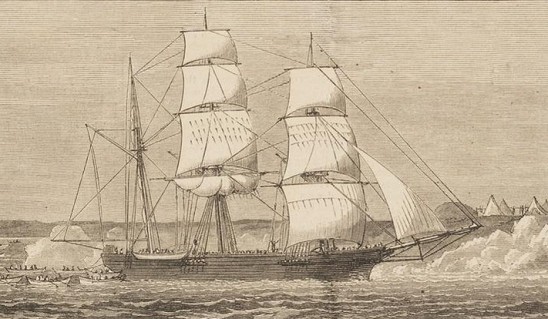
Detail –"Escape of the Bark Florence" (Captain R. H. Kelley) |

|
|
WRECK OF WHALERS.
Twelve Boats Lost in the Arctic Ocean. A TERRIBLE STORY OF ICE-BOUND CREWS. San Francisco, Cal., Oct 21, 1876.
The whaling bark Florence arrived this afternoon from the Arctic Ocean with 100 men on board, being a part of the crews of the Arctic whaling fleet, twelve of which she reports lost in the ice with a portion of the crews. The remaining survivors have gone to Honolulu on the bark Three Brothers. The following is a synopsis of the written report of the masters of the fleet: – On our arrival in the Behrings Sea we found plenty of ice and extreme weather, and but few whales were taken in the first part of the season. We commenced taking walrus on June 1, and the vessels engaged soon got all they had casks for. Between the 20th of July and the 1st of August the ships worked over to the east shore and so north toward Point Barrow as fast as the ice opened. The bark Arctic was crushed by the ice on July 7, off the Sea Horse Islands, eighteen miles from the bend. escape of the crew.
The crew escaped to the shore, and finally were taken on board by the bark Onward, and subsequently distributed among the fleet, Captain Whitney going on board the bark Rainbow. About the 1st of August the fleet, fourteen in number, reached Point Barrow. The Northern Light and Norman remained south walrusing and escaped the disaster that followed. We had to stand from Point Barrow several times, owing to the ice standing on shore. August 14. – A breeze from the north and northwest broke up the ice. Whales made their appearance and soon all the ships were actively engaged northeast of Point Barrow. The wind held from the west to north east until the night of August 16, when it began blowing fresh from east northeast. drifting with the ice.
All the ships stood in shore and anchored to avoid drifting ice. On the evening of the 19th the wind increased and hauled to the north, bringing the ice on shore, and we all ran under the south side of Point Barrow, where we found a lee for four hours, but on the next morning were obliged to run south as far as Cape Smith. The Rainbow and Three Brothers remained at Point Barrow for the next three days. The whales were numerous at Cape Smith and the vessels were busy taking them. In the meantime a wind set in from the west, which caused an uneasy feeling. The space occupied by the vessels extended seven or eight miles off the shore, running parallel with the land south. This kept steadily closing. On the 23d the wind freshened from west northwest, and all the vessels except the Rainbow and Three Brothers, who were still anchored at Point Barrow, were surrounded by a drift of ice and beat to the southwest. In the afternoon the wind began hauling south of west, but we still hoped, before the ice closed on us, to reach the open sea or at least the Seahorse Islands, where we could find shelter. At sunset the ice stopped our progress. a thick fog.
On the morning of the 24th a thick fog set in. At this time the heavy ice packed and reached along the whole coast. About two miles to leeward the ships were all lying in an open strip of water. Between that and the shore the Clara Bell lost her rudder, when she ran near the shore and anchored. The ice closed around her, and a large berg grounded south of her and formed a breakwater, behind which she lay. The bark Florence drifted up to Cape Smith and got under the lee of the grounded iceberg, which proved her salvation. The ships Josephine, St George, Cornelius Howland and barks Camilla, James Allen and Onward were enclosed by pack ice during the afternoon and drifted rapidlv to northeast between the Woodyard Refuge inlets. The ship Marengo, under all sail, got within three or four ship-lengths of open water when the ice closed on her. As we neared Point Barrow the current slackened, and for two days we drifted slowly. The Rainbow and Three Brothers, under Point Barrow lay, in comparative safety, witnesses of our distress, but were unuble to render any assistance. The Marengo, St. George and bark Acora Barns [sic] each sent a boat ashore, intending to follow with others, containing provisions and supplies in case of disaster, but owing to the ice starting afresh, were unable to do so. On the 26th the first officer of the Three Brothers, with a boat's crew, took the wife of Captain Hackmott off the bark Acora Barns [sic] to his ship for safety. fourteen men lost.
The next day the St. George's men attempted to haul a boat ashore over the ice, bnt were caught in a fog. Thirteen of them got on board the Rainbow and Three Brothers and the others regained the ship, except one, who perished. Next day the thirteen men tried to get back to the St. George, but never reached here. Eleven were rescued by Captain Owen, of the Three Brothers; the others were frozen to death on the ice. The prospect was now very gloomy, the ships being held helplessly in the ice and drifting rapidly to the northeast. August 28 reached the end of the bank, and the current changed to east. The ships at Point Barrow were no longer visible, and the situation was worse than over, the only hope being an easterly gale. August 29 found ourselves off Point Targent. The crew of the Marengo attempted to got ashore, but returned unsuccessful. a council held.
The next day the masters held a council on the Java, and concluded there was no further hope of saving the ships, some of which were already badly ripped by the loe. This was only a touch of what might be expected. The ships altogether had about three mouths' provisions, not enough to last through the winter. After a full discussion, and seeing no way out of the difficulty, it was decided that the only way to save the lives of all was to reach the land before escape became impossible. September 5 was the day chosen for starting. The ships were twenty or thirty miles from land and abreast of the west head of Smith's Bay. September 5, all being ready on board the C. Holland [sic], St. George, Marengo, Desmond, James Allen, Acora Barns [sic] and Onward, the signal for departure was given. The boats had been put in the best possible condition. The baggago consisted of about twenty-five days' rations of bread and meat and a change of clothing and a blanket for each man. Everything elso but guns and ammunition was left on board. The main hope was to find open water enough inside of the ground Ice to navigate the boats southward and so reach the two ships, which were supposod to be outside of the pack. We left at three o'clock P. M. We would first carry the baggage a half mile or so ahead, then return and drag the boats along. The ice was very rough in places, and many holes which would not bear the weight of a man were encountered. Many of the men fell through and suffered much from cold. The first night we camped on the ice about four miles from the ships The next morning we resumed the march in a blinding snow storm from the northeast. The prospect was most discouraging. Several of the men deserted and returned toward the ships, where numbers of the crew remained who refused to face the hardship and journey toward the land. Of their fate we know nothing. On September 6 we reached a strip or open water, when we launched our boate and pulled toward the land. All that day and the next we kept working through and over the ice, and at eight o'clock P. M. made land two miles west of Point Targent. We continued working along the shore and at noon on the 9th sighted the Three Brothers and Rainbow at Point Barrow, and reached them hefore night. We found the ice all sold beyond tne the only chance of escape was to drag boats overland to the open sea, a distance, as afterward proved, of 130 miles. We mado sleds and attempted the journey, but on reaching Cape Smith we found the bnrk Florence there. After consultation It was deotded that any effort to proceed would be madness. and preparations were commenced for wintering as best we could at Point Barrow. The boats were prepared for whaling, as that was the only resource for our food, and work was commenced on the house. On the night of September 13 the ice began to break up before a strong east wind, and on the next day the Florence waa able to get under way. All hands, with the baggage, were put on board, ran down the coast and found the Clara Bell frozen fast in the ice. The Captain said he would stay by her til the 17th, when, if there was no prospect of getting out he would leave In the boats for clear water, where the Florence was to wait for him. Made Sea Horse Island that night, the next night made Wainwright's Inlet. Waited there for the crew of the Clara Bell and to get water./p> On the afternoon of the 18th the Threo Brothers and Rainbow, which had escaped from Point Barrow, joined the former, bringing the crew of the Clara Bell, which remained fast in the ice, with no hopes of getting out. A part of the people in the Florence were then put on board the Three Brothers and a rendezvous appointed at St. Lawrence Bay, where they would stop for water. Both arrived there on the 23d and left next day for San Francisco, the Three Brothers for Honolulu. the abandoned vessels.
The following Is a list of the abandoned vessels: – Barks Onward and Clara Bell, San Francisco; ships St. George and Marengo, and barks Cornelius Holland,[sic] James Allen and Java. New Bedford; ship Camilia aud barkentine Josephine, Boston; bark Acors Barnes, New London, and the Hawaiian barks Desmond and Arctic. The vessels had on board altogether 1,000 barrels oF oil, besides a largo amount of whalebone and ivory. It Is the undivided opinion of every master that no hope can be obtained of the rescue of the ships or those who remained on board of them. All are undoubtedly lost and carried away to the northeast in the immense icepack, which closed them in for miles around. W. H. KELLY, Master Marengo. |
|
Source.
"Wreck of Whalers"
This transcription used images from
The Library of Congress' Chronicling America..
Last updated by Tom Tyler, Denver, CO, USA, Jan 23, 2026
|
|

