|

CRUSHED AMONG ICEBERGS. |
** [Click on image to enlarge.] |
CRUSHED AMONG ICEBERGS.
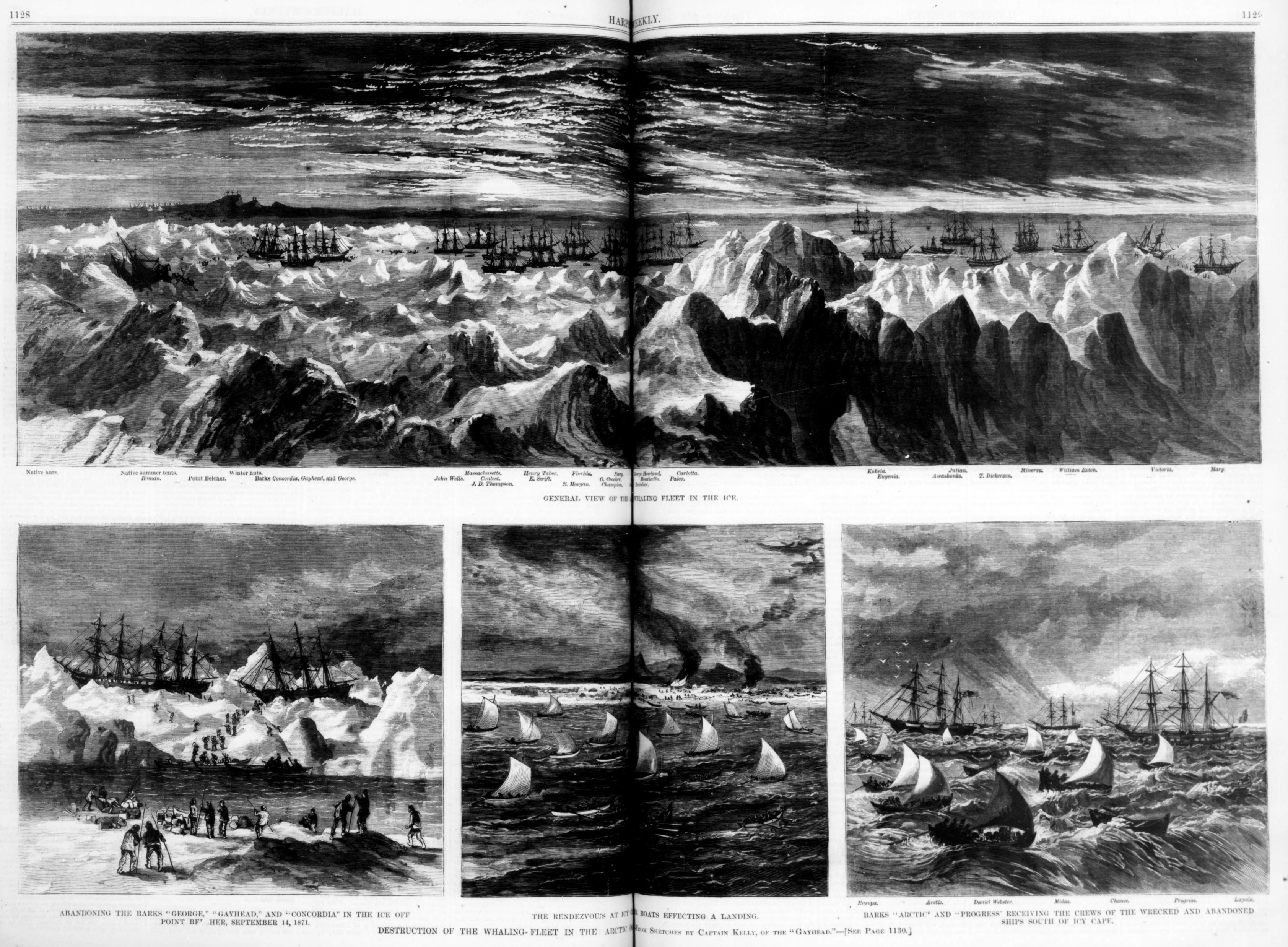
Of the arctic whaling fleet, forty in number, which proudly sailed on their perilous voyage from San Francisco and Honolulu last season, thirty-three have been crushed in the ice, and their crews have barely escaped with life through many hardships and perils. The tidings of this catastrophe were brought to Honolulu on the 23d October; and on that and the following day no fewer than 1200 shipwrecked mariners were landed upon the Hawiian shores. The particulars of this crushing blow to the whaling enterprise of America may be gathered from the following details, supplied to us by Mr. Thomas G. Thrum, of Honolulu, to whom also we are indebted for the several graphic sketches of some of the frighful situations of the fleet and its distressed crews which appear in our opening pages this week. Early in May the whalers arrived at the south of Cape Thaddeus, where they found the ice; but it was so closely packed that they were unable to make much headway northward, and the wind was strong from the northeast for most of the month. June commenced with light and variable winds and foggy weather, but the ice opened somewhat, and the ships made up in sight of Cape Navarine, where five or six whales were taken, and many more were heard spouting among the heavy ice, but they soon left. Toward the middle of June the ice opened, enabling the fleet to pursue their way north, picking up a few whales in crossing the Anadir Sea. When the ships made Cape Behring, the whales had mostly passed through the straits; the fleet had also passed through by the 30th June. They now commenced catching walrus, but with small success in comparison with former seasons. In the latter part of July strong winds prevailed from southeast and northeast, breaking up the walrus hunting; so the fleet pressed to the north-east for Icy Cape. Finding the ice disappear from the east shore south of Cape Lisburne, the fleet pushed to eastward, following the ice, the main body of which was in latitude 69° 10’, in to the east shore, where they found a clear strip of water running along the land to northeast, and in this water the whalers worked up to a few miles off Icy Cape. Here some of them anchored, being unable to proceed further through the ice lying on Blossom Shoals, the wind at the same time blowing strong from the northeast. the wind moderated, and the ice started off the shoals about the 6th of August. In a few days most of the fleet reached north of Blossom Shoals, and the weather being favorable, they worked up to northeast, making Wainwright Inlet, where they captured a large number of whales, though many more were lost, the ice being very heavy and densely packed; but notwithstanding this, the prospects appeared good, and promised a large season's catch. The ships all anchored or made fast to heavy ground-ice, and whaling was continued smartly for several days, when, about the 11th August, a large number of the boats that had been cruising in the open ice were caught in it by a shifting wind setting the ice on shore. This wind was from the west, and the ships were compelled to get under way to save themselves from being jammed. They worked in-shore under the lee of the ground-ice, and it was only with the utmost difficulty that they succeeded in saving the boats, having to haul them for long distances over the ice, which now set steadily on shore; and, to avoid being stove, the ships got into shoal water. On the 13th the ice stopped, having at last grounded, leaving an open space of water along the land up to Point Belcher. The boats were kept off whaling continually, and plenty of whales were heard and seen among the heavy ice, but were inaccessible. Up to the 25th of August the ships remained safely anchored and tied up to the ice, waiting for a strong northeaster to open up the ice off the land. On that day a strong northeast gale set in, and the ice opened and went off shore. On the 27th the weather was good, whales plentiful, and many were taken: and as it was considered that the ice was going off permanently, the ships all got under way, and began whaling in earnest. They had fine weather and light, variable winds on the 28th; but on the 29th a southwest wind, light in the morning, freshened so toward the evening that the ice set inshore, and caught some of the ships in the pack, while the rest barely succeeded in retreating inshore ahead of the ice, where they anchored in from three to four fathoms of water, the ice still coming in, and small ice packing round the ships. By the strong current which ran to the northeast the large, heavy floe-ice grounded in the shoal water, and inside of this many of the ships lay, while those which could not get in kept working in, as they found it possible, to prevent staving. Storms and winds from south to northwest, with snow, now visited the devoted vessels, many of which were so close together as not to have room enough to swing clear of each other. And now a series of disasters began, which culminated in the almost total destruction of the arctic whaling fleet. On the 2d of September the brig Comet was completely crushed in the heavy ice, her crew hardly escaping to the other vessels. The ice, too, began to set on shore heavily, and the open space of water becaitie gradually narrower, and the possibility of the vessels getting out grew less and less. Still our brave Mariners cherished strong hopes that a northeast gale would yet open a way for their passage. Indeed, though dav after day went without any sign of the ice opening, the brave men were more anxious about the loss of time than their apparent danger – so unwilling were they to believe that the ice would not go off shore, as in all their former experience it had done under similar circumstances. Nothing, however, could be viewed but ice off shore to the utmost range of vision, and the only clear water to be seen was that inshore, and which had become narrowed to from two hundred yards to half a mile wide, where the ships were lying, some packed in the ice, others in open water extending from Point Belcher to about two or three miles south of Wainwright Inlet. The wind continued from southeast to southwest, always light from southeast, and fresh from southwest, causing the ice to pack more closely together every day. On the 7th the bark Roman had been crushed by the ice. She had been caught while cutting a whale, and had drifted helplessly with the ice so far as Sea-horse Islands, and was there caught between two immense floes of ice, one of them being aground, and the other, a tremendous floe of several miles in length, thundered against the fated vessel from off shore, crushing her to atoms. The officers and crew fortunately escaped over the ice to the other ships, saving hardly any thing but their lives. These several disasters were alone enough to strike the fleet with consternation, but worse was slowly but surely approaching; and on the 8th the fleet beheld the bark Awashonks shattered between the stupendous floe and ground ice, and again received a fugitive crew who had lost their all. The jeopardy in which they were situated now forced itself upon the gallant mariners; and as the season was rapidly advancing toward its close, and the ice increased daily in the open water, the danger of being frozen in seemed imminent. The masters all met to consult upon the situation, and arrange some means for the rescue of their crews, in the event of its becoming impossible to remove the ships from their pent-up position. The masters concluded to make preparations for the final escape, but indulged in sanguine hopes that the ice would yet open, and obviate the necessity for abandoning the ships which were so dear to them. In the first place, they lightened the brig Kohola, to get her over the bar at Wainwright Inlet, on which there was five or six feet of water. Her oil and stores were then landed on the deck of the Charlotte, of San Francisco, but the Kohola was then found to draw nine feet of water. After taking her down the coast close to the beach, an attempt was made to take her over the shoal water, but unsuccessfully, on account of her draught, and the project had to be given up. Then an expedition of three boats was fitted out and went down the coast, under the command of Captain D. R. Fraser, who succeeded in finding the vessels Arctic, Progress, Midas, Lagoda, Chance, Daniel Webster, and Europa, which had kept out of the ice, and he found their masters willing to stay and wait for the crews of the distressed vessels as long as their anchors would hold out. Indulging in their cherished hope that the ice would yet open and let them out, the masters and crews remained steadfast to the distressed vessels, and Captain Redfield, of the brig Victoria, repeated upon his vessel the experiment whick had been tried upon the Kohola, but without effect. As on the night of the 9th September the clear water round the ships began to freeze over and the weather became calm, it was deemed well to lose no time in forwarding supplies of provisions to the vessels waiting in the south before the passage by boats was cut off by the ice, and so compel them to travel on the ice to those vessels. The boats were coppered round the bows to protect them from damage by the ice, which had already accumulated in the open space, and the provisions were sent south. This measure was adopted with much reluctance by the brave hearted men, because it appeared so much like an ultimate abandonment of their vessels, and that was a thing hard for them even to entertain Still they knew that in case their ships escaped the destruction then impending, those provisions could be reconveyed to their vessels; and it was this reflection that buoyed them up in their sad task, and they "hoped against hope" to the very last. After waiting what was to them a long, dreary while, until the 15th September, another meeting of the masters took place, when the painful conclusion was arrived at that in order to save the lives of their crews they would be obliged to abandon their vessels, as it was quite impossible to winter there, the supply of provisions being insufficient for three or four months, which is less than a third of the length of winter in those regions. The masters also concluded that as the ships lay in the open sea, exposed to the weather, the probability was strong that they would all be destroyed by the ice, although they were ready to stay any length of time by their ships that they could exist upon the provisions, if sure of a vessel to take them off in the last extremity. Consider the case as they would, they could not see any prospect of saving the ships if they staid by them, and unless they made their escape while they could do so, starvation and death seemed the only alternative. Accordingly, with heavy hearts, and feelings which none but those who have been similarly situated can describe or realize, all the ships’ companies, at the preconcerted signal – colors set at the mast-heads – got ready to leave their vessels on the 14th; and on that day at four p.m. every ship’s company had left their vessels and proceeded on their way south, carrying only such provisions and clothing as were positively needful. During their progress southward they found that the ice had increased to an extent greater than they had imagined, and felt satisfied that, even though they had succeeded in taking the brigs over the bar at Wainwright Inlet, they would never have got them into the clear water in the south. On the night of the 14th they camped on the beach, and at daylight on the 15th they went on their way to Icy Cape, the wind blowing strong from the south. When they came in sight of the waiting ships they were indeed grateful to that Providence which had guided them, and preserved means for their rescue from the frightful perils and hardships through which they had passed. They experienced great difficulty in getting off to the ships, owing to the rugged sea and necessarily deep loading of the boats. The Arctic, Midas, and Progress each lost an anchor in trying to hold on to receive the crews who went on board the seven vessels then standing by for the rescue, as promised to Captain Fraser. The boats were cut adrift, as the crowded state of the ships precluded them from saving one of them. On the 16th September – the last boat's crew having been taken on board – the seven vessels weighed anchor, the wind blowing strong from northwest, and proceeded southwest for Plover Bay, where they touched, and took in water and wood sufficient for the vovage to the Hawaiian Islands. They reached Plover Bay on the 24th, and sailed thence the 25th September for Honolulu. The distance traveled by the boats after the abandonment, until reaching the rescuing vessels south of Icy Cape, was about seventy miles; the ice to seaward being one compact mass, and the water along the beach being a very narrow strip, for the entire distance very shoal. |
|
Source.
"Crushed Among Icebergs"
This transcription used the images at the
Internet Archive.
Last updated by Tom Tyler, Denver, CO, USA, May 21, 2025
|
|

