|

|
|
P. C. ADVERTISER
SUPPLEMENT
Saturday, Oct. 28, 1871. [From our Extra, October 23.] From the Arctic  Immense Destruction of Property. A Crushing Blow to the Whaling Business. 33 Ships Lost! 1000 Shipwrecked Seamen! Circumstantial Account from Ship Masters.
By the arrival Monday, Oct. 23, of the Hawaiian whaling bark Arctic, Captain Tripp, we are in receipt of truly disheartening news from the whaling fleet lately cruising in the Arctic Ocean. The greater portion of the fleet, numbering over thirty vessels, has been caught in the ice, and hopelessly crushed or held fast so that they had to be abandoned. Fortunately, the weather was such that all the crews were safely got on board the vessels which were outside the pack, although in some instances, the utmost expedition had to be used to save life. In the case of the Roman, as described to us by one of her company, the sight must have been fearfully interesting. The floe caught the ship on each side, and lifted her up bodily, keel out. Relaxing its grip for an instant, the ship settled between the icv jaws of the floe, when coming together again, she was crushed like an eggshell, into atoms, and as the spasmodic relaxation again occurred, she disappeared, leaving not a vestige of the lately noble vessel in sight, forty-five minutes from the time the ice first closed upon her. It is an open, question as to whether any of these ships will be found on the return or spring, in a condition to be saved. It was considered probable that in the first northerly gale, they would all be destroyed by the moving heavy ice. Besides, the natives, who are numerous in the neighborhood, would without delay, strip them of everything moveable. For the following circumstantial and highly interesting account of this great disaster, the effects of which will be severely felt in the homes and business circles of the East, as well as here and in San Francisco, we are indebted to Captains Tripp, of the Arctic, Kelley of the Gay Head, Allen of the Minverva, Bliven, of the Eliz. Swift, Loveland, of the Reindeer, Nye, of the Eugenia and Newbury, of the Paiea. About the 1st of May, 1871, the whaleships began to arrive at the ice south of Cape Thaddeus. They found plenty of ice, and closely packed so that they make but little headway to the north. The wind blew strong from the northeast most of the month of May. About the 1st of June the ice opened some and let the ships up in sight of Cape Navarino. Here five or six whales were taken; a good many were heard spouting amongst the heavy ice, but they soon left. The fore part of June, the winds were light and variable with a good deal of fog. About the middle of the month the ice opened and the fleet pushed to the north. A few whales were taken and picked up in crossing the Anadir Sea. By the time the ships got to Cape Bhering and Plover Bay the whales had all passed through the straits. The bark Oriole was stove and put into Plover Bay to try and repair. The fleet passed through Bhering Straits between the 18th and 30th of June, some of them taking on board the crew of the Japan, which was wrecked at Cape East last fall, not seeing any whales and finding large quantities of ice. The whole fleet now engaged in catching walrus; these were very shy and scarce in comparison to former seasons, the boats frequently going 15 or 20 miles in the ice to get them; there was a good deal of fog in June and July, while they were walrusing. and also large bodies of ice. The east shore being unapproachable until the very last of July. The latter part of July they had some strong winds from S. E. and N. E. This broke up the walrus fishing, and the fleet now pushed to N. E. for Icy i Cape. The ice began to disappear from the east shore south of Cape Lisburne; the fleet pushed on to eastward, the main body of ice being in about Lat of 69° 10' or 15'; they followed the ice into the east shore; they found a clear strip of water running to N. E. along the land. In this clear water, they worked up to within a few miles of Icy Cape, and some of them anchored, not being able to proceed any further on account of the ice lying on Blossom Shoals; at this time the wind was blowing strong from the N. E. for several days. On the 6th of August the wind moderated and the ice started off the shoals. Several ships got under way and passed the shoals, and in a few days the most of the fleet were north of Blossom shoals. The weather was good, and they worked to northeast as far as Wainwright Inlet; here they found whales, and a number were taken at once, but the ice being very heavy and closely packed, a great many were lost. Still the prospect looked very favorable, and hopes were entertained of making a large season's catch. All the ships either anchored or made fast to the heavy ground ice. Whaling was now carried on briskly for several days, the boats cruising among open ice, but on the 11th of August a large number of boats were caught in the ice by the wind shifting, and setting the ice on shore. The wind was from the west, and the ships were obliged to get under way to keep from being jammed in the ice, and work in shore under the lee of the ground ice. With considerable difficulty they succeeded in saving their boats by hauling them a long distance over the ice, some of them being badly stove by so doing, but they were all saved finally. The ice kept setting on shore steadily; and the ships kept fleeting into shoal water to avoid being stove, and some of them grounded, but were easily got off again. On the the 13th the ice stopped, having grounded, leaving an open strip of water along the land as far as Point Belcher. Boats were kept off whaling every day. They saw and heard plenty of whales among the heavy ice, but could not get to them at this time. They had a great deal of fog at times, clearing off for a short time. All this time the ships were lying safely anchored and tied up to the ice, waiting for it to open off the land, as they expected it would the first strong northeast wind that blew. In the mean time reports were brought of plenty of whales being seen off Sea Horse Islands, and several ships sent boats up there with orders to catch and cut the whales on the ice, (they carrying everything necessary for so doing,) and tow the blubber to the ships, as there was no chance to get there with the ships, on account of the ice and shoal water. Four whales were taken in this way, after a great deal of labor and hardship in sleeping out on the cold shore and among the ice. On the 25th Aug. it blew a strong N. E. gale, and the ice opened and went off shore. On the 27th had good weather, whales were quite plenty, and a number were taken. The ships all got under way, and stood off shore and commenced whaling, every one thinking the ice was going off for good, and every opportunity was taken advantage of to catch whales. On the 28th, fine weather and light variable winds. On the 29th, light southwest winds, which freshened towards the latter end of the day, setting the ice in shore so fast that some of the ships were caught in the pack. The rest retreated in shore ahead of the ice. Here they anchored in from 3 to 4 fathoms water, the ice coming in and the small ice packing around the ships. By the strong current running to the N. E. the large heavy floe ice grounded in the shoal water; inside of this the ships lay, or at least the most of them, and those who did not get in kept working in as they had a chance, to keep from being stove. At this time it began to snow and they had several storms and winds from S. to N. W. Here they were all jammed close together, some not having room to swing clear of each other. On the 7th of Sept. the bark Roman was crushed by the ice. She having got caught while cutting a whale. She drifted helplessly with the ice as far as Sea Horse Islands, and was there caught between two heavy floes of ice, one of the floes was aground, and an immense floe of several miles in extent came against her from off shore, crushing her like an eggshell in 45 minutes. She sunk head foremost leaving her mizzenmast and her stern out of water, the ice having held her up until it separated. The Captain, officers and crew escaping over the ice with the boats, and not saving scarcely anything, except the clothes they had on. The crew were received on board the other ships. On the 2d Sept the brig Comet was crushed in the heavy ice; her crew were taken on board the other ships, and cared for. It now became evident that the ice was setting on shore very heavily, the open strip of water became narrower every day, and no possible chance to get out. Still no one thought there would be any difficulty of getting out the first N. E. gale. On the 8th of Sept. the bark Awashonks was crushed between the heavy floe and the ground ice. Her crew were also received on board other ships. As day after day passed and no signs of the ice opening, the masters of the ships became anxious about the loss of time, as the season was passing away. They were unwilling to believe that the ice would not go off shore, as all their former experiences it had done at this time of the year. Nothing would be seen but one solid body of ice off shore as far as the eye could see, except the narrow strip in shore which was from 200 yards to half a mile wide. The ships were lying, some jammed in the ice and some in open water, all the way from Point Belcher to 2 or 3 miles south of Wainwright Inlet. 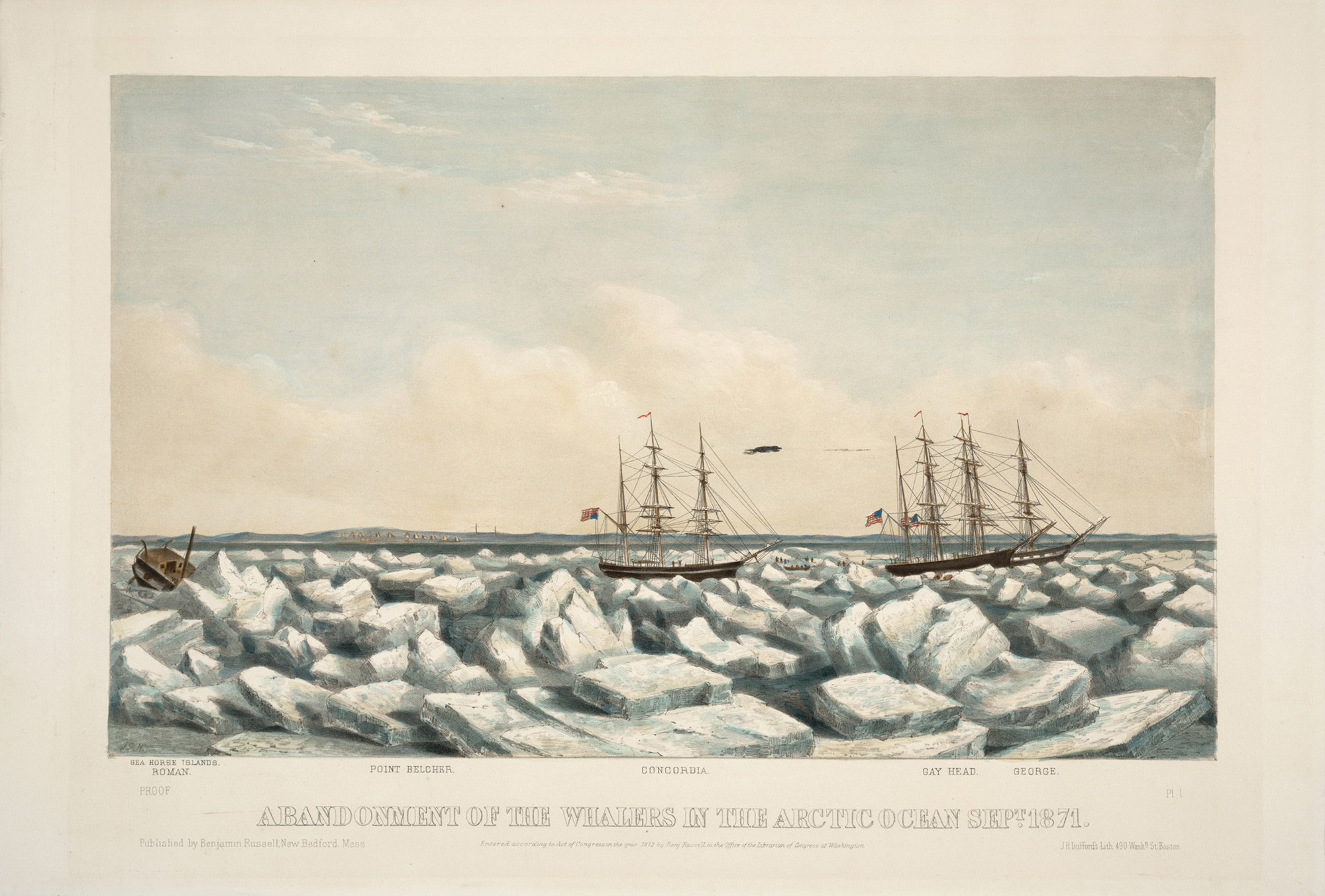
Pl.1: Abandonment of the Whalers in the Arctic Ocean Sept. 1871. [Click on image to enlarge.] 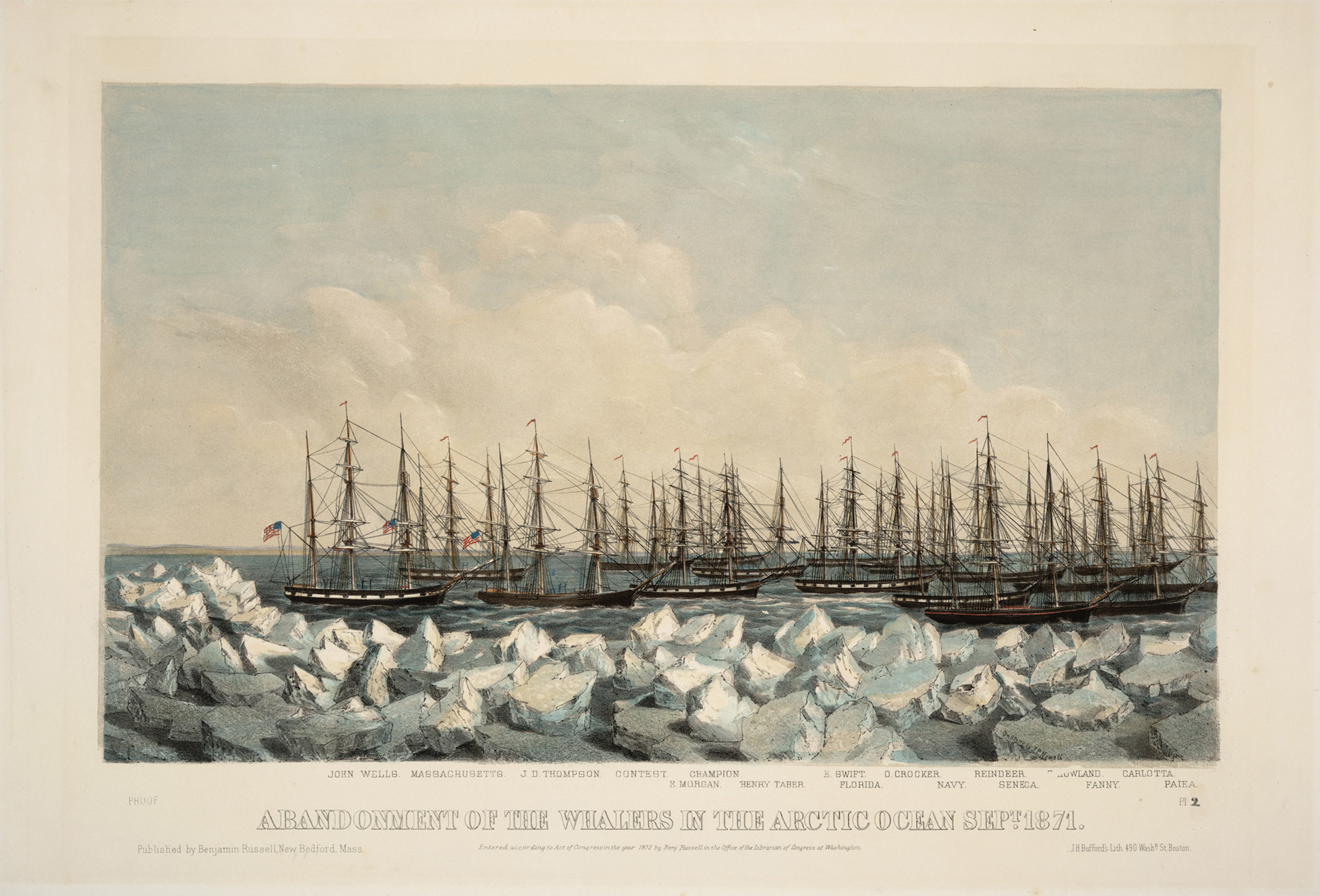
Pl.2: Abandonment of the Whalers in the Arctic Ocean Sept. 1871. [Click on image to enlarge.] 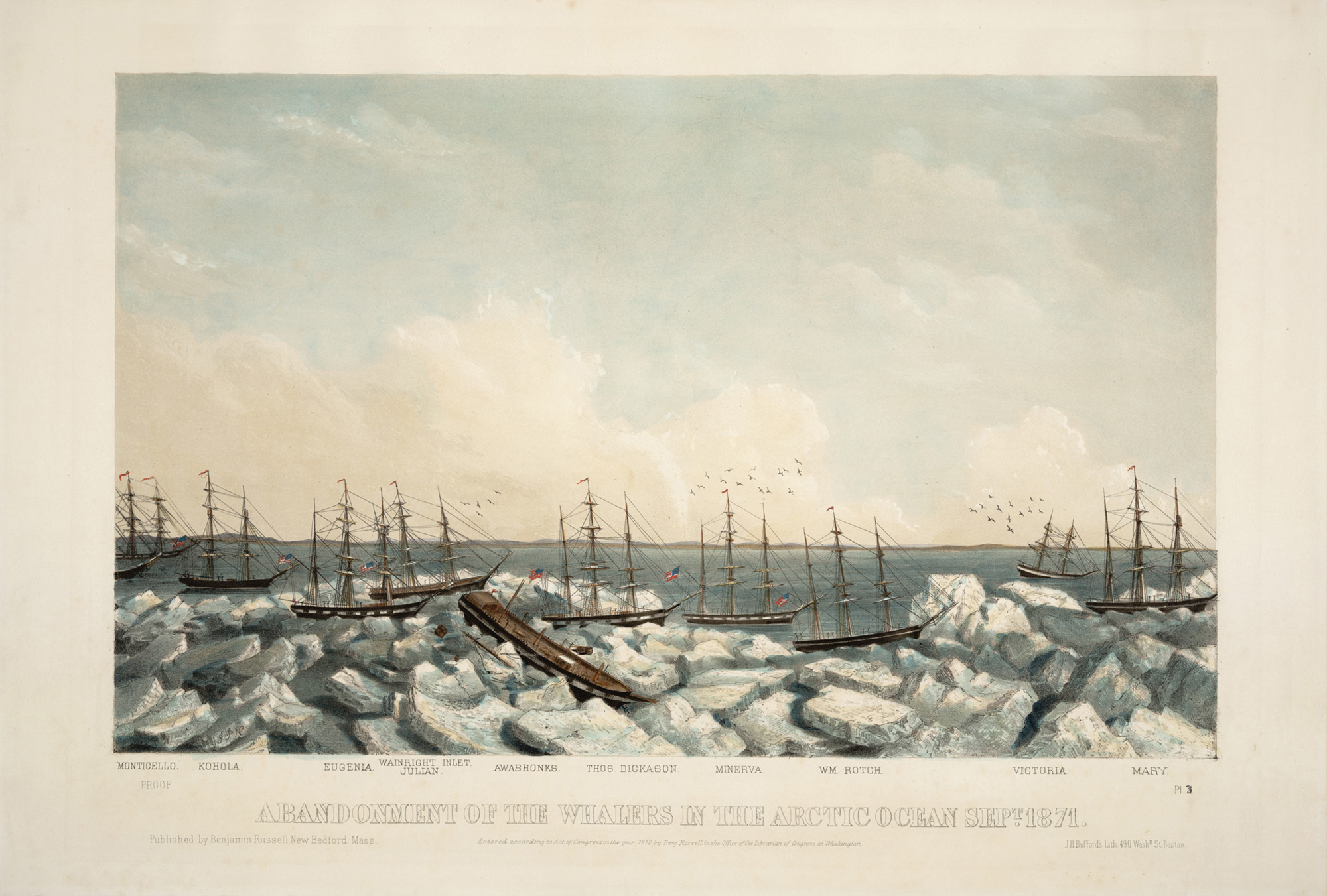
Pl.3: Abandonment of the Whalers in the Arctic Ocean Sept. 1871. [Click on image to enlarge.] During all this time, every one was expecting a N.E. gale, but instead the wind continued from S. E. to N. W., always light from S. E. and fresh from S. W. This kept the ice packing together more closely every day. The Masters of the ships now became seriously anxious about getting out of this perilous situation. The danger of their situation was apprent to every one, and as the season was advancing, there was great danger of being frozen in, as the ice was making daily in the open strip of water. Notice was now given, and a meeting was held by all the masters, in order to concent some measures for the safety of their crews, in case they found it impossible to escape from their dangerous situation. It was decided to lighten the brig Kohola, and try to get her over the bar at Wainwright Inslet, on which there was 5 or 6 feet of water. This was done. She was hauled alongside the Charlotte of San Francisco, and her oil and stores landed on her deck, and she was then found to draw 9 feet of water. However, she was taken down the coast in the narrow strip of open water, close to the beach, and an attempt made to get her over the shoal water. This they found to be impossible, as she drew too much water, and this was given up. At the same time an expedition of three boats was fitted out under the command of Capt. Fraser, to go down the coast until they came to the open sea, and then to try and find any of the ships which might have got out of the ice, or kept out, as it was known there were seven vessels to the south. This was deemed expedient, as they were afraid that they would leave the east shore and go to the westward, and so remain in ignorance of the situation of the rest of the fleet. He succeeded in finding the barks and ships Arctic, Progress, Midas, Lagoda, Chance, Daniel Webster, and Europa, and the Captains of these vessels at once expressed their willingness to stay and wait for the crews of the distressed ships, as long as their anchors would hold them. Still hoping the ice would open and let them out, in the meantime Captain Redfield of the Brig Victoria tried to get his vessel over the bar by lightning her, but without succeeding. On the night of the 9th of Sept., the weather was calm, and the clear water around the ships froze over, and it was with great difficulty that a whale boat could be got through it. The boats had to be coppered around the bows to keep the ice from cutting through the planking. No time was now lost in sending provisions by the boats to the south, as they were apprehensive that their retreat by the boats might be cut off, and it might be that they would be obliged to travel by land to where the ships were anchored. It being well known among every ship's company that there waa not provisions enough to last over 3 or 4 months at the most. In case the ships escaped from the ice these provisions could be taken on board again, for all hoped against hopes to the last. It was hard to entertain any thoughts of leaving their ships, there being no harbor where they could winter, even had they provisions enough to do. And more, they knew that if the ships did not get out they would either be crushed or driven ashore by the ice the first northwest gale. On the l3th of September another meeting was held by the Masters, the painful fact having forced itself upon the mind of every one, that in order to save the lives of their crews they would have to abandon their ships. None but those similarly situated could tell how difficult it was for them to arrive at this painful conclusion, and to winter was utterly impossible, as their provisions would not last one third of the winter, which is nine months in duration in these latitudes. And then to what purpose could it be done, as there was no place of safety for the ships; had they been in a harbor some of the crews might have been left to take care of them, and keep the natives from destroying them. But as they lay in the open sea exposed to every storm, the chances were that they would all be destroyed by the ice. Under these trying circumstances they were forced to come to the conclusion to abandon the ships to save their lives, and the colors were accordingly set as agreed on – at the mast-heads – to notify all the ships companies to get ready to leave on the 14th of Sept. The Masters of the distressed vessels knew if they were caught by the bad weather, the chances were that they would never get back again, after being blown off. Thus, although they were ready to stay any length of time by their ships as long as they could be sure of a ship to take them off at the last moment, and that time had now arrived, and as every one regretted leaving their ships, still there was no alternative. Starvation and death awaited them should they be obliged to stay accordingly, boats were loaded with such provisions and clothing as were absolutely necessary, and by 4 P. M. every ship's company had left, and were on their way south. As they made their way down the coast they found the ice much worse than they had any idea of, and a great deal of shoal water besides, so that even if they had succeeded in getting the brigs over the bar at Wainwright Inlet, they never could have got them in the clear water south! At night they camped on the beach, and at daylight on the 15th, they proceeded on their way to Icy Cape; it blew strong from the south, and when they came in sight of the ships they found considerable difficulty in getting off to them, as the boats were loaded deep and the sea rugged. The bark Arctic Midas and Progress, lost each an anchor in trying to hold on to take them on board, they were very kindly received on board these ships – seven in number as before mentioned. The boats were cut adrift, as it was impossible to save them, the ships being so crowded. On the 16th, tne last boats, crews were taken on board, and the wind blowing strong from NW, they weighed anchor and steered to SW, it having been agreed between the Captains of the ships to proceed to Plover Bay, and there get water and wood to last them on the passage to the Sandwich Islands. This was done by five of the ships, the Arctic, Progress, Midas, Lagoda and Europa, which arrived there on the 24th, and sailed again on the 25th. 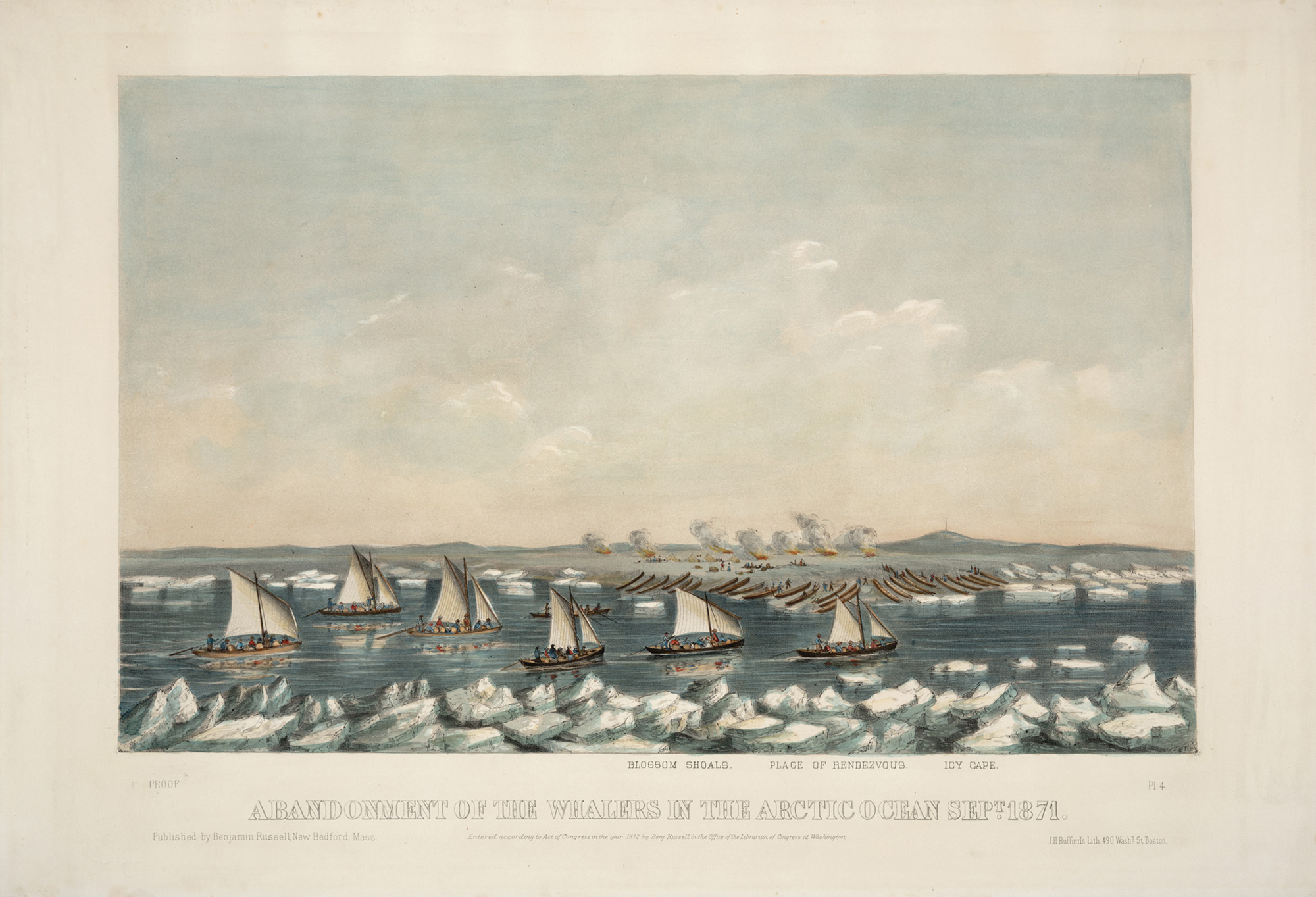
Pl.4: Abandonment of the Whalers in the Arctic Ocean Sept. 1871. [Click on image to enlarge.] 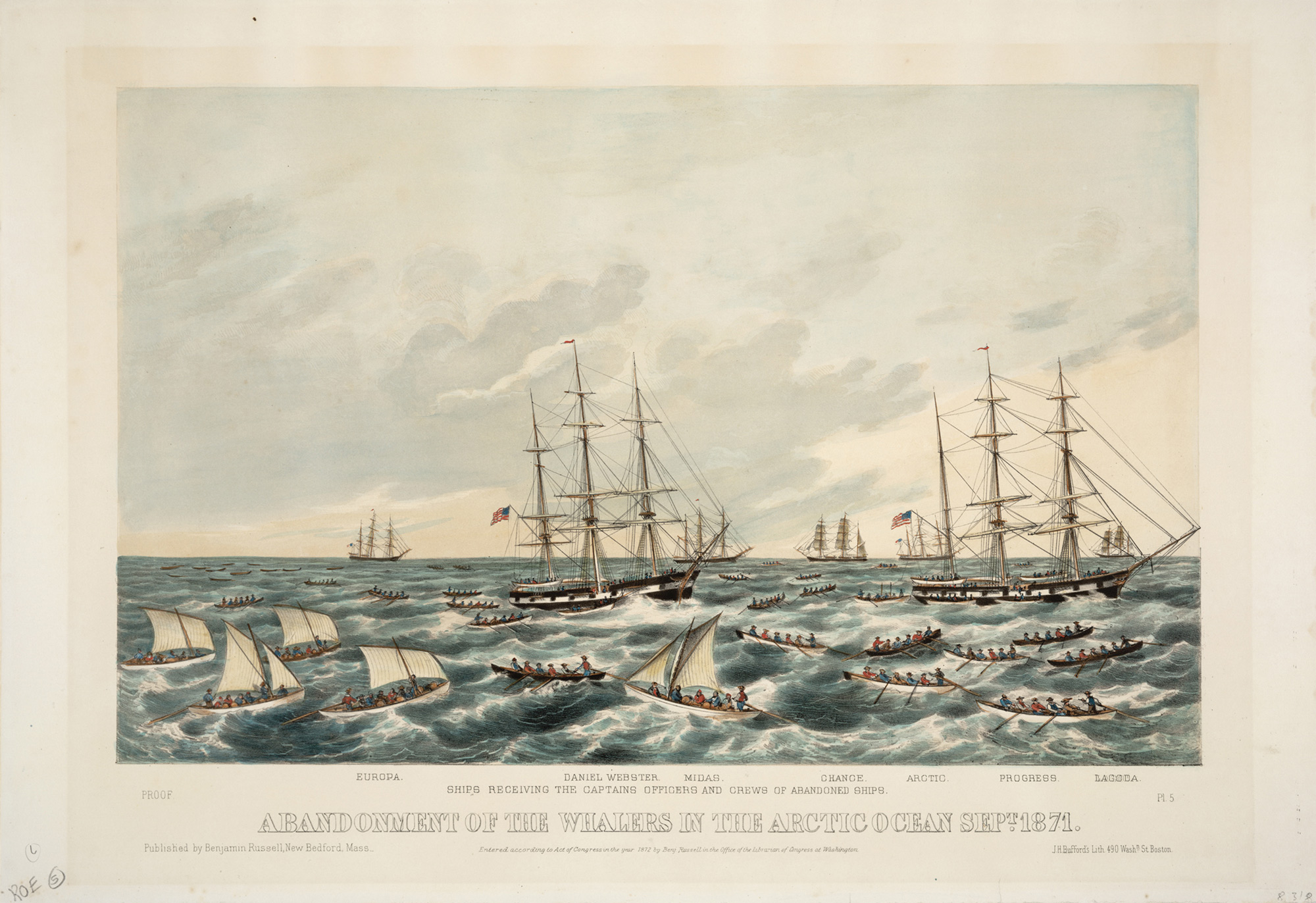
Pl.5: Abandonment of the Whalers in the Arctic Ocean Sept. 1871. [Click on image to enlarge.] The distance traversed by the boats after abandoning the ships before reaching the ships South of Icy Cape, was about 70 miles the ice being in one solid body all the way to Icy Cape, leaving a narrow strip of clear water along the beach – the entire distance – but also very shoal. Annexed is a list of the names of the abandoned ships and the amount of oil each ship had taken up to the time they were lost, and as they lay in rotation along the ice and land: Concordia, 650 barrels; Gay Head. 530 do; George. 300 do; John Wells, 300 do; Massachusetts, 350; J. D. Thompson, 100 sperm and 770 do; Contest, 850 do; E. Morgan, 150 do; Champion, 275 sperm and 300 do; Henry Taber, 300 do; E. Swift, 700 do; Florida, 550 do; O. Crocker, 200 do; Navy, 280 sperm and 400 do; Reindeer, 800 do; Seneca, 450 do; Fanny, 300 do; Geo. Howland, 500 do; Monticello, 270 sperm and 630 do; Carlotta, 700 do; Paiea, 100 do; Kohola, 150 do; Eugenia. 250 do; Julian, 40 sperm and 200 do; Awashonks, clean; T. Dickason. 550 do; Minerva, 130 do; Wm. Rotch, 200 do; Mary, 300 do; Roman, 650 do; Comet, 30 do. The following are the names of the vessels saved and the amount of oil taken by each: Arctic, 480 barrels; Progress, 250 do; Chance, 220 sperm and 280 whale; Daniel Webster, 250 do; Lagoda. 725 do; Europa, 330 do; Midas, 450 do, 140 sperm. |
|
Source.
"From the Arctic ..."
This transcription used the images at the
Chronicling America Historic Newspapers.
Last updated by Tom Tyler, Denver, CO, USA, Jan 14, 2026
|
|

