|
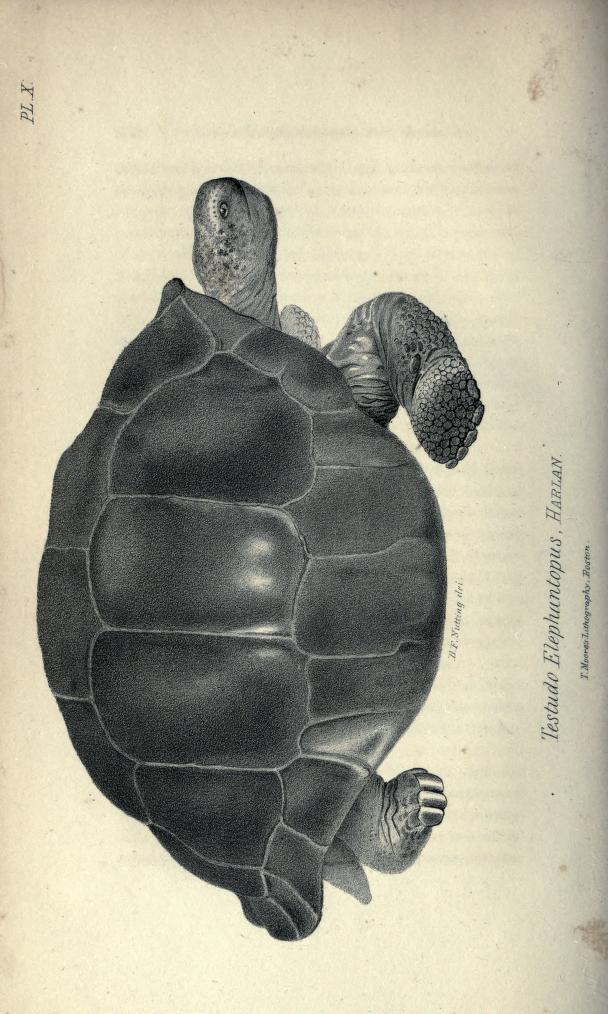
PL.X. Testudo Elephantopus, Harlan. [Click on image to enlarge.] |
. . . .
ART. XXII. – ANATOMICAL DESCRIPTION OF THE GALAPAGOS TORTOISE. By J. B. S. Jackson, M. D. Read February 1st, 1837.
In the summer of 1834, Capt. John Downes, of the United States Navy, soon after he returned from his voyage in the frigate Potomac, made a very valuable present to this Society of two large Land Tortoises. They were the largest and finest specimens out of a number brought by him from the Galapagos Islands, a small volcanic group in the Pacific Ocean, lying under the equator and about 110 leagues distant from the South American coast. One of them, which was a male, died in the course of the summer; the other, a female, lived till the weather became cold, was kept in a frozen condition through the winter, and dissected in the following spring. Both of the dissections were hastily made, but notes of each were taken at the time; and these, imperfect as they are, with a few additions which I can safely make, I would now offer to the Society The only scientific description which I have seen of this Tortoise, is by Dr. Harlan and may be found in the 5th Vol. of the Journal of the Academy of Natural Sciences of Philadelphia. The specific name elephantopus, which he has given it, is very appropriate, and is founded on a resemblance which has been noticed by other observers. He considers it as quite distinct from |
the Testudo Indica and that there is no other species with which it can be confounded. Dr. Bell, however, the author of a very splendid work on the testudinata, now in the course of publication in London, regards the two as the same species; – that it is indigenous to the Galapagos Islands, and has been casually introduced into other countries through the medium of commerce. This difference of opinion may be accounted for by the remark which has been made, that entirely distinct species are found in this group of islands Captains Porter, Delano, Basil Hall, and more recently Mr. J. N. Reynolds, have each in their popular Journals, given an interesting description of these tortoises of the profusion in which they are found, such as to have furnished a name for these islands to the Spaniards who discovered them (galapago, a fresh-water tortoise) – of their immense size, some of them weighing between 3 and 400 pounds – their being able to live without food or water for a year or more, their harmless disposition, their ungainly and even disgusting appearance, their clumsy movements and their great delicacy as an article of food, far exceeding, according to Capt. Porter, the finest green turtle. The following additional account of their habits was prepared for the Society by Mr. Reynolds, the author of the "Voyage of the Potomac," a gentleman to whom the Society is indebted for many valuable donations, and at whose suggestion Capt. Downes was induced to present to us the two fine specimens which are the subject of this paper. He says, "From the last of May to December, embracing the rainy season, the Terapin leaves the mountains and high grounds and may be found spread in all directions over the plains and low grounds near the sea, where they feed principally upon the prickly pear, and |
find water in the little lakes in the crevices of rocks. From January to May, as the dry season advances, they return again to the high ground where the trees are larger, vegetation more abundant and where springs may be found issuing from the sides of the mountains. These watering places become much frequented, and paths leading to them may be traced for a great distance along the sides of the hills; and I have seen in many places, the rocks worn away more than six feet in depth, and just sufficiently wide to allow them room to pass. At these springs hundreds of them are often seen at a time, waiting their turns to drink, or, becoming impatient, pile themselves one upon another, in their efforts to obtain water. When satisfied, they again return by the little roads hewn through the soft rocks and again disappear amid the thick underwood." The following observations were made on our own specimens External characters. The male tortoise weighed at the time of its death 302 lbs., having gained 17 lbs. during the few weeks that it was in the possession of the Society. The general outline and the form and number of the scuta are so well represented in Plate XI., as scarcely to need any description; of the vertebral there are five, of the costal four on each side, of the marginal twenty-three and of the sternal sixteen. A remarkable concavity of the sternum, which belongs to the sex, could not be well represented, neither the slight depth of the furrows between the scuta which in some places are so faint as to be with difficulty traced. Surface of the upper shell quite smooth, except near the edges of the scuta, where are seen the remains of the concentric lines, and of the lines which radiate from the angles of |
the scuta towards the centre, both of which are much more strongly marked in the young animal, as shown in two or three specimens in the Cabinet. There are, however, irregularities on the surface which are evidently the result of external injury, and correspond with a thickening of the bone beneath. Color of the upper shell deep brown, almost black; under shell has a light shade of the same color and the surface is more rough than that of the upper. Dimensions as follows: length of upper shell, following the curve, three feet nine inches; breadth of same, three feet ten inches; vertical diameter, seventeen inches; lateral, two feet four inches; circumference of upper shell, following the edge, nine feet ten inches; length of head and neck sixteen inches; of head alone five and a half inches; and breadth four and a half; anterior extremity twenty inches in length, and the posterior a very little longer; length of tail, eleven inches, and breadth at base, four; longest nail on hind foot, one and a half inches-there are five toes on the front, and four on the hind feet Weight of the female not noted, but it was not far from 240 pounds. In Pl. X. is seen a drawing made from a very correct colored view which was taken after death, but before the dissection. The color and the number of the scuta are the same as in the male; the form of the upper shell, however, is quite different, having almost a globular appearance and the sternum is much less hollowed, showing one of the peculiarities of the sex. "The lateral compression of the anterior part of the dorsal shell and the elevation of its front margin," by which some have thought the Galapagos Tortoise to be distinguished from the Indian (Proceedings of the Zoölogical Society of London, Oct. 14th 1834), was not found in any one |
of our specimens which we know to have come from the Galapagos Islands, though it is strongly marked in a small shell in the Cabinet, which otherwise corresponds with this species. Dimensions of the female as follows: length of the upper shell, following the curve, three and a half feet, breadth of the same four feet two inches, vertical diameter seventeen inches, and lateral, two and a half feet; circumference of upper shell, not following the edge seven feet two inches; length of head and neck, one foot, of head alone six inches, and breadth four and a half inches; length of anterior extremity from sixteen to seventeen inches; of posterior, seventeen to eighteen; longest nail on hind foot two inches. Tail very short and thick, scarcely extending as far backwards as the upper shell; not corneous at tip; that of the male considerably longer. Skin of head dark brown, thin and not at all lax as in Dr. Harlan's specimen; that of neck and greater part of anterior extremities is of a dirty brownish color, thin, rugous, and quite lax; on the palmar face of the fore-arms it becomes thicker, darker and granulated, on the dorsal face of the fore-arms and feet, and on the soles of the feet, it is nearly or quite black, exceedingly thick and dense and almost horny in structure; it is made up of protuberances, varying from two to six lines in diameter; those on the soles of the feet quite flat, for the most part of a very regular five or six sided form, and separated by deep fissures; those on the back of the feet and fore-arms are convex and rather oblong; on the radial edge of the elbow and over the lower end of the ulna in front are two of them which measure one and three fourth inches by three fourths. Skin of the posterior outlet and extremities generally, resembles that of the anterior. – The form of the feet which has furnished Dr. Harlan with so expres-
|
sive a name for the species, and also that of the nails is well represented in Plate X. and is strongly characteristic of the Land Tortoise It may here be mentioned, that the following description applies more particularly to the female One of the Eyes examined; form globular; about three fourths of an inch in diameter; nine ossific plates in anterior part of sclerotic coat, slightly convex on the external face, overlapping irregularly and varying in width from two to three lines (a line being considered as the twelfth of an inch). Lachrymal glands large and granular. Lower eyelid much deeper than the upper The Ear had a single ossiculum, long, slender and funnel-shaped at its inner extremity, such as is generally, if not always, found in this order of reptiles. The faculty of hearing is denied by Capt. Porter, but there was abundant proof to the contrary in our two specimens during life, and the observation was fully confirmed by dissection The Jaws were very powerful, being formed of a dense, horny substance, and made up of serrated ridges corresponding with grooves which fit perfectly into each other like the blades of scissors. They measure in thickness, or from without inwards, from one half to nearly an inch; vertically, one and a half inch in front, but diminishing to one half, towards the articulation. The upper surface of the lower jaw consists of a deep, well defined groove, bounded on either side by a sharp, high ridge, and terminating anteriorly in a stout conical tooth which is very much larger than any in the upper jaw; the outer ridge is serrated upon the summit and upon the outside as far down as where it shuts into the upper jaw; it is rough from numerous, fine, projecting points and lines; |
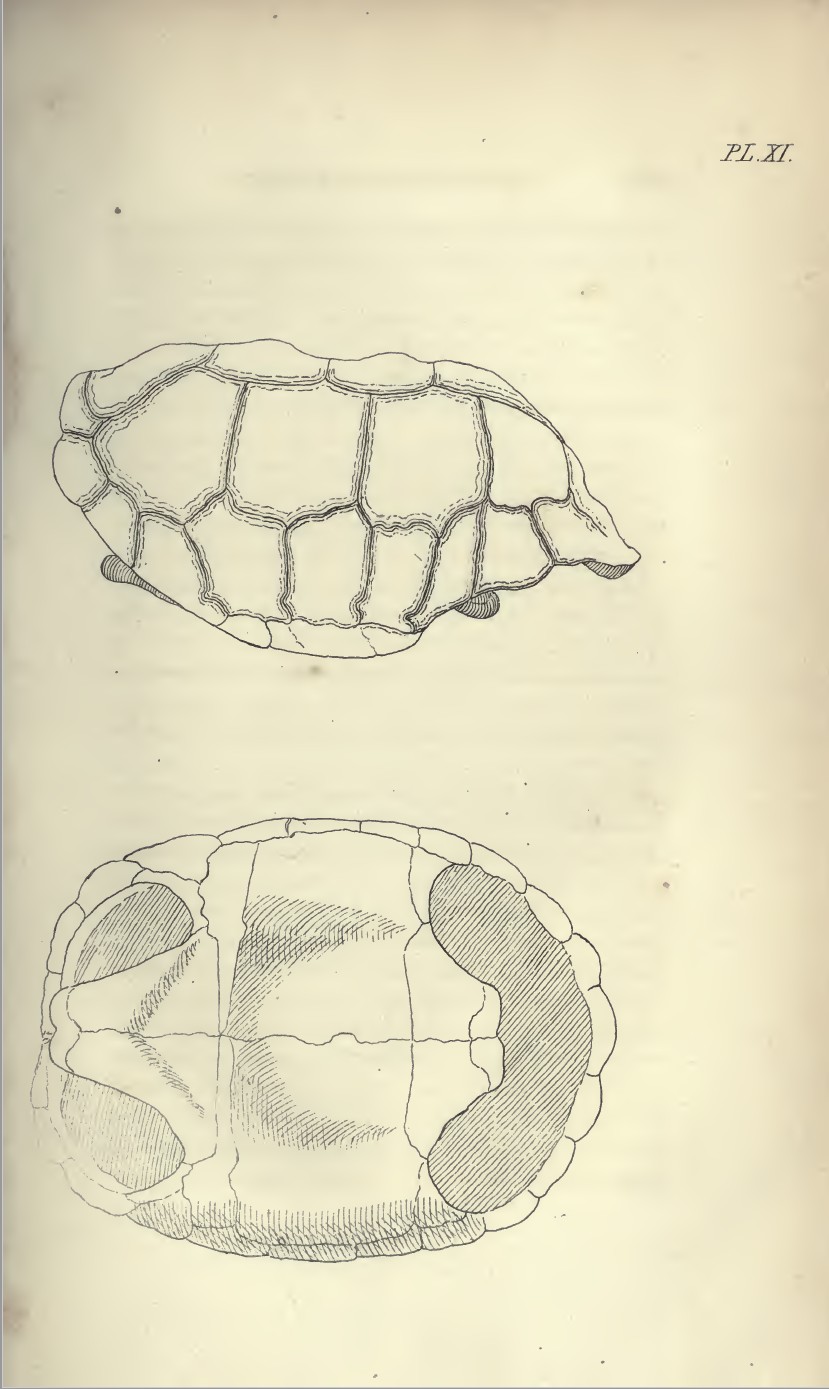
PL.XI. [Click on image to enlarge.] |
the inner ridge is also serrated, but very much less so. The lower surface of the upper jaw is marked by a strong, prominent, serrated ridge with regularly inclined sides, and fitting exactly in the groove in the lower jaw; on each side of it are deep grooves to receive the marginal ridges in the lower jaw; these grooves again are bounded by high, sharp ridges – the outer one is serrated and becomes more and more so as we proceed forwards, till at last we come to three teeth, one on each side of considerable size and one in the middle which is smaller; directly behind these is a deep hollow to receive the large tooth in the lower jaw On the mucous membrane of the Mouth and fauces, which is thin and quite firm, are seen the minute openings of innumerable mucous follicles, but no trace of the spines which are so conspicuous in the green turtle and some others; neither were they found in the oesophagus. The follicles are much larger along the sides of the tongue than elsewhere. Just inside the lower jaw and beneath the tip of the tongue are two glands, of a flattened, oval form, one and a half inches long, one inch wide, and one third of an inch thick; on their surface are more than thirty openings, some of them very large and all communicating with cavities filled with a tenacious, transparent mucus which collected repeatedly during the process of maceration to which the parts were subjected. The opening of the nostrils on the inside of the mouth is bounded on each side by a high ridge an inch long, and probably intended to close the passage during the process of the deglutition of air The Tongue is a triangular, or, as it would commonly be called, a heart-shaped organ. It is three inches long |
and at the base two and a quarter inches wide; upper surface covered with long, soft, slender papillae The OEsophagus, which is generally described as capacious, measured twenty three inches in length, and transversely, when cut open, four inches. The mucous membrane was thrown into longitudinal folds, and resembled that of the mouth in structure, and in being covered with innumerable, fine openings of follicles; no epithelium; contained a considerable quantity of mucus. Muscular coat very thick towards the stomach, but at the upper part it was almost or quite wanting, the deficiency being probably supplied by a superficial muscle which was external to and covered the upper half of the trachea; the fibres were generally, if not altogether, transverse; the connexion between this and the mucous coat was by means of a very loose cellular tissue. According to Capt. Porter, "these turtles carry with them a constant supply of water in a bag at the root of the neck; and on tasting that found in those we killed on board, it proved perfectly fresh and sweet." Mr. Reynolds, in his " Voyage of the Potomac," fully confirms this remark; but nothing of the kind was found in either of our specimens The Stomach, which is probably the bag referred to by Capt. Porter, seems to be little more than an expansion and thickening of the oesophagus, the limits between the two not being very readily seen; the pylorus, on the contrary, is as strongly marked as I have ever seen it in any of the mammalia, forming a prominent ridge which projects into the duodenum, and into which all of the tissues enter; according to Cuvier (Leçons d' Anat. Comp. iii. p. 412,) the pylorus has no valve, but the cardia is well marked. The length of the large curvature |
was twenty-six and a half inches; being cut open, the cardia measured transversely six inches, the largest part of the organ, which was not far from this, was found to be ten inches, after which it gradually became smaller towards the pylorus where it was four and a half inches. The mucous membrane was thrown into broad, longitudinal folds, and connected with the muscular by means of a lax, cellular tissue; towards the pylorus these tended to be effaced, and the membrane altogether, was less movable upon the parts beneath. The muscular coat was very thick and dense, having on its external surface a fibrous appearance, so that the organ looked not unlike the gizzard of a bird; towards the cardia it was from one to two lines in thickness, gradually increasing till within three inches of the pylorus, where it had reached its maximum and measured from four to five lines; it then became suddenly very thin and continued so till it reached the pylorus; this change of structure is well described and figured by Sir E. Home in his work on Comparative Anatomy. The stomach and intestines of the male tortoise were filled with grass more or less digested. The female, which lived for some time after being taken from its food, had in its stomach an abundance of mucus, but nothing else; in the small intestine a quantity of liquid, and in the large intestine grass The Intestines of the male tortoise were about five times the length of the animal, as Blumenbach found in the hawks-bill turtle; the small intestine measuring seven feet three inches in length and five and a half inches transversely, when cut open, the large intestine nine feet in length. In a dissection of the Testudo Indica (Proceedings of the Zoological Society of London, March 8th, 1831) the large intestine was found to be nearly |
twice the length of the small. In the female, they were more than seven and a half times as long as the body of the animal, the proportionate difference being much greater than we should expect to find between two individuals of the same species; the length of the small intestine was eight and a half feet, of the large thirteen and a half feet; this last, it need hardly be said, takes numerous turns instead of going nearly straight to the vent as stated by Cuvier (Anatomie Comp. iii, p. 512). The small intestine is of an uniform size from the pylorus to the coecal valve, measuring seven inches transversely when cut open; just beyond its commencement the large intestine is from ten to eleven inches, afterwards diminishing to five, but increasing again to seven in the rectum, and in the cloaca to nine inches. According to Cuvier, the large intestine is four times as large as the small The mucous membrane is thin; in the upper part of the small intestine it has a reticulated appearance, in which respect, as well as in their muscularity, the intestines resemble those of the common green turtle; it afterwards became more lax, and the appearance just noticed passed by imperceptible degrees into fine longitudinal folds, which insensibly disappeared, and the lower portion of the small intestine and the whole of the large was smooth and polished, except the rectum in which were found once more the longitudinal folds, but not strongly marked as they have sometimes been described. In a small tortoise of the same species, procured for the Society by Dr. Charles T. Jackson, isolated mucous follicles were observed about the termination of the small, and the two extremities of the large intestine, but nothing of the kind was seen in either of the large ones. The muscular coat of the small intestine was one line in thickness at the two |
extremities, but in the intermediate portion it was considerably less; the fibres, wherever observed, were transverse; for the first five or six inches of the large intestine it measured from six to seven lines in thickness, was quite firm and had a shining white fascia external to it, such as was seen in the stomach; it was generally about as thick as in the small intestine, but in the rectum it again became thicker. The coecal valve was well developed and made up of all the tissues The Liver was an immense organ and consisted mainly of three lobes, one on the right which was subdivided into two, and one on the left which was entire. In the male tortoise it weighed fourteen and a quarter pounds (avoird.) In the female the weight was not ascertained, but the dimensions were as follows: – Transverse diameter of the two right lobes taken together eighteen inches, and of the left twelve inches; antero-posterior diameter of the two right lobes eleven inches, and of the left fourteen inches; the greatest thickness, which was rather more than two inches, was in the posterior part of the organ; – towards the anterior edge it became much thinner and more irregular (in these measurements the animal is supposed to be in its natural position upon the under shell); inferior face quite smooth and regular. The lobes on the right side united with the one on the left superiorly and anteriorly, by a thin slip of the same substance two inches wide. The organ is uniform in its texture, soft to the feel and of a very faint pink color, mottled with grey; there was no exudation of fat upon the recent cut surface, as we were led to expect from the description by Capt. Porter, but there is a considerable quantity of it upon a specimen which is preserved in spirit in the Cabinet of the Society. The gall-bladder was situated towards |
the middle of the posterior edge of the extreme right lobe, mostly on the upper surface, but just appearing also on the under; it was in a great measure imbedded in the substance of the organ, of a pyriform shape and three inches in length; in the male tortoise it contained a little yellowish, watery fluid, and in the female ℥ijss or ℥iij of a thin, dark fluid; parietes firm, and the inner surface quite smooth except for several small, rough prominences. Bile ducts not satisfactorily traced. Vena portae quite large The situation of the Spleen was very peculiar, being found in all three of the specimens in the right side of the abdomen, between and rather below the coecum and a convolution of large intestine, with both of which it seemed to be intimately connected. The color was deep red, consistence firm, and in form and apparently in structure it resembled the same organ in the human subject. It measured, in the female, five inches long, two and a half wide and one and three fourths inches in thickness The Kidneys were situated just in front of the sacrum, not far from the vertebral column, and obliquely to the direction of it. They were partially invested by peritoneum, but otherwise closely connected with the neighboring organs. The external tunic being removed, they were found to be much lobulated. Internally there was no division into cortical and tubular portions and there was no proper pelvis. In the female they measured six inches in length and four in width. The ureters were five inches long, large enough to admit a full-sized catheter and terminated in the urethra near the opening of the oviducts, but on the side most distant from the bladder; so that the urine, in order to reach that organ, would have to take a perfectly retrograde course |
The immense size of the Bladder is one of the most remarkable peculiarities in this order of reptiles; and indeed it is so far out of proportion to that of the kidneys, that it has been thought to be not so much a receptacle for the urine as for other fluids, for those which are absorbed by the skin. Carus, in his Comparative Anatomy, gives this as the opinion of Townson and seems disposed himself to adopt it. The bladder of the male tortoise was inflated and dried for preservation, but was unfortunately lost without having been measured; it would, probably, have held two gallons or even more. In each of our three specimens this organ was exceedingly thin, having very little muscular development, and the fundus was divided deeply into two horns of unequal size; they all contained some fluid and a considerable quantity of coarse, earthy substance, of a whitish color and easily crumbling down. Urethra about two inches long and three inches transversely, when cut open; common to the urinary and genital organs, and terminated in a rounded, somewhat prominent lip upon the under surface of the cloaca, about ten inches from the vent The Cloaca, as already stated, measured transversely when cut open nine inches, and its length was about ten The Clitoris was remarkably developed and most perfectly resembled the penis, or corresponding male organ, in miniature. It was from three to four inches long, three fourths of an inch wide, and terminated at the distance of three inches from the vent in a pointed, or, as it would commonly be called, a heart-shaped gland which was grooved in the centre and measured also three fourths of an inch long, and the same at its widest part. Like the penis, it had two long, distinct, fleshy muscles, which arise deep within the pelvis, and reach quite to the gland |
The two Oviducts hang loosely from the upper shell, enclosed in a broad duplicature of peritoneum, by which they are supported as the intestines are, by their mesentery, approaching the median line towards their termination, but receding far from it towards their ovarian extremity. When removed from the body, one of them was measured and found to be of the prodigious length of twelve feet; the average width, before being cut open, was two inches; at its ovarian extremity it was broader than this, and extremely thin and delicate; towards the cloaca it gradually became thicker and smaller, measuring three inches transversely at this part when cut open, and one line in thickness, having a fleshy feel, marked externally by longitudinal rugae and still more so on the internal surface, showing how far it may have been distended. The termination of the oviducts in the urethra was quite prominent, having a rounded, mamillary form, smaller than any other part, but quite dilatable. Blumenbach speaks of the two uteri, as if they were distinct from the oviducts, but there seems to be no ground for the distinction. In each of the oviducts, ten inches from their termination, there was an egg, two and a half inches in diameter and perfectly round; shell not fully formed The ovaries were situated one on each side of the vertebral column, and consisted of a broad duplicature of peritoneum, the ova hanging more or less in clusters from its free edge, or being enclosed between its folds near it. There were about forty or fifty of these ova on each side; those which appeared to be in a state fit for impregnation were about one and one fourth inches in diameter, perfectly round, of a deep yellow color; the investing membrane was very delicate and vascular, and the contents in which the color resided had the consistence of thick |
honey, giving the whole a beautifully translucent appearance. By far the greater proportion, however, appeared to be withering, as after the expulsion of the ova; these were of all sizes, from that of the most perfect downwards; the forms were various and irregular, the surface uneven, and the investing membrane had more or less of a dead, opaque, whitish appearance and was much thickened; the contents resembled crumbling masses of soft, yellow wax. Besides these, there were also multitudes of others, most of them very minute and completely wasted Of the Penis nothing was noted. It was an organ, however, of immense size, and perfectly resembled the clitoris in form, as I have already stated. Two very long, round, fleshy muscles, which served as retractors, arose from deep within the pelvis and reached quite to its extremity. The two prolongations from the peritoneal cavity, extending its whole length and terminating in a cul de sac, were quite distinct The Testicles, situated very near to the kidneys, were four and a half inches long, and one inch at the widest part, elongated, narrow and of a pyriform shape. The epididymis is separated from the body, and the vasa deferentia open into the urethra in about the same place as the oviducts in the female Heart of the male tortoise. The two auricles were very large, of a regular, rounded form, having an entire, thin, membranous septum between them, and separated from the ventricles on the external surface by a deep furrow; neither of them had any appendix. The right was much the largest of the two; a single vena cava entered at the upper part (supposing the organ to be in its natural position) and regurgitation of the blood was |
prevented by two thin, semilunar valves on the inside of the auricle, the inner one extending about three fourths the length of the cavity, the outer one being considerably shorter, and the two terminating in a muscular band which would tend completely to close them; muscular structure of this cavity well developed, except on septum and towards the opening into ventricle, the bands running very irregularly. The left auricle receives two small, very delicate, pulmonary veins, which unite just as they enter; the line of entrance is sufficiently marked, but there are no valves as on the right side; Dr. Grant also found these valves wanting in the Testudo Indica, (Proceedings of the Zoological Society of London, March 26th, 1833), though, according to Cuvier (Anat. Comp. iv, 218), they are found here as well as in the right auricle. This cavity is moderately thick and muscular, the fibres running nearly in a straight line from the ventricular opening, some of them being nearly an inch in length and easily raised. The opening into the ventricle is considerably smaller than on the right side. The ventricle is a broad, flattened, crescentic, kidney-shaped organ, not connected by a tendinous ligament to the pericardium, as stated by Carus (Comp. Anat. ii, 285). It measures transversely at the base three and two thirds inches, and from the base to the part corresponding to the apex two inches. Parietes generally about half an inch thick, but on the right side, just below the giving off of the vessels, they are much thinner; on the outside they are firm, but towards the inner surface spongy, and on the left side very much more so than on the right, the muscular fibres being of considerable size and forming distinct meshes with some small columnae carneae; beneath the auricular septum they form a complete lace- |
work. The cavity of the ventricle is single, measuring two and three fourths inches from side to side and sufficiently large midway to allow the passage of the index finger; very much more free on right side than on left The auriculo-ventricular valves are thin and membranous and stand out on each side from the septum over the cavity of the ventricle. That on the right side is much the largest, measuring an inch and a half along its free edge, and two thirds of an inch from the base to the free edge at its broadest part; superiorly, it turns backwards and terminates bluntly on the inner surface of the ventricle; inferiorly, it inclines to the right, becomes quite pointed and is inserted into the upper part of a large fleshy column, which by its action would tend to shut the valve; this column makes part of the inferior parietes of the right side of the cavity of the ventricle, running its whole length from behind forwards, inclined to the right, forming a kind of septum and probably having for its especial object to direct the blood into the great vessels. The free edge of the valve on the left side is eleven lines, and its broadest part five and a half; the two extremities turn down equally and are attached, the inferior to the inner surface of the ventricle, the superior to several fine, muscular bands which pass off towards the left side and direct the blood into the spongy wall of the ventricle. Just at the opening of the right auricle into the ventricle there is an accessory valve, an inch and a fourth long, and about a line in width, of a semi-lunar form, with a sharp edge, and commencing just where the large valve terminates on the fleshy column; nothing of the kind was found on the left side; in the Testudo Indica Dr. Grant found it at both the auriculo-ventricular openings. The three great vessels arise from the supe- |
rior-anterior part of the right side of the ventricle, are situated one directly above the other and have a moderately thick septum between them. The pulmonary artery is the lowest of the three, and is quite as large as the two aortas; an inch and a half from its origin it divides into two. The superior aorta, which is nearest to the auricular opening, gives off branches, which are about as large as itself, rather more than an inch from its origin. The other aorta is considerably smaller than the last and gives off no branch of any size till it reaches the abdominal organs; after supplying these, it unites with the continuation of the superior aorta by a large branch about three inches in length. Each of the three vessels has two very deep, semilunar valves. According to Cuvier (Anat. Comp. iv, 221), land tortoises have but a single origin for all the arteries of the body, though the marine have two; Dr. Grant, however, found two aortas, commencing by separate orifices from the ventricle, in the Testudo Indica Of the Lungs very little was noted. In the female they extended the whole length of the upper shell, even amongst the bones connected with the extremities, filled up the space on each side of the vertebral column, and reached much more than half the way down to the union of the two shells. Trachea fourteen inches and three fourths of an inch wide; rings perfect and of an oval form; in the male it was seventeen inches long and the primary bronchi were eight inches. These last continued in a straight line nearly or quite to the posterior extremity of the lungs, but not receding far from the median line. The secondary bronchi go off regularly on each side, inclining backwards, small at their origin but immediately becoming of an immense size, measuring probably not less than three or four inches transversely when cut open. |
Rings very irregular and imperfect. Some fine, spongy appearance connected with the secondary bronchi in anterior and middle part of lungs, but posteriorly, the structure, instead of being cellular, seems to consist of a very coarse, loose net-work made up of fine, white, tendinous cords. No muscular fibres detected There was a great quantity of Fat in the male tortoise, filling up the space on each side in the upper shell just above the junction with the lower. In the female this had in a great measure been absorbed, and was very much altered in appearance Organs of Locomotion in the male tortoise. The bone, compared by Cuvier to the os quadratum, terminates in a transverse, articulating surface in the form of a groove which receives a corresponding ridge in the lower jaw; in the female, instead of a groove, the upper surface has an arched, concave form. Zygomatic arch quite narrow. Temporal fossa very large, giving origin to a muscle of proportionate size. Articulating surface of occiput with atlas very prominent, much more so than in the green turtle, allowing great freedom of motion. Eight cervical vertebrae; most of them have a ball and socket joint, the posterior extremity being convex; the third is convex at each extremity; the longest are situated about midway and measure four inches; towards the union with the back shell they become much shorter but in proportion thicker, and the processes very prominent; the atlas is scarcely an inch in length and neither are the spinous processes united together nor are the sides to the body of the bone. There seems to be no good reason, however, why this bone should be excluded from the list of vertebrae as Cuvier has done, though it is so little developed (Anat. Comp. i, 172); the dentatus, also, is quite small, and |
the odontoid process is a distinct piece. The muscles are numerous, but very distinct, as, indeed, they were in every part of the body; some arising from the upper shell and some from one or more vertebrae to be inserted into those above; one pair arises from the dorsal vertebrae, nearly or quite as far back as the sacrum, is inserted into three of the cervical vertebrae and at last reaches the base of the skull. The muscles of deglutition or of respiration, on the front of the neck, which raise and depress the large hyoid bone, are also very interesting, and especially a pair which passes transversely nearly around the upper half of the neck, arising from the articulating processes and reaching as high as the temporal bone. That peculiar bone, which has received so many names and none more appropriate than that of lunula, which it owes to its form, was about fourteen inches long, formed of one continuous piece and united at each extremity to the upper and the under shells by a short and very strong ligament. The scapula is firmly attached to it, five inches from the lower extremity, and is somewhat triangular, extending backwards four and a half inches. The humerus is nine and a half inches long and four and a half inches in circumference midway; head of the bone round and near it are two tuberosities, one of which is of immense size; lower articulating surface has a convex, oblong form. Radius and ulna from five and a half to six inches long; no olecranon; lower end of ulna larger than that of radius. There are eight carpal bones, one of which seems formed by the union of two; besides these, there are three bones to each toe, all of which may be considered as phalangeal or one of them may be regarded as a metacarpal bone; besides a row of five metacarpal bones, Carus gives three phalangeal to the three middle toes and two to each of the two others |
(Comp. Anat. i, 150). The muscles which move the shoulder are of immense size; one, which is probably the largest in the body and entirely fleshy, arises from almost the whole anterior half of the under shell and is inserted into the small trochanter at the head of the humerus; the others take their origin principally from the lunula and scapula, except a few from the upper shell and go to be inserted in and about the great trochanter of the humerus. The long flexor and extensor of the forearm also arise from the scapula, except for one head of the last. Below these the different parts of the upper extremity have their flexors and extensors, pronators and supinators very much like the higher classes. Of the vertebrae, besides the cervical, there are eight dorsal, four sacral and twenty-one caudal. The sacrum unites firmly with the pelvis, but moves freely on the last dorsal vertebra, as do the ilia also by a broad surface on the transverse processes; all of these articulations have a synovial membrane, as have also, those of the caudal vertebrae. The symphysis pubis, as it is usually called, is quite broad and in this case formed about equally by the ossa pubis and the ischia, the limits being quite distinct as the three coxal bones are not united by ossification; anteriorly it is flat and pointed, posteriorly broad and thick; from the anterior edge of the pubes a very prominent spine arises, two and a half inches long, about as large as the middle finger and directed outwards to receive a muscle arising from the under shell. Obturator foramen an inch and a half in diameter and nearly circular. The femur is seven and three fourths inches long and altogether considerably smaller than the humerus; has a single trochanter at upper extremity of moderate size, the lower having a convex oblong form. Tibia and fibula five and a fourth inches long. There are seven |
tarsal bones; one only articulates with the leg and this is very much larger than any of the rest towards the outer extremity, however, and on one side is a line as if there had formerly been a small separate bone; to one of the tarsal bones which is situated on the outer edge, and projects quite beyond the rest, there is attached a very small bone, which appears to be the rudiment of another toe. Each of the four toes has three bones, to which the same remarks will apply that were made in the case of the anterior extremity. The muscles of the posterior extremities generally, were smaller than those of the anterior, and in proportion to the size of the bones; one, which was attached quite round the posterior margin of both shells, was admirably calculated to expel the air from the lungs, by forcing the organs in upon them. . . . .
|
|
Source.
J. B. S. Jackson, M. D.
This transcription used the images at the
Internet Archive.
Last updated by Tom Tyler, Denver, CO, USA, Dec 20, 2025
|
|

