|

|
. . . .
PAITA.
Fayette M. Ringgold, Consul. September 1, 1858.
I have the honor to submit to the department a report on whalers and the whaling system, as pursued and carried on from several ports in the United States; and I hope, although I shall be compelled to go somewhat into details, the tediousness therefrom will be compensated for by the information contained. I feel confident that there is no branch of trade or enterprise entered into in the United States, in which so large a capital is invested, that is so little understood, except by the immediate persons concerned. Even intelligent merchants in other ports, who speculate in the results of a whaling voyage, know little, and care less, from whence and by what means they are taken. I shall, therefore, not confine myself to merely giving the number of vessels and men employed, the amount of tonnage, average quantity of oil taken, &c., but do my utmost to lay before you an exact account of the whale system – the advancement and improvements introduced into modern whaling on the one hand, and the abuses and acts of injustice on the other. From after the war of 1812 we may date the commencement of American whaling in the Pacific. Commodore Porter, in that erratic yet bold expedition in the Essex, by destroying the English whale fleet on this side of land gave the impetus and laid the foundation to a vast trade which the eastern States, with their characteristic energy, and especially Massachusetts, eagerly grasped, and from which they have reaped millions of profit. At that period I doubt whether there would have numbered more than ten or twelve American whalers in this ocean; but at the close of the war English capitalists on this branch, having either been ruined or fearing to again entrust their vessels so far from home and for so long a time, left the Pacific free, and consequently the American trader found this immense space entirely at his disposal. For many years so successful were the voyages, and in comparatively so short a space of time were they performed, that nothing but old condemned merchant vessels, patched up, sometimes newly rigged, with the necessary boats and whaling gear, were sent to this coast; but latterly, that is, within the last twelve years, a great change has taken place, and a much superior class of vessels has been constructed. This is owing to the circumstance that whales have either become much more scarce, which some of the most experienced masters affirm, or they have become more knowing, more cautious and wilder, as others equally experienced assert. In all probability, a combination of these causes would be nearer the truth. The |
sperm whale is endowed with an extraordinary acuteness of hearing, and the smallest splash of a paddle, or an order given in too loud a tone, will be the signal for instant disappearance; and as they are either taught by nature or experience that they can, and vessels cannot, go "dead in the wind's eye," they dart off in that direction, and are soon lost to sight. It has been found, therefore, that a fast sailing clipper, although she cannot compete with the whale when thoroughly alarmed, yet when he is seen from aloft she can, by quick sailing and proper manoeuvering, get more rapidly withing lowering distance, and thereby have a great advantage over the old tubs that formerly went to sea. Many full, and numbers of half clippers have been of late years added to the whaling fleet, and others are annually being built. As a matter of course, new, light, and commodious vessels render the labors of the seamen less, and their comforts much greater. There is no more of that everlasting pumping, patching, and calking; these have been more or less done away with. The men have dry bunks to sleep in, and when not cutting in whales or trying out oil their work is comparatively light. It was also found that the system of bad beef, bad pork, and worse biscuit, turned out in the end an unprofitable economy. For good men, accustomed to wholesome food at home, and shipped at small lays or shares, would desert with the hope of bettering themselves, and the master would consequently be compelled to take any class, whether good or bad, to make up his complement, giving at the same time better lays and larger advance. I am satisfied that there are no vessels afloat, as a general rule, that have better provisions and in greater abundance than whalers. Beside the salt provisions and small stores, these vessels touch at some port at least every six months and lay in large supplies of fresh meats, vegetables, and fruits. On one occasion I knew a master to buy some sixty barrels of sweet potatoes, paying a high price for them, although told that they were too old to keep. His reply was that there were no others to be had, (which was a fact,) and if he took them on board the men would be satisfied, even if he had to throw them into the sea in two days. It will be perceived from the foregoing that there has been considerable improvement in the building of vessels and the care for the comforts of the men, and I wish sincerely my report could cease here. I should be only too glad if over the picture which I shall now be compelled to sketch I could draw a curtain. I would be glad for the sake, and name, and reputation of our countrymen now engaged in whaling; but I having imposed on myself this, (which I conceive to be not a task, but a sacred duty,) I will not shrink from doing justice to the mariner, after having bestowed that praise which was due to the owner and master. In order to make myself thoroughly understood it will be necessary to explain that, generally speaking, when a vessel is being fitted out for a whaling voyage to the Pacific ocean, from the United States, a shipping master is applied to, who, if he has not on hand a sufficient number of men, immediately sends his runner through the interior of Massachusetts, New Hampshire, Vermont, New York, and even as far as Ohio, to pick up what are termed green hands. As these shipping masters make large profits upon each and every man whom they procure, they use every means in their power to excite the fancy and stimulate the ambition of those whom chance may throw in their way. They return to the port with ten or fifteen able-bodied young men, who are shipped by the proper authority, and are then told they can amuse themselves at their boarding-house until the day of sailing, and that the shipping master has orders to supply them with clothing adapted to and necessary for the voyage they are about to undertake. The time of sailing arrives; all hands are huddled on board; their chests, into which they have had no chance of looking, are put into the forecastle when the vessel is about getting |
under way; they have already signed a receipt for it; the order is given to make sail, and off they speed on a voyage of four years. Each sailor is charged on the owners' books with an average outfit of seventy (70) dollars, but this sum is not paid the shipping master until the vessel has been six months at sea. By many owners interest is charged on this sum, for outfit, from the day of sailing until the return of the vessel. When at sea the sailor opens his chest for the first time, when it is discovered, alas, too late, that he has received, including the value of the chest and all in it, property to the amount of from twenty to twenty-five dollars. The result is, that in the beginning of the voyage the men are not only dissatisfied, but they are compelled, upon the first appearance of cold and rugged weather, to seek warm clothing from the slop chest, which, in many instances, is placed on board by the owners as a profitable speculation, they paying the master a small commission for his trouble. The lay or share for a green hand is from the one one-hundred and eightieth (1/180) to the one two-hundredth (1/200;) that is, one barrel of oil for every one hundred and eighty or two hundred that are taken. And I will now show what profit accrues to a green hand. A sperm whale ship of 350 tons will take on a voyage of four years 1,200 barrels of sperm oil. This is a liberal average. The share or part which the sailor who has the 1/180 lay will have coming to him will be two hundred and ten (210) gallons, or equal, at the present home prices, to two hundred and sixty-two dollars and twenty-five cents, ($262.25;) but from this sum there are to be made sundry deductions. Ten per cent. discount on the amount of oil taken, for leakage and shrinkage, is always made, and very frequently three per cent. for insurance, although, if the vessel is lost, with five hundred barrels of oil on board, and it is fully covered by insurance, the owners recover all and the men get nothing, because this charge is not made on the men until the vessel is safe home, and the policy of insurance is, of course, made out in the name of the owner; or, as an old sailor once expressed himself to me, when a vessel was burnt in this bay: "It's no use, sir, to give me a certificate; the owners play an open and shut game. If the vessel gets home I pay for insurance; but if she is lost they pay the insurance and pocket the profits." And it is so. Then the accumulated interest (not always charged) on the original seventy dollars outfit, and twelve per cent. per annum on any money given, as liberty money, during the voyage. Finally, ten dollars ($10) is charged every man, whether discharged on the coast or at home, for "fitting, shipping, and medicine chest" – a phrase the meaning of which I have never been able to have satisfactorily explained to me. The following is the result of the seaman's voyage for four years:
| |||||||||||||||||||||||||||||||||||||||||||||||
But, allowing that every dollar of the $262.25 should be handed to the seaman at the end of the voyage; that the seventy dollars first advanced should be admitted as a gratuity; that the outfit should have been properly and honestly put up; that even the money advanced and the clothes given on the voyage, and all the interest upon these various sums, should be thrown in as a gift to encourage the young man to continue a profession for which he may by this time have conceived some liking, what would be his monthly wages? A sum so preposterously small that I feel almost ashamed to mention it. It seems incredible that an intelligent, active young American should pass through four years of labor, (not to mention dangers, both from sea and monster,) separated from family and country, at the rate of five dollars and twenty-two cents ($5.22) per month. Yet such is the case. I grant, as the owners and masters contend, that this is his first voyage; that he had no expenses; that, if he conducted himself properly and felt disposed, he can take advantage of knowledge he has now gained, and demand from the owners a much better lay, and perhaps, if recommended by the master, a better position – such as boat steerer; but before he can reap the benefit of these advantages we must be assured that he has really obtained them; we must know whether he is not entirely destitute, or even in debt to the ship, and thereby compelled to re-ship almost immediately; we must know what class of master and mates he has had over him; whether they have treated him kindly; whether they have been willing to advise or instruct him, or whether they have (which, I am sorry to say, is generally the case) left him to himself and that sink of immorality the forecastle. It is very clear, no matter what may be the amount of his instruction, or what the sum of knowledge gained on the voyage, the pecuniary benefit is merged into the hands of the owners. But there are other and more serious results, springing from this system of small pay, (which, by the way, is almost too mild a term,) to the country at large. The vast amount of uncultivated and unpopulated territory at home would naturally lead us to discourage, in every possible way, the emigration of our native born citizens. Every arm is useful; and when we find that three or four thousand young men yearly sail from the United States in whalers, and, becoming disgusted, desert, and either from shame or moral corruption never return, or, if they do return in after years, are no credit to their country, we are naturally led into the reflection, and from thence the conclusion, that the cause which produces this must be of the most serious nature; and I am satisfied, in my own mind, that the small profit as the result of labor is more the cause than the bad treatment which they sometimes receive at the hands of the masters and mates. It is almost impossible to expect that twenty-five or thirty men can exist at sea for the length of six months without some slight disagreement; and when we take into consideration, on the one hand, that men may be obstinate, self-willed, or perverse, or that, on the other, the master or mate may be too exacting or prone to tyrannize, it is not at all astonishing that there should be complaints, of minor or greater character, frequently entered at the different consulates. But I must defer to a future occasion observations upon the personal ill treatment of seamen, and its causes, and, should the department desire and approve of it, I will with pleasure place before it several cases of an exaggerated character that have come under my official and personal knowledge; and, in conclusion, I will now place in tabular form the number of whale vessels sailing out of the United States, with their tonnage, average number of men, average amount of oil, &c.; also a table showing the amount of profit derived by the owners from these voyages, |
from which last it will be seen that it would be very easy for them to largely increase the pay of their men, and still make an enormous interest on their money. TABLE A.
Showing the number of vessels, number of seamen, and average catch and value of oil and bone in whaling vessels sailing from the United States, the average term of voyage being four years.
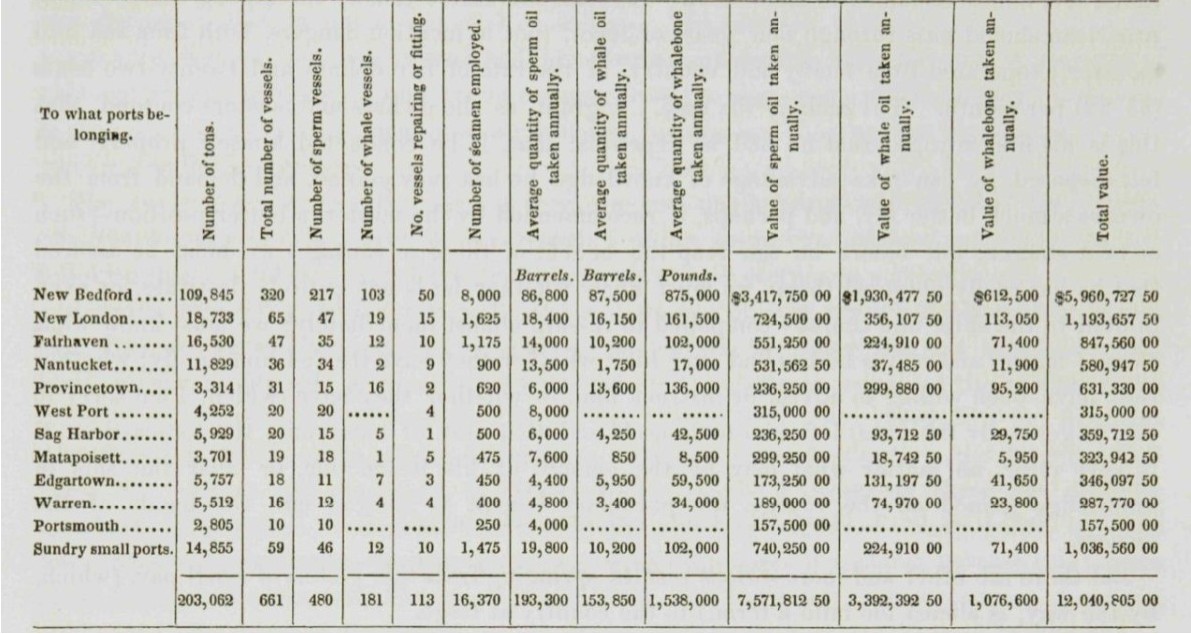
[Click on image to enlarge.]Note. – The intention of this table is to show more the relative results of a whaling voyage than to represent an accurate statistical item.
TABLE B.
Showing the value of the whaling vessels, interest on same, annual expenses, &c.
|
|
Source.
Fayette M. Ringgold, Consul.
This transcription used images at
Google Books.
Last updated by Tom Tyler, Denver, CO, USA, Jul 11, 2026
|
|

