|
|
|
The manner of the Whale-fishing in Groenland given by Mr. Gray to
Mr. Oldenburg for the Society. (1663) |
. . . .
The history of whale-fishing, and of the making of whale-oil, was delivered in by the secretary from Mr. Gray of the Greenland company, who had been in those parts, and present at the killing of whales and the making of oil a dozen times; and was ordered to be registeredq as follows: "We have, according to the bigness or smallness of our ships, the more or fewer boats: a ship of 200 tuns may man six boats; a vessel of 80 or 100 tuns, four q Original Register, vol. ii. p. 308. |
boats; a vessel of 60 tuns, three boats, or more, not less; three boats being as few as may be with convenience to kill a whale. Each boat hath six men, a harponeer, a steersman, and four oars to which men the merchant giveth (besides their wages) for every thirteen tuns of oil (which we call a whale, when there is so much for each boat, to the harponeer 61. 10s. the (leerfman 3l. and to each oar 1l. 10s. in all for each boat 151. 10s. which we call whale-money. We have several men and boats upon several convenient places, which we call Look-outs, that constantly remain looking out by turns for the whale, which, when we fish in harbour, cometh into a smooth bay, where is a good harbour
Thus having gotten one iron into her, our boats row where they think she will rise (after she hath been beating herself at ground) and get two or three irons more into her, and then we account her secure. Then when she is near tired with striving, and wearied with the boats and ropes, we lance her with long lances, the irons and staves whereof are about twelve or fourteen foot long, with which we prick her to death; and in killing her, many times she staveth some of our boats, beating and flourishing with her tail above water, that the boats dare scarce come nigh her; but oftentimes in an hour's time she is dispatched. Thus having killed her, our boats tow her (all of them rowing one before another, one fast to another like a team of horses) to the ship’s stern, where, after she hath lain twenty four hours, we cut off the blubber, and take the fins (which we commonly call the whale bone) and her tongue out of her mouth, and with a great pair of slings and tackle we turn her round, and take all that is good off her, and then we turn her carcass a-drift, and tow the blubber (cut in pieces) to the shore, where works stand to manure it. Having made fast the blubber to the shore, we have a water side-man, who-stands in a pair of boots to the middle leg in water, and slaweth such flesh as is not clean cut from the blubber. Then we have two men with a barrow, that,when the water-side man hath cut it in pieces of about two hundred weight, carry it up to a stage standing by our works like a table; then we have a man with a |
long knife, who we call a stage-cutter, who sliceth it into thin pieces about half an inch thick, and a foot long, or longer, and throws it into a cooler we call a slicing-cooler, betwixt which and another cooler (called a chopping cooler) we have men we call choppers placed; five or six men, who upon blocks cut about a foot and an half square (made of the tail of the whale, which is very tough) do take the sliced blubber and chop it very small and thin, not above a quarter of an inch thick, and an inch or two long, and thrust it off from their blocks into the chopping-cooler, which holds two or three tuns. Then upon a plat-form is built a copper-hole about four foot high, to which there is a stoke-hole, and on this copper-hole is a broad copper, which containeth about a butt, hanged with mortar and made tight round the edges. And over the stoke-hole, upon an arch, stands a chimney, which draws up the smoak an flamed. And we have one we call a tub-filler, who with a ladle of copper, whose handle is about six foot long, taketh the chopt blubber out of the chopping-cooler, and puts it into a hogshead made with straps for that purpose; and he draws this hogshead from the chopping cooler’s side to the copper, and putteth it in; under which having once kindled a fire of wood, and boiled a copper or two of oil, the scarf, which remains after the oil is boiled out of the blubber (which we call fritters) we throw under the copper, which makes a fierce fire, and so boileth the oil out of the blubber without any other fewel. Then when we find that it is boiled enough, we have two men, whom we call copper-men, who with two long-handled copper-ladles take both oil and fritters out of the copper, about half, and put it into a barrow (we call a fritter-barrow) made with two handles, and barrel-boards set about half a quarter of an inch one from the other, through which the oil runneth and the fritters remain; from which the oil being drained, whilst another copper of oil boils, they are cast into the stoke-hole and burnt, and the barrow stands ready again on the first oil-cooler, to receive what is taken out of the next copper. Out of this barrow the oil runs into a great thing we call a cooler, made of deal-boards, containing about five tuns, which is filled within an inch of a hole (made in the side for the oil to run into the next spout) with water to cool the oil, and so the oil runs upon the water through this hole into a spout about ten or twelve foot long,into another cooler filled as aforefeid, and out of that through a long spout into a third filled as aforefaid, and out of that in a long spout into a butt laid under the end of this spout; which being full, the hole of the cooler next the butt is stopt till another butt is laid under, and then the plug being taken out it filleth another, till we have done boiling. Then we fill up our oils, when they are thoroughly cold, and mark them and roll them into the water, rafting twenty together, and so tow them aboard, hoist them into our ships, and stow them to bring them home. And for our fins, which grow in two gums in the whale’s mouth (whereof in a whale’s mouth, great and small, are about 600, 460 whereof being merchandable) we cut them one by one out of the gums, and having rubbed them clean, we bind them up sixty in a bundle, and so taking account of them, ship them aboard in our long boat. |
Upon the shore we have a tent for our land-men, built of stone, and covered with deals, and cabbins made therein for our blubbermen to lodge; and we have a great working tent with a lodging-room over it, where about six coopers work, to get ready casks to put the oil into." Sir Robert Moray moving, that it might be considered, whether there might not be devised an engine fit to strike the whales with more ease and sureness, and at a greater distance than those now in use, it was ordered, that Dr. Wilkins and Mr. Hooke should think of such an engine, that might be cheap and easy to be managed. . . . .
|
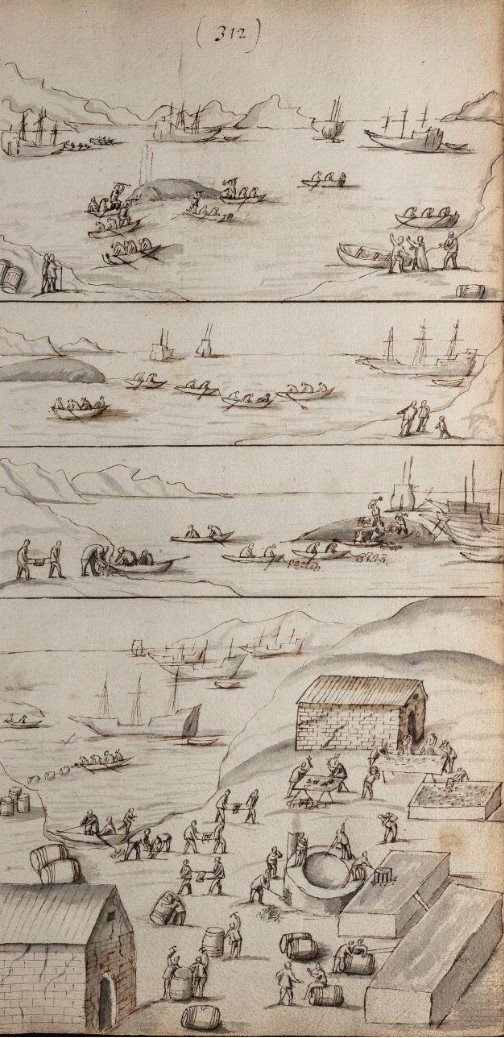 Image courtesy of the Royal Society of London. |
NOTE."Mr. Gray of the Greenland company" has not been identified. Stephen Gray associated with this paper by the Royal Society is definitely not the Gray to which Oldenberg's introduction refers. Henry Oldenburg (c1618-1677) was a "German/English diplomat turned professional correspondent" who was an early member of the body that would become Royal Society of London. In 1662 when the body received their charter from King Charles II, Oldenberg was made one of the two secretaries of the Society. His duties were to correspond with other learned societies and to convey their reports and activities to members. On March 6, 1665 he published the first issue of the "Philosophical Transactions". In the final paragraph two members are mentioned. The first was John Wilkins (1614–1672) an English Anglican clergyman, natural philosopher, and author, and one of the founders of the Royal Society. He was Bishop of Chester from 1668 until his death. Also, Wilkins was one of the few persons to have headed a college at both the University of Oxford and the University of Cambridge. He was a polymath, although not one of the most important scientific innovators of the period. The second was Robert Hooke (1635–1703), another English polymath who was active as a physicist ("natural philosopher"), astronomer, geologist, meteorologist, and architect. He is credited as one of the first scientists to investigate living things at microscopic scale in 1665, using a compound microscope that he designed. The two illustrations reproduced here are by courtesy of the Royal Society of London. They appeared in the Society's Register Book where Oldenberg transcribed the original contribution from Mr. Gray. The title for this page was also taken from the Register. |
|
Source.
Gray: "The history of whale-fishing, and of the making of whale-oil."
This transcription used the images at the
Internet Archive.
Last updated by Tom Tyler, Denver, CO, USA, Jul 11, 2026
|
|


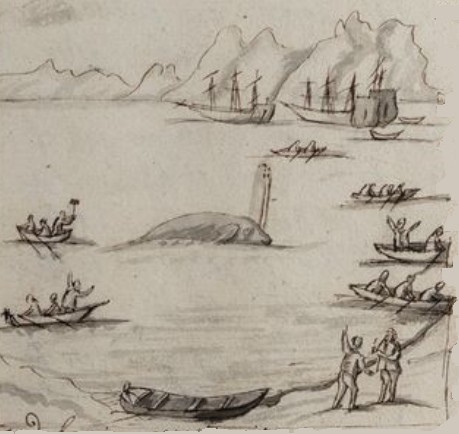 for our ships: and having discovered the whale, which swimmeth with her back above water, or is descried by the water, which she bloweth into the air, one look-out maketh signs to another by hoisting up a basket upon a pole, and then all the boats row after her; and having opportunity to row up with her, before she goweth down, strike a harping-iron into her, to which is a staff joined, being about six foot long, called a harping-staff, to the socket of which iron is a white rope, with an eye seized very fast. This rope is about five fathom long, lying upon the fore-part of the boat (which we call a shallop) always coiled over a little pin, ready to take up, to give scope to the iron, when it is thrown at the whale; and to this hand-rope is a warp of 300 fathoms seazed, to veer after the whale, lest, when she is struck, by her swift motion(which is often down to the ground, where the water is 60, 70, or 80 fathom deep) she should sink the boat.