|
|
|
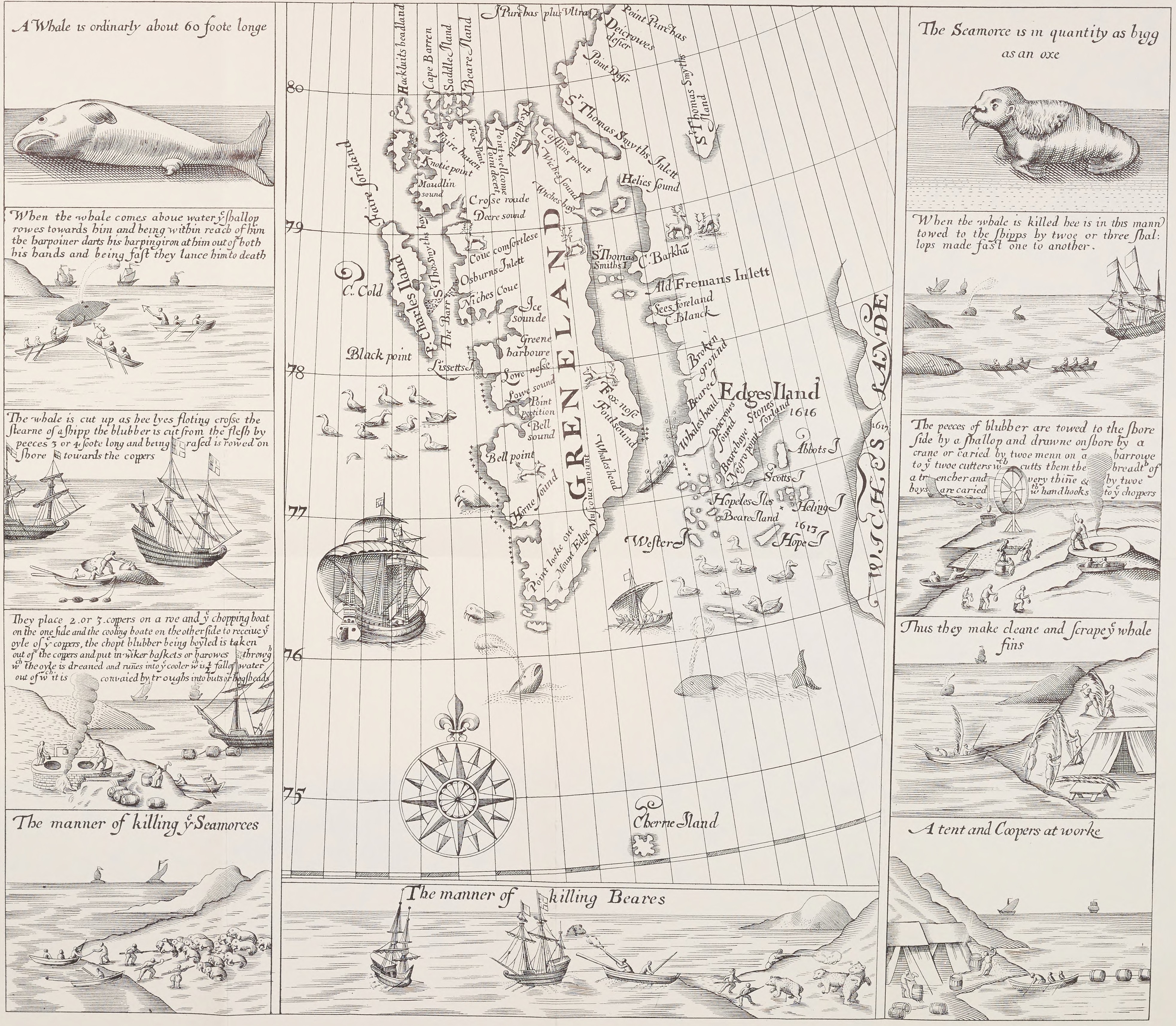
[Click on image to enlarge.]Text of the narrative vignettes )
(Counter-clockwise from the upper left
|
|
TO THE
RIGHT WORSHIPFULL SIR HUGH HAM- mersly, Knight, Alderman of the Citie of London, Governour of the Worshipfull Company of the Muscovia Merchants: And to the Worshipfull Mr. Alderman Freeman, Captaine William Goodler; and to all the rest of the Worshipfull Assistants and Adventurers in the said famous Company; Edward Pellham dedicateth both this and his future Labours. Right Worshipfull and most famous Merchants: THE hard adventure my poore selfe and fellowes underwent in your Worships service, is a great deale plea- santer for others to reade, than it was for us to endure. How ever hard, wee have now endured it; and if ever after ages shall speake of it (as the world still doth of the Dutchmens hard Winter in Nova Zembla), thus much of the Voyage shall redound to your honours, – that it was done by your servants. This may also returne to our countreys good; that if the first inhabiting of a Countrey by a Princes Subiects (which is the King of Spaines best title to his Indycs) doth take possession of it for their Soveraigne: then is Green-land by a second right taken livery and Seisin of for his majestics vse, his Subjects being the first that ever did (and I believe the last that ever will) inhabite there. Many a rich returne may your Worships in generall, and the brave adventurers in particular, receive from this and other places: and may your servants be ever hereafter warned to take heede by our harmes. God send your worships long life, and much honour, and sufficient wealth, to maintaine both. This is the hearty prayer of your worships poore servant, Edward Pellham.
|
|
GODS POWER AND PROVIDENCE IN THE
PRESERVATION OF EIGHT MEN IN GREEN-LAND, NINE MONETHS AND TWELVE DAYES. Edward Pellham |
TO THE READER.
Courteous Reader: That God may have the only glory of this our deliverance, give mee leave to looke backe unto that voyage which the Dutch-men made into Nova Zembla in the yeare 1596. In which place, they having beene (like ourselves) overtaken with the Winter, were there forced to stay it out as wee were. Which being an Action so famous all the world over, encouraged mee both to publish this of ours, as also now to draw our some comparisons with them; that so our deliverance and Gods glory may appeare both the more gracious and the greater. This Nova Zembla stands in the degree seventy-six North latitude; our wintering place is in seventy-seven Degrees and forty Minutes, that is, almost two degrees neerer the North Pole than they were, and so much therefore the colder. The Dutch were furnished with all things necessary both for life and health; had no want of any thing: Bread, Beere, and Wine they had good, and good store. Victuals they had Gods plenty, and apparell both for present clothing and for shift too; and all this they brought with them in their ship. We (God knowes) wanted all these. Bread, Beere, and Wine we had none. As for meate, our greatest and chiefest feeding was the Whale Frittars, and those mouldie too, the loathsomest meate in the world. For our Venison 'twas hard to finde, but a great deale harder to get and for our third sort of provision the Beares; 'twas a measuring cast which should be eaten first, Wee or the Beares, when we first saw one ano- |
ther; and we perceived by them, that they had as good hopes to devoure us as wee to kill them. The Dutch kill'd Beares, ' tis true; but it was for their skinnes, not for their flesh. The Dutch had a Surgeon in their Companie; wee, none but the great Physician to take care and cure of us. They had the benefite of bathing and purging; wee, of neither. They had their Ship at hand to befriend them; wee had here perished, had not other Ships fetcht us off. They had Card and Compasse: wee, no direction. If the Dutch complained therefore of the extremity of the cold (as well they might), and that when in building their house, they (as Carpenters use to doe) put the iron nayles into their mouthes, they there froze, and stucke so fast, that they brought off the skinne and forced blood: how cold, think you, were we, that were faine to maintaine two fires to keepe our very morter from freezing? The Dutch complain'd, that their walls were frozen two inches thicke on the inside for all their fire; and if ours were not so, 'twas our pains and industry at first in building. The Dutchmens clothes froze upon their backes, and their shooes were like hornes upon their feete; but that was their own ignorance; for they had Sea-coles enough with them, if they had knowne how to use them. If theire drinke and Sacke were so hard frozen into lumps of yce, that they were faine to cut it out: how much harder was it for us, that were forced to make hot Irons our best toasts to warme the snow withall for our mornings draughts? They used heated stones and billets to their feete and bodies to warme them; which, though an hard shift, yet was it better than wee had any. Lay now all these together: the distance of place, wec being many miles more into the cold than they; the want both of meate and clothes; and that the house wee lived in, we had but three dayes respite to build for nine moneths to come; and then may the world see that the Dutch had the better provisions, and wee the abler bodies. If, therefore, |
the Dutch-mens deliverance were worthily accounted a wonder, our's can amount to little lesse than a miracle. The greater therefore our deliverance, the greater must be Gods glory. And that's the authors purpose in publishing of it. God keepe the readers from the like dangers. So prayes he that endured what he here writes of. Edw. Pellham.
the names of the men thus staying in green-land,
for nine moneths and twelve dayes. William Fakely, gunner; Edward Pellham, gunners mate, the author of this relation; John Wise and Robert Goodfellow, seamen; Thomas Ayers, whale-cutter; Henry Bett, cooper; John Dawes and Richard Kellett, land-men. |
GODS POWER AND PROVIDENCE IN THE PRESERVATION OF EIGHT MEN IN GREEN-LAND, NINE MONETHS AND TWELVE DAYES. But wee had the sentence of death in our selves, that wee should not trust in our selves, but in God which raiseth the dead. Who delivered us from so great a death, and doth deliver: in whom wee trust that he will yet deliver us. 2. Cor. i, ver. 9, 10.
|
our comely sayles to this supposed prosperous gale, and ranging through the boysterous billowes of the rugged Seas, by the helpe and gracious assistance of Almighty God, wee safely arrived at our desired Port in Greenland, the eleventh of June following. Wherupon, having moored our ships and carryed our caske ashoare, wee, with all expedition, fell to the fitting up of our Shallops with all thinges necessarie for our intended voyage. Wee were in companie three Ships; all which were then appointed by the order of our Captaine, Captaine William Goodler, to stay at the Foreland, untill the fifteenth of July; with resolution, that if we could not by that time make a voyage according to our expectation, then to send one ship to the Eastward, unto a fishing place some fourescore leagues from thence; whither, at the latter end of the yeare, the Whales use more frequently to resort. A second of the three ships was designed for Green-harbour (a place some fifteene leagues distant to the southward), there to trie her skill and fortune, if it were possible there to make a voyage. The third ship (which was the same wherein wee were) was appointed to stay at the Fore-land, untill the twentieth of August. But the captaine having made a great voyage at Bell Sownd, dispatches a Shallop towards our ship, with a command unto us to come to him at Bell Sownd aforesaid: his purpose being, both to have us take in some of his Trane-Oyle, as also, by joyning our forces together, to make the fleete so much the stronger for the defence of the merchants goods homeward bound, the Dunkirkers being very strong and rife at sea in those dayes. Upon the eighth day of August (thereupon), leaving the Foreland, wee directed oure course to the Southward, towards Green-harbour, there to take in twenty of our men, which had out of our ships company beene sent into the lesser ship for the furtherance of her voyage. But the winde being now contrary, our ship could no way lye our course. The fifteenth day, being calme and cleare, |
and our ship now in the Offing, some foure leagues from Blacke-point and about five from the Maydens pappes (which is a place famous, both for very good, and for great store of venison), our Master sent us eight men here named altogether in a shallop, for the hunting and killing of some Venison for the ships provision. Wee thus leaving the ship, and having taken a brace of dogs along with us, and furnisht our selves with a snap-hance, two lances, and a tinderboxe, wee directed our course towards the shoare, where in foure houres wee arrived, the weather being at that time faire and cleare, and every way seasonable for the performance of our present intentions. That day we laid fourteene tall and nimble Decre along, and being very weary and throughly tyred (first with rowing, and now with hunting), wec fell to eate such victuals as wee had brought along, agreeing to take our rest for that night, and the next day to make an end of our hunting, and so fairely to returne to our ship againe. But the next day, as it pleased God, the weather falling out something thicke, and much yce in the Offing betwixt the shoare and the ship (by reason of a Southerly winde driving alongst the coast), our ship was forced so farre to stand off into the sea to be cleare of the yce that wee had quite lost the sight of her; neither could wee assure our selves whether shee were inclosed in the drift ycc or not; and the weather still growing thicker and thicker, we thought it our best course to hunt alongst the shoare, and so to goe for Green-harbour, there to stay abord the ship with the rest of our men vntill our own ship should come into the Port. Coasting thus along towards Greene-harbour, wee kill'd eight Deere more; and so at last having well loaden our Shallop with Venison, wee still kept on our course towards Green-harbour, where, arriving upon the seventeenth day, wee found (to our great wonderment) that the ship was departed thence, together with our twenty men aforesaid. That |
which increased our admiration was, for that wee knew they had not victuals sufficient aboard to serve them (by proportion) homewards bownd; which made vs againe to wonder what should be the reason of their so sudden departure. Perceiving our selves thus frustrated of our expectation, and having now but bare three dayes (according to appointment) to the uttermost expiration of our limited time for our departure out of the Country, wee thought it our best course to make all possible speed to get to Bell Sownd unto our Captaine; fearing that a little delay might bring a great deale of danger. For the lightening therefore of our shallop, that she might make the better way through the waters, wee heaved our Venison overboard and cast it all into the sea. Having thus forsaken Green-harbour with a longing desire to recover Bell Sownd (from thence distant some sixteene leagues to the Southward), that night wee got halfe way about the point of the Nesse, or point of land called Low-Nesse: but the darknesse or mistie fogge increasing so fast upon us, that it was impossible for us to get further; even there, betweene two rocks, we coved from the seventeenth day at night vntill the eighteenth day at noone. At which time, the weather being somewhat clearer (though very thicke still), wee left the Nesse behinde us, still desirous to recover Bell Sownd; but having never a Compasse to direct our course by, nor any of our company that was Pilot sufficient to know the land when he saw it, we were faine to grabble in the darke (as it were) like a blind man for his way, and so over-shot Bellpoint at least tenne leagues to the Southward towards Horne Sownd. Some of us in the meane time knowing that it was impossible to bee so long a rowing and sayling of eight leagues (for wee did both row and sayle), made enquirie How the harbour lay in? whereunto there was a ready answer made, That is, lay East in. Taking the matter therefore into our better consideration, some of us judged, that it could not |
possibly be further to the Southward (our reason being, our observation of the lands rounding away and trenting towards the Eastward) and resolved thereupon to row no further on that course for the finding of Bell Sownd. And though wee were againe perswaded by William Fakely, our Gunner (a proper Seaman, though no skilfull Mariner, who had been in the Country five or sixe times before, which none of our sea-men had beene), that it was further to the Southwards; yet we, trusting better to our own reasons than unto his perswasions, againe returned towards the Northward, which was our best and directest course indeed for the finding of Bell Sownd. Steering of which course wee were now come within two miles of Bell Point, and the weather being faire and cleare, wee presently descryed the tops of the loftie mountaines. William Fakely thereupon looking about him, presently cries out unto us, That wee were all this while upon a wrong Course; upon hearing of which words, some of our companie (yea the most) were perswaded to wend about the Boates head the second time, unto the Southwards; which one action was the maine and onely cause of our too late repentance, though for mine owne part (as it is well knowne), I never gave consent unto their counsell. And thus upon the fatall twentieth day August (which was the utmost day of our limited time for staying in the Country), wee againe returned the quite contrary way, namely, to the Southward. Thus utterly uncertaine when and where to finde the Sownd, a thousand sadde imaginations overtooke our perplexed minds, all of us assuredly knowing that a million of miseries would of necessitie ensue, if wee found not the ships whereby to save our passage. In this distracted time of our thoughts, wee were now againe the second time runne as farre to the Southward as at the first; and finding by all reason thereupon, how that there was no likelihood at all of finding any such place further to the |
Southward, we wended the shallop the second time unto the Northward. William Fakely hereupon, being unwilling to condescend unto our agreement, still perswaded us that That could not possibly bee our Course; but we, not trusting any longer unto his unskilfull perswasions (though all in him was out of good will and strong conceit of his being in the rights), bent our Course to the Northward; and hee not consenting to steere any longer, I tooke the Oare out of his hand to steere the Boate withall. The weather all this while continued faire and cleare, and it pleased God at the very instant time to send the winde Easterly; which advantage we thankfully apprehending, presently set sayle. The winde increased fresh and large, and our Shallop swiftly running, we arrived the one and twentieth day at Bellpoint, were we found the wind right out of the Sownd at East Northeast so fiercely blowing, that we could not possibly row to Windwarde; but being forced to take in our sayle, we were faine to betake ourselves to our oares; by helpe of which wee recoverd some two miles within the shoare, where wee were constrained for that time to cove, or else to drive to Lee-wards. Thus finding this to be the very place we had all this while sought for, (he now also agreeing thereunto,) we forthwith sought out and found an harbour for our Shallop; and having brought her thereunto, two of our men were presently dispatched over land unto the Tent at Bell Sownd, to see if the ships were still there, of which, by reason of the times being expired and the opportunitie of the present faire winde, wee were much afraid. The Tent being distant ten miles at the least from our Shallop, our men at their comming thither finding the ships to be departed out of the Roade, and not being certaine whether or not they might be at Bottle Cove, (three leagues distant on the other side of the Sownd,) riding there under the Loome of the land; againe return unto us with this sadde newes. The storme of winde hitherto con- |
tinuing, about midnight fell starke calme, whereupon we, unwilling to lose our first opportunity, departed towards Bottle Cove, betwixt hope and feare of finding the ships there; whither comming the two-and-twentieth, and finding the ships departed, we, having neither Pilot, Plat, nor Compasse for our directors to the Eastward, found ourselves (God he knoweth) to have little hope of any delivery out of that apparent danger. Our feares increased upon us, even whilst we consulted whether it were safest for us either to goe or stay. If goe, then thought wee upon the dangers in sayling, by reason of the much yce in the way, as also of the difficultie in finding the place when wee should come thereabouts. If we resolved still to remaine at Bell Sownd, then wee thought that no other thing could be looked for but a miserable and a pining death, seeing there appeared no possibility of inhabiting there, or to endure so long, so darksome, and so bitter a winter. And thus were our thoughts at that time distracted, thus were our feares increased; nor were they causeless feares altogether. Well wee knew that neither Christian or Heathen people had ever before inhabited those desolate and untemperate Clymates. This also, to increase our feares, had wee certainly heard, how that the merchants having in former times much desired, and that with proffer of great rewards for the hazarding of their lives, and of sufficient furniture and of provision of all things that might be thought necessary for such an undertaking, to any that would adventure to winter in those parts; could never yet finde any so hardy as to expose their lives unto so hazardous an undertaking: yea, notwithstanding these proffers had beene made both unto Mariners of good experience and of noble resolutions, and also unto divers other bold spirits, yet had the action of wintering in those parts never by any beene hitherto undertaken. This also had we heard, how that the company of Muscovie Merchants, having once procured the reprive of some male |
factors that had heere at home beene convicted by Law for some haynous crimes committed; and that both with promise of pardon for their faults, and with addition of rewards also, if so be they would undertake to remaine in Greenland but one whole yeare, and that every way provided for too, both of Clothes, Victuals, and all things else that might any way be needfull for their preservation. These poor wretches hearing of this large proffer, and fearing present execution at home, resolved to make tryall of the adventure. The time of yeare being come, and the ships ready to depart, these condemned creatures are imbarked, who after a certain space there arriving, and taking a view of the desolateness of the place, they conceived such a horrour and inward feare in their hearts, as that they resolved rather to returne for England to make satisfaction with their lives for their former faults committed, than there to remaine, though with assured hope of gaining their pardon; Insomuch as the time of the yeare being come that the ships were to depart from these barren shoares, they made knowne their full intent unto the Captaine, who, being a pittifull and a mercifull Gentleman, would not by force constraine them to stay in that place, which was so contrary to their minds; but, having made his voyage by the time expired, hee againe imbarked and brought them over with him to England; where, through the intercession and meanes of the worshipfull companie of Muscovie merchants, they escaped that death which they had before beene condemned unto. The remembrance of these two former stories, as also of a third (more terrible than both the former, for that it was likely to be our own case), more miserably now affrighted us: and that was the lamentable and unmanly ends of nine good and able men, left in the same place heretofore by the selfe same Master that now left us behinde; who all dyed miserably upon the place, being cruelly disfigured after their deaths by the savage beares and hungry foxes, which are not onely the |
civilest, but also the onely inhabitants of that comfortlesse Countrey; the lamentable ends and miscarriage of which men, had beene enough indeed to have daunted the spirits of the most noble resolution. All these fearefull examples presenting themselves before our eyes, at this place of Bottle Cove aforesaid, made us, like amazed men, to stand looking one upon another, all of us, as it were, beholding in the present, the future calamities both of himselfe and of his fellowes. And thus, like men already metamorphosed into the yce of the Country, and already past both our sense and reason, stood wee with the eyes of pittie beholding one another. Nor was it other mens examples and miscarriages and feares alone that made us amazed, but it was the consideration of our want of all necessary provision for the life of man, that already strooke us to the heart; For we were not only unprovided, both of clothes to keepe us warme and of foode to prevent the wrath of cruell famine, but vtterly destitute also wee were of a sufficient house wherein to shrowd and shelter our selves from the chilling cold. Thus for a space standing all mute and silent, weighing with our selves the miserie wee were already fallen into, and knowing delay in these extremities to be the mother of all dangers, we began to conceive hope even out of the depth of despaire. Rowsing up our benummed senses therefore, wee now lay our heads and counsels together, to bethinke our selves of the likeliest course for our preservation in that place; seeing that all hopes of gaining our passage into England were then quite frustrate. Shaking off therefore all childish and effeminate feares, it pleased God to give us hearts like men, to arme our selves with a resolution to doe our best for the resisting of that monster of Desperation. An agreement thereupon by a generall consent of the whole Companie we then entered into, to take the opportunitie of the next faire weather and |
goc for Green-harbour, to hunt and kill Venison for part of our winter provision. Having thus agreed amongst ourselves, the five and twentieth day of August, the weather and wind being both faire, wee direct our course towards Green-harbour, some sixtecne leagues (as I before told you) distant from Bell Sownd; and the winde being fresh and faire, within the space of twelve houres we there arrived. Upon which place being now landed, the first thing we did was to make us a Tent with the sayle of our Shallop, pitcht up and spread upon our Oares; a sorry one (God knowes) though it were, yet under it we resolved to rest our selves that night, to refresh our bodies with such food as wee there had, and the next day to returne againe unto our hunting. The weather that night proving faire and cleare, wee made our sleepe the shorter (and, alas, what men could sleepe in such an extremitie!); and fitting our selves and Shallop the best we might, to Coles Parke we went, a place some two leagues distant from us, and well knowne unto Thomas Ayers, that was one of our Companie, to be well stored with Venison. Comming a-shore at which place, though we found not so many Deere as we indeed cxpected, yet seven we killed the same day and foure Beares to boote, which wee also intended to eate. But the weather beginning now to overcast, and not likely to continue good for hunting, wee that night returned againe unto Green-harbour, where, making us a Tent of our Sayle and Oares (as is before described), we fell to eate of such meate as God had sent us, and betooke our selves to our rest upon it. Having rested our selves a while, and now finding the weather to cleare up, we broke off our sleepe for that time, fitting our selves and two dogges againe to goe a hunting, leaving William Fakely and John Dawes behinde us in the Tent at Green-harbour as our Cookes (for the time), to dresse some meate that wee had for our refreshment at our return. |
Departing thus from the Tent, wee rowed towards Coles Parke; in the way whither, upon the side of a hill, by the sea side, wee espyed seven Deere feeding, whereupon presently a-shoare we went, and with our Dogs kill'd sixe of them; after which, the weather againe overcasting, wee thought it to little purpose to goe any further at that time, but resolved to hunt all along the side of that hill, and so at night to returne unto our Tent. Going thus along wee kill'd sixe Deere more, which wee had no sooner done but it began to blow and raine and to be very darke; whereupon wee hasted towards the Tent, there intending to refresh our selves with victuals and with rest for that night, and the next day to returne againe to our hunting. This purpose of ours was by the foule weather the next day hindered; for it fell so blacke, so cold, and so windy, that we found it no way fitting for our purpose. Lading therefore our owne Shallop with Beares and Venison, and another Shallop which we there found haled up and left by the Ships Companie, as every yeare they use to doe; lading this other shallop, I say, with the Graves of the Whales that had beene there boyled this present yeare (which wee there found in heapes flung upon the ground), wee, dividing our selves into two equal companies, that is to say, William Fakely, with one Sea-man and two Land-men with him, betaking themselves unto one Shallop, and Edward Pellham, with another Sea-man and two Land-men more with him, going into the other Shallop; wee all committed our selves unto the Sea, intending with the next faire weather to goe to Bell Sownd unto our Tent; which was the place wee set up our rest upon, to remaine at all the winter. Towards Bell Sownd therefore we went, with a purpose there to lay up our Store of what victuals wee had already gotten together; and with the next faire winde to come hither againe, to trie if it were possible for us there to provide our selves of some more Venison for our Winter provision. |
Having thus laden both our Shallops, appointed our Companie, and all ready now for our departure; wee were overtaken with the night, and there forced to stay upon the place. The next day was Sunday: wherefore wee thought it fit to sanctifie the Rest of it, and to stay our selves there untill Munday, and to make the best use wee could of that good day, taking the best course wee could for the serving of God Almighty; although we had not so much as a Booke amongst us all, the whole time wee staid in that Country. The Sabbath day being shut up by the approaching night, wee betooke our selves to our Rest, sleeping untill the Sunne awakened us by his beginning to shew himselfe upon the Munday morning. The day was no sooner peept, but up we got, fitting our selves and businesse for our departure. The weather was faire and cleare at the first, but after some foure houres rowing, the skie began so to overcast, and the winde to blow so hard, that we could not possibly get to Bell Sownd that night, but Coved halfe way untill the next morning, at which time we recovered Bottle Cove. To which place, when wee were once come, we found the winde (then at South-west) to blow so hard, that it was impossible for us to reach Bell Sownd, but were forced to stay at Bottle Cove for that night. Our Shallops we made fast one unto another with a Rope, fastening the head of the one unto the sterne of the other; and so casting our Grabnel or Anchor over-board, we left them riding in the Cove. But see now what a mischance, for the tryall of our patience, and for the making of us to relye more upon his providence than upon any outward meanes of our owne, God now suffered to befall us: We being now all a-shore, the South-west winde blew so hard and right into the Cove, that it made the Sea go high; our Anchor also comming home at the same time, both our Shallops casting alongst the shoare, sunke presently in the Sea, wetting by this mcanes our whole provision, the weather withall beating some of it out of the |
Boates, which wee found swimming up and downe the shoare. For, coming out of our Tent in the meane time, judge you what a sight this was unto us, to see, by mischance, the best part of our provision (the onely hope of our lives), to be in danger utterly to be lost (or at least spoyled with the Sea-water), for which we had taken such paines, and run such adventures in the getting. In this our miserie wee saw no way but one (and that a very desperate one), namely, to runne presently into the high-wrought Sea, getting by that meanes into our Shallops to save the remainder of our provisions, ready now to be washt quite away by the billowes. A Halser thereupon we got, which fastning unto our shallops, wee, with a Crabbe or Capstang, by maine force of hand, heaved them out of the water upon the shoare. This done, all along the Sea side we goe, seeking there and taking up such of our provisions as were swumme away from our Shallops. Having by this meanes gleaned up all that could be gotten together, we resolved from thenceforth to let our Boates lye upon the shoare, till such time as the weather should prove faire and better; and then to goe over unto Bell Sownd. The third of September, the weather proving faire and good, we forthwith launched our Shallops into the water, and in them wee that day got into Bell Sownd. Thither, so soone as we were come, our first businesse was to take our provision out of our Shallops into the Tent; our next, to take a particular view of the place, and of the great Tent especially, as being the place of our habitation for the ensuing Winter. This, which we call the Tent, was a kinde of house (indeed), built of Timber and Boards very substantially, and covered with Flemish Tyles, by the men of which nation it had, in the time of their trading thither, beene builded. Fourescore foot long it is, and in breadth fiftie. The use of it was for the Coopers, employed for the service of the Company, to worke, lodge, and live in, all the while |
they make caske for the putting up of the Trane Oyle. Our view being taken, we found the weather beginning to alter so strangely, and the nights and frosts so to grow upon us, that wee durst not adventure upon another hunting voyage unto Green-harbour; fearing the Sownd would be so frozen that wee should never be able to get backe to our Tent againe. By land it was (we knew) in vaine for us to thinke of returning, for the land is so mountainous that there is no travelling that way. Things being at this passe with us, we bethought ourselves of building another smaller Tent with all expedition; the place must of necessity be within the greater Tent. With our best wits, therefore, taking a view of the place, we resolved upon the South side. Taking downe another lesser Tent therefore (built for the Land-men hard by the other, wherein in time of yeare they lay whilest they made their Oyle) from thence we fetcht our materials. That Tent furnisht us with one hundred and fifty deale-boards, besides Posts or Stancheons and Rafters. From three Chimneys of the Furnaces wherein they used to boyle their Oyles, wee brought a thousand Bricks: there also found wee three Hogsheads of very fine Lyme, of which stuffe wee also fetcht another Hogshead from Bottle Cove, on the other side of the Sownd, some three leagues distant. Mingling this Lyme with the Sand of the Sea shore, we made very excellent good morter for the laying of our Bricks: falling to worke whereupon, the weather was so extreame cold, as that we were faine to make two fires to keepe our morter from freezing. William Fakely and my selfe, undertaking the Masonrie, began to raise a wall of one bricke thicknesse, against the inner planks of the side of the Tent. Whilest we were laying of these Bricks, the rest of our Companie were otherwise employed every one of them: some in taking them downe, others in making of them cleane, and in bringing them in baskets into the |
Tent. Some in making morter, and hewing of boards to build the other side withall, and two others all the while in flaying of our Venison. And thus, having built the two outermost sides of the Tent with Bricks and Morter, and our Bricks now almost spent, wee were enforc't to build the other two sides with Boards; and that in this manner. First, we nayl'd our Deale boards on one side of the Post or Stanchcon, to the thicknesse of one foot: and on the other side in like manner: and so filling up the hollow place betweene with sand, it became so light and warme, as not the least breath of ayre could possibly annoy us. Our Chimneys vent was into the greater Tent, being the breadth of one deale board and foure foot long. The length of this our Tent was twenty foot, and the breadth sixteene; the heighth tenne; our seeling being Deale boards five or sixe times double, the middle of one joyning so close to the shut of the other, that no winde could possibly get betweene. As for our doore, besides our making it so close as possibly it could shut; we lined it morcover with a bed that we found lying there, which came over both the opening and the shutting of it. As for windowes, we made none at all, so that our light wee brought in through the greater Tent, by removing two or three tyles in the eaves, which light came to us through the vent of our Chimney. Our next worke was, to set up foure Cabbins, billetting our selves two and two in a Cabbine. Our beds were the Deeres skinnes dryed, which we found to be extraordinary warme, and a very comfortable kinde of lodging to us in our distresse. Our next care then was for firing to dresse our mcate withall, and for keeping away the cold. Examining, therefore, all the Shallops that had beene left a-shoare there by the Ships, we found seven of them very crazie, and not serviceable for the next yeare. Those wee made bold withall, brake them vp and carried them into our house, stowing them over the beames in manner of a floore; in |
tending also to stow the rest of our firing over them, so to make the outer Tent the warmer, and to keepe withall the snow from dryving through the tyles into the Tent, which snow would otherwise have covered every thing, and have hindered us in comming at what wee wanted. When the weather was now grown colde, and the dayes short (or rather no dayes at all) wee made bold to stave some emptie Caske that were there left the yeare before, to the quantitie of a hundred tunne at least. We also made use of some planks and of two old Coolers wherein they cool'd their Oyle) and of whatsoever might well bee spared, without damnifying of the voyage the next yeare. Thus, having gotten together all the firing that wee could possibly make, except we would make spoyle of the Shallops and Coolers that were there, which might casily have overthrowne the next yeares voyage, to the great hinderance of the Worshipfull Companie, whose servants wee being, were every way carefull of their profite. Comparing, therefore, the small quantitie of our wood, together with the coldnesse of the weather, and the length of time that there wee were likely to abide, we cast about to husband our stocke as thriftily as wee could, devising to trie a new conclusion. Our tryall was this: When wee rak't up our fire at night, with a good quantitie of ashes and of embers, wee put into the midd'st of it a piece of Elmen wood-where, after it had laine sixteene houres, we at our opening of it found great store of fire upon it, whereupon, wee made a common practice of it ever after. It never went out in eight moneths together, or thereabouts. Having thus provided both our house and firing; upon the twelfth of September, a small quantity of drift yce came driving to and fro in the Sownd. Early in the morning therefore wee arose, and looking every where abroad, we at last espyed two Sea-horses lying a-sleepe upon a piece of yce: presently thereupon, taking up an old Harping Iron |
that there lay in the Tent, and fastening a Grapnell Roape unto it, out launch't wee our Boate to row towards them. Comming something neere them, wee perceived them to be fast a-sleepe: which my selfe, then steering the Boate, first perceiving, spake to the rowers to hold still their Oares, for feare of awaking them with the crashing of the yce; and I, skulling the Boate easily along, came so neere at length unto them, that the Shallops even touch'd one of them. At which instant, William Fakely being ready with his Harping Iron, heav'd it so strongly into the old one, that hee quite disturbed her of her rest: after which, shee receiving five or sixe thrusts with our lances, fell into a sounder sleepe of death. Thus having despach't the old one, the younger being loath to leave her damme, continued swimming so long about our Boate, that with our lances we kill'd her also. Haling them both afto this into the Boate, we rowed a-shoare, flayed our Sea-horses, cut them in pieces to roast and eate them. The nineteenth of the same moneth we saw other Sea-horses, sleeping also in like manner upon severall pieces of yce; but the weather being cold, they desired not to sleepe so much as before, and therefore could wee kill but one of them, of which one being right glad, we returned again into our Tent. The nights at this time, and the cold weather increased so fast upon us, that wee were out of all hopes of getting any more foode before the next Spring; our onely hopes were to kill a Beare now and then, that might by chance wander that way. The next day, therefore, taking an exacter survey of all our victuals, and finding our proportion too small by halfe, for our time and companie, we agreed among our selves to come to an Allowance, that is, to stint our selves to one reasonable meale a day, and to keepe Wednesdayes and Fridayes Fasting dayes, excepting from the Frittars or Graves of the Whale (a very loathsome meate) of which we allowed our selves sufficient to suffice our present hun- |
ger, and at this dyet we continued some three moneths or thereabouts. Having by this time finished what ever we possibly could invent for our preservations in that desolate desert; our clothes and shooes also were so worne and torne (all to pieces almost) that wee must of necessity invent some new device for their reparations. Of Roape-yarne therefore, we made us thread, and of Whale-bones needles to sew our clothes withall. The nights were wax't very long, and by the tenth of October the cold so violent, that the Sea was frozen over, which had beene enough to have daunted the most assured resolutions. At which time, our businesse being over, and nothing now to exercise our mindes upon, our heads began then to be troubled with a thousand sorts of imaginations. Then had wee leisure (more than enough) to complaine our selves of our present and most miserable conditions. Then had wee time to bewaile our wives and children at home, and to imagine what newes our unfortunate miscarriages must needes be unto them. Then thought wee of our parents also, and what a cutting Corasive it would be to them, to heare of the untimely deaths of their children. Otherwhiles againe, wee revive our selves with some comfort, that our friends might take, in hoping that it might please God to preserve us (even in this poore estate) untill the next yeare. Sometimes did we varie our griefes, complaining one while of the cruelty of our Master, that would offer to leave us to these distresses; and then presently againe fell wee, not onely to excuse him, but to lament both him and his companie, fearing they had beene overtaken by the yce and miserably that way perished. Thus tormented in mind with our doubts, our feares, and our griefes; and in our bodies, with hunger, cold and wants, that hideous monster of desperation began now to present his ugliest shape unto us; hee now pursued us, hee now laboured to seize upon us. Thus, finding our selves |
in a Labyrinth, as it were, of a perpetuall miserie, wee thought it not best to give too much way unto our griefes; fearing they also would most of all have wrought upon our weakenesse. Our prayers we now redoubled unto the Almighty, for strength and patience in these our miseries, and the Lord graciously listned unto us, and granted these our petitions. By his assistance therefore, wee shooke off these thoughts and cheer'd up our selves againe, to use the best meanes for our preservations. Now, therefore, began we thinke upon our Venison and the preserving of that, and how to order our firing in this cold weather. For feare, therefore, our firing should faile us at the end of the yeare, wee thought best to roast every day halfe a Deere and to stow it in hogsheads. Which wee, putting now in practice, wee forthwith filled three Hogsheads and an halfe, leaving so much raw as would serve to roast every Sabbath day a quarter, and so for Christmas day and the like. This conclusion being made amongst us, then fell wee againe to bethinke us of our miseries, both passed and to come: and how (though if it pleased God to give us life) yet should we live as banished men, not onely from our friends but from all other companie. Then thought we of the pinching cold and of the pining hunger; these were our thoughts, this our discourse to passe away the time withall. But as if all this miserie had beene too little, we presently found another increase of it: For, examining our provisions once more, wee found that all our Frittars of the Whale were almost spoyled with the wet that they had taken, — after which, by lying so close together, they were now growne mouldie; And our Beare and Venison we perceived againe, not to amount to such a quantity as to allow us five meales a weeke, -whereupon, we were faine to shorten our stomacks of one meale more, -so, that for the space of three moneths after that, we for foure dayes in the weeke fed upon |
the unsavory and mouldie Frittars, and the other three, we feasted it with Beare and Venison. But, as if it were not enough for us to want meate, we now began to want light also: all our meales proved suppers now, for little light could we see; even the glorious Sunne (as if unwilling to behold our miseries) masking his lovely face from us, under the sable vaile of cole-blacke night. Thus, from the fourteenth of October till the third of February, we never saw the Sunne; nor did hee, all that time, ever so much as peepe above the Horizon. But the Moone we saw at all times, day and night (when the cloudes obscured her not) shining as bright as shee doth in England. The skie, ' tis true, is very much troubled with thicke and blacke weather all the Winter time, so that then we could not see the Moone, nor could discerne what point of the Compasse shee bore upon us. A kinde of daylight wee had indeed, which glimmer'd some eight houres a day unto us, in October time I meane; for from thence, unto the first of December, even that light was shortened tenne or twelve minuts a day constantly, so that, from the first of December till the twentieth, there appeared no light at all, but all was one continued night. All that wee could perceive was, that in a cleare season now and then, there appeared a little glare of white, like some show of day towards the South, but no light at all. And this continued till the first of January, by which time wee might perceive the day a little to increase. All this darksome time, no certainety could wee have when it should be day or when night: onely my selfe out of mine owne little judgement, kept the observation of it thus. First, bearing in minde the number of the Epact, I made my addition by a day supposed (though not absolutely to be known, by reason of the darknesse) by which I judged of the age of the Moone; and this gave me my rule of the passing of the time; so that, at the comming of the Ships into the Port, I told them the very day of the moneth, as directly as they themselves could tell mee. |
At the beginning of this darksome, irkesome time, wee sought some meanes of preserving light amongst us; finding therefore a piece of Sheete-lead over a seame of one of the Coolers; that we ript off and made three Lamps of it, which maintaining with Oyle that wee found in the Coopers ' Tent, and Roape-yarne serving us in steed of Candle-weekes, wee kept them continually burning. And this was a great comfort to us in our extremity. Thus did we our best to preserve our selves; but all this could not secure us, for wee, in our owne thoughts, accounted our selves but dead men; and that our Tent was then our darksome dungeon, and that we did but waite our day of tryall by our judge, to know whether wee should live or dye. Our extremities being so many, made us sometimes in impatient speeches to breake forth against the causers of our miseries; but then againe, our consciences telling us of our owne evill deservings, we tooke it either for a punishment upon us for our former wicked lives; s; or else for an example of God's mercie in our wonderfull deliverance.. Humbling our selves therefore, under the mighty hand of God, wee cast downe our selves before him in prayer, two or three times a day, which course we constantly held all the time of our misery. The new yeare now begun: as the dayes began to lengthen, so the cold began to strengthen; which cold came at last to that extremitie, as that it would raise blisters in our flesh, as if wee had beene burnt with fire: and if wee touch't iron at any time, it would sticke to our fingers like Bird-lime. Sometimes, if we went but out a doores to fetch in a little water, the cold would nip us in such sort, that it made us as sore as if wee had beene beaten in some cruell manner. All the first part of the Winter we found water under the yce, that lay upon the Bache on the Sea-shoare. Which water issued out of an high Bay or Cliffe of yce, and ranne into the hollow of the Bache, there remaining with a thicke yce over it, which yce, wee at one certaine place daily digging |
through with pick-axes, tooke so much water as served for our drinking. This continued with us untill the tenth of Januarie, and then were wee faine to make shift with snow-water, which we melted by putting hot Irons into it. And this was our drinke untill the twentieth of May following. By the last of Januarie were the dayes growne to some seven or eight houres long, and then we again tooke another view of our victuals, which we now found to grow so short that it could no wayes last us above sixe weekes longer. And this bred a further feare of famine amongst us. But our recourse was in this, as in other our extremities, unto Almighty God, who had helps, wee knew, though we saw no hopes. And thus spent wee our time untill the third of Februarie. This proved a marvellous cold day; yet a faire and cleare one; about the middle whereof all cloudes now quite dispersed, and nights sable curtaine drawne; Aurora, with her golden face, smiled once againe upon us, at her rising out of her bed; for now the glorious Sunne, with his glittering beames, began to guild the highest tops of the loftie mountaines. The brightnesse of the Sunne, and the whitenesse of the snow, both together was such, as that it was able to have revived even a dying spirit. But to make a new addition to our new joy, we might perceive two Beares (a shee one with her Cubbe) now comming towards our Tent; whereupon wee straight arming our selves with our lances, issued out of the Tent to await her comming. Shee soone cast her greedy eyes upon us, and with full hopes of devouring us shee made the more haste unto us; but with our hearty lances we gave her such a welcome as that shee fell downe, and biting the very snow for anger. Her Cubbe seeing this, by flight escaped us. The weather now was so cold, that longer wee were not able to stay abroad; retiring therefore into our Tent, wee first warmed our selves, and then went out againe to draw the dead Beare in unto us. |
Wee flaied her, cut her into pieces of a stone weight or thereabouts, which served us for our dinners. And upon this Beare we fed some twenty dayes, for shee was very good flesh and better than our Venison. This onely mischance wee had with her, that upon the eating of her Liver our very skinnes peeled off; for mine owne part, I being sicke before, by eating of that Liver, though I lost my skinne, yet recover'd I my health upon it. Shee being spent, either wee must seeke some other meate, or else fall aboard with our roast Venison in the Caske; which we were very loath to doe for feare of famishing, if so be that it should be thus spent before the Fleete came out of England. Amidst these our feares, it pleased God to send divers Beares unto our Tent, some fortie at least as we accounted. Of which number we kill'd seven: That is to say, the second of March one; the fourth, another; and the tenth a wonderfull great Beare, sixe foote high at least. All which we flayed and roasted upon woodden spits (having no better kitchen-furniture than that, and a frying-pan we found in the Tent). They were as good savory meate as any beefe could be. Having thus gotten good store of such foode, wee kepte not our selves now to such straight allowance as before; but eate frequently two or three meales a-day, which began to increase strength and abilitie of body in us. By this, the cheerfull dayes so fast increased, that the several sorts of Fowles, which had all the Winter-time avoyded those quarters, began now againe to resort thither, unto their Summer-abiding. The sixteenth of March, one of our two Mastive Dogges went out of the Tent from us in the morning; but from that day to this he never more returned to us, nor could wee ever heare what was become of him. Fowles that I before spake of, constantly use every Spring time to resort unto that Coast, being used to breede there most abundantly. Their foode is a certaine kinde of small fishes. Yearely upon the abundant comming of these Fowles, |
the Foxes, which had all this Winter kept their Burrows under the Rockes, began now to come abroad and seeke for their livings. For them wee set up three Trappes like Rattrappes, and bayted them with the skinnes of these Fowles, which wee had found upon the snow, they falling there in their flight from the hill whereupon they bred towards the Sea. For this Fowle, being about the bignesse of a Ducke, hath her legs placed so close unto her rumpe, as that when they alight once upon the land, they are very hardly (if ever) able to get up againe, by reason of the misplacing of their legs and the weight of their bodies; but being in the water, they raise themselves with their pinions well enough. After wee had made these Trappes, and set them apart one from another in the snow, we caught fiftie Foxes in them; all which wee roasted, and found very good meate of them. Then tooke wee a Beares skinne, and laying the flesh side upward, wee made Springes of Whales bone, wherewith wee caught about sixty of those Fowles, about the bignesse of a pigeon. Thus continued wee untill the first of May, and the weather then growing warme, wee were now pretty able to goe abroad to seeke for more provision. Every day therefore abroad wee went, but nothing could we encounter withall untill the 24 of May, when, espying a Bucke, wee thought to have kill'd him with our Dogge, but he was grown so fat and lazie that he could not pull downe the Deere. Seeking further out therefore, wee found abundance of Willocks egges (which is a Fowle about the bignesse of a Ducke), of which egges, though there were great store, yet wee being but two of us together, brought but thirty of them to the Tent that day, thinking the next day to fetch a thousand more of them; but the day proved so cold, with so much Easterly winde, that wee could not stirre out of our Tent. Staying at home therefore on the 25 of May, we for that day omitted our ordinary custome. Our order of late (since |
the faire weather) was, every day, or every second day, to goe up to the top of a mountaine, to spie if wee could discerne the water in the Sea; which, untill the day before, we had not seene. At which time, a storme of winde comming out of the Sea, brake the maine yce within the Sownd; after which, the winde comming Easterly, carried all the yce into the Sea and cleared the Sownd a great way, although not neare the shoare at first, seeing the cleare water came not neere our Tent by three miles at least. This 25 of May therefore, wee all day staying in the Tent, there came two Ships of Hull into the Sownd; who, knowing that there had been men left there the yeare before, the Master (full of desire to know whether we were alive or dead) man'd out a Shallop from the Ship; with order to row as far up the Sownd as they could, and then to hale up their Shallop, and travell over-land upon the snow unto the Tent. These men, at their comming ashore, found the Shallop which we had haled from our Tent into the water, with a purpose to goe seeke some Sea-horses the next faire weather; the Shallop being then already fitted with all necessaries for that enterprize. This sight brought them into a quandary; and though this encounter made them hope, yet their admiration made them doubt that it was not possible for us still to remaine alive. Taking therefore our lances out of the Boate, towards the Tent they come; wee never so much as perceiving of them, for wee were all gathered together, now about to goe to prayers in the inner Tent, onely Thomas Ayers was not come in to us out of the greater Tent. The Hull men now comming neere our Tent, haled it with the usuall word of the Sea, crying " Hey: " he answered againe with " Ho, " which sudden answer almost amazed them all, causing them to stand still halfe afraid at the matter. But we within hearing of them, joyfully came out of the Tent, all blacke as we were with the smoake, and with our clothes tattered with wearing. This uncouth sight made them fur- |
ther amazed at us; but, perceiving us to be the very men left there all the yeare, with joyfull hearts embracing us, and wee them againe, they came with us into our Tent. Comming thus in to us wee showed them the courtesie of the house, and gave them such victuals as we had; which was Venison roasted foure moneths before, and a Cuppe of cold water, which, for noveltie sake, they kindly accepted of us. Then fell wee to aske them what newes? and of the state of the Land at home? and when the London Fleete would come? to all which they returned us the best answers they could. Agreeing then to leave the Tent, with them wee went to their Shallop, and so aboard the Ship, where we were welcomed after the heartiest and kindest English manner; and there we stayed our selves untill the comming of the London Fleete, which we much longed for, hoping by them to heare from our friends in England. Wee were told that they would be there the next day; but it was full three dayes before they came, which seemed to us as tedious a three dayes as any we had yet endured, so much we now desired to heare from our friends, our wives, and children. The 28 of May the London Fleete came into the Port to our great comfort. A-board the Admirall we went, unto the right noble Captaine William Goodler, who is worthy to be honoured by all Sea-men for his courtesie and bounty. This is the Gentleman that is every yeare chiefe Commander of this Fleete; and right worthy he is so to be, being a very wise man, and an expert Mariner as most be in England, none dispraised. Unto this Gentleman right welcome we were, and joyfully by him received; hee giving order that we should have any thing that was in the Ship that might doe us good and increase our strength; of his owne charges giving us apparell also, to the value of twenty pounds worth. Thus, after fourteene dayes of refreshment, wee grew perfectly well all of us; whereupon the noble Captaine sent William Fakely and John Wyse (Mason's own Apprentice), |
and Thomas Ayers, the Whale-Cutter, with Robert Goodfellow, unto Master Mason's Ship, according as themselves desired. But, thinking there to be as kindly welcomed as the lost Prodigall, these poore men, after their enduring of so much misery, which through his meanes partly they had undergone, no sooner came they aboard his ship, but he most unkindly call'd them Run-awayes, with other harsh and unchristian terms, farre enough from the civility of an honest man. Noble Captaine Goodler understanding all these passages, was right sorie for them, resolving to send for them againe, but that the weather proved so bad and uncertaine. I for mine owne part, remained with the Captaine still at Bottle Cove, according to mine owne desire; as for the rest of us that staied with him, hee preferred the Land-men to row in the Shallops for the killing of the Whales; freeing them thereby from their toylesome labour a-shoare, bettering their Meanes besides. And all these favours did this worthy Gentleman for us. Thus were wee well contented now to stay there till the twentieth of August, hoping then to returne into our native Country; which day of departure being come, and we imbarked with joyfull hearts, we set sayle through the foaming Ocean, and though cross'd sometimes with contrary windes homeward bound, yet our proper ships at last came safely to an Anchor in the River of Thames, to our great joy and comfort and the Merchants benefite. And thus by the blessing of God came wee all eight of us well home, safe and sound; where the Worshipfull Companie our Masters, the Muscovie Merchants, have since dealt wonderfully well by us. For all which most mercifull Preservation, and most wonderfully powerfull Deliverance, all honour, praise, and glory be unto the great God, the sole Author of it. He grant us to make the right use of it, Amen. FINIS. |
|
Source.
Edward Pellham.
This transcription used the images at the
Internet Archive.
Last updated by Tom Tyler, Denver, CO, USA, Jul 11, 2026
|
|

